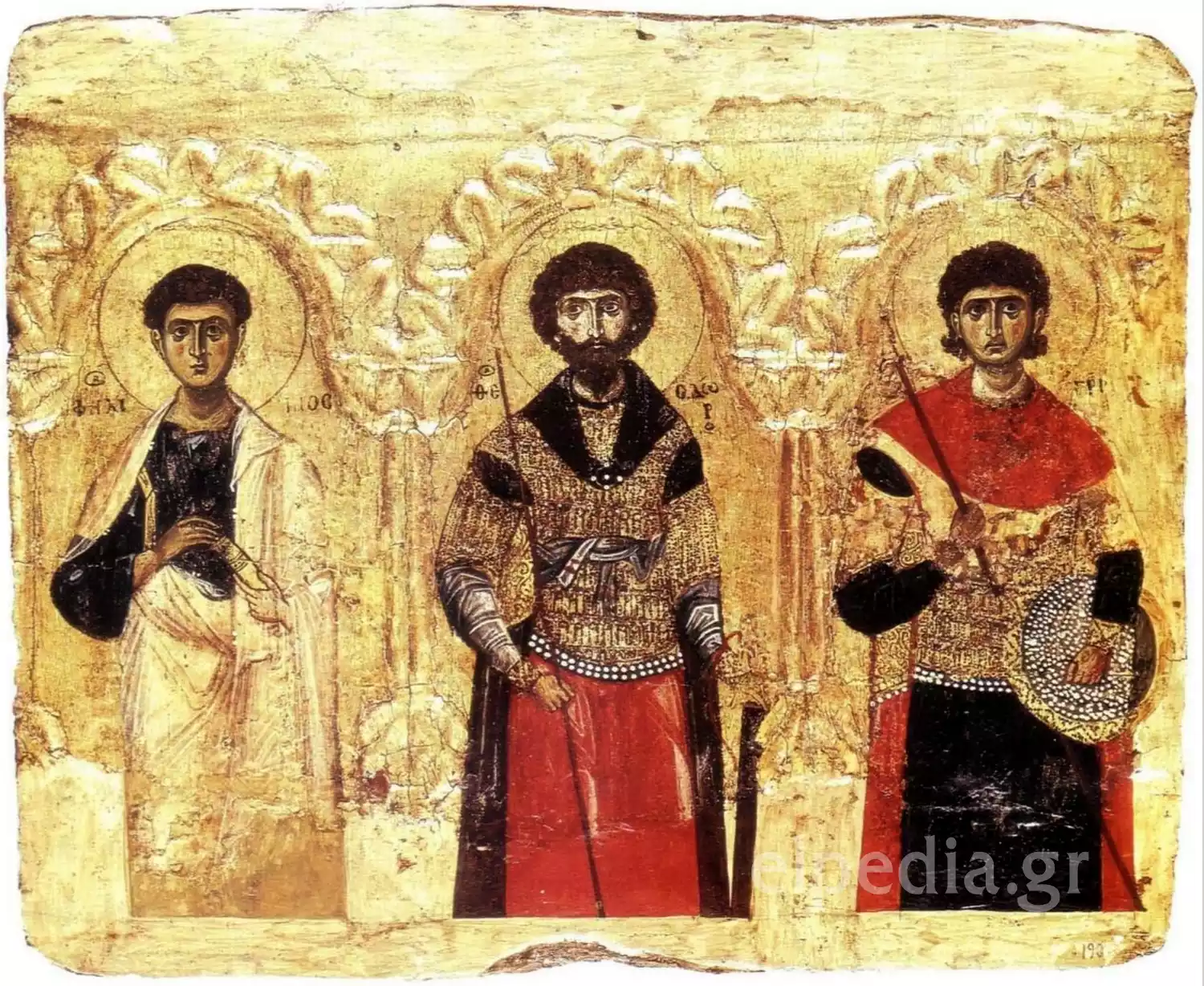
A rare fragment of a Byzantine templon epistyle, dated to the first half of the twelfth century, preserves upon its golden ground three figures of saints, painted one beside the other beneath arched, relief frames that imitate the foliate ornament of carved stone. It is preserved today in the State Hermitage Museum in St Petersburg, the product, in all likelihood, of a Constantinopolitan workshop, no name of painter or patron having survived.
The names of the three figures may be discerned, although fragmentarily, in inscriptions above the haloes: the young and beardless apostle Philip on the left, the warrior saint Theodore in the centre in richly wrought breastplate, and on the right a third figure armed with spear and shield, whom the surviving inscription leads us to identify as Saint Demetrios. The iconographic tradition of the warrior saints in Byzantium, with Theodore and Demetrios precisely as its protagonists, has occupied modern scholarship at length concerning the relation between cult and military ideology within the empire. This triptych does not stand alone. It formed part of a longer painted array upon the same epistyle, wherein, as a rule, the enthroned Christ held sway at the centre between the Theotokos and the Forerunner, with apostles and saints completing the row on either side, in a scheme known as the Great Deesis. The composition did not function merely decoratively above the templon. It organised visually an entire theology of mediation, wherein every holy figure, whether apostle or military martyr, stood as an intermediary between the faithful and the sanctuary.
The Templon Epistyle and the Array of the Three Saints
The Architectural Staging of the Composition
Above each figure there opens an arch, carved in relief depth and clad in gold leaf, full of spiralling tendrils recalling capitals of the Corinthian type, translated, however, into the language of painting and not of actual stone-carving. Slender columns divide one figure from another, giving the epistyle the sense of a small, imaginary colonnade.
No landscape, no architectural detail beyond the arches, nothing to draw attention away from the three faces. The gold covers the whole of the ground, without gradation, without chiaroscuro, with the result that the three saints seem to hover in a space that belongs not to the earth. The haloes, plain discs without ornament, repeat the same form in all three figures, creating a visual rhyme that unifies the array despite the marked differences of dress and age among the saints.
The Apostle Philip: The Austerity of the Apostolic Form
On the left, Philip stands with his body slightly turned, youthful, with dark curling hair and a face without a beard, a feature that at once distinguishes him from his two uniformed companions. His tunic, in shades of ochre and cream, is covered by a mantle of dark blue or black, cast over the shoulder with the typical drapery of apostolic iconography. One hand holds what resembles a scroll, whilst the other traces a gesture of speech, not of blessing. No armour, no weapon. The sanctity of Philip is expressed here through the very nakedness of his presence, through the absence of every outward sign of power, in deliberate contrast to the two saints who flank him.
Theodore and Demetrios: Military Sanctity
Theodore, in the centre, wears a breastplate of densely woven or leather material with geometric ornament, girded at the waist with a belt studded with pearls, whilst beneath the breastplate there projects a red garment reaching to the knees. He holds a spear upright, his gaze grave, almost stern, his beard thick and curling. On the right, the third figure wears a red chlamys with a golden border over a dark-coloured garment, holding a spear in one hand and a round shield with an ornamented surface in the other. The military iconography of Theodore had developed earlier and more intensely than that of any other warrior saint, already from the fourth century, whilst the establishment of saints in military dress as a widely diffused convention belongs chiefly to the middle Byzantine period, precisely the years in which the present work is placed.
Demetrios, martyr of Thessalonica at the beginning of the fourth century and patron of his city, embodied the mediation of the warrior saint between earthly conflict and spiritual. The spear in the hands of the two warrior saints did not refer only to actual battle. It functioned also as a symbol of an invisible struggle, that between the Church and whatsoever threatened the salvation of the faithful.
Colour, Matter, and the Traces of Time
The surface of the wood, there where the painting has been worn away, leaves visible the gesso ground upon which the gold leaf was laid, a technique customary in the Byzantine hagiography of the period. The hues that predominate, the red, the black, the ochre, alternate sparingly upon the dominant gold, without a wealth of intermediate tones. At the corners and at the lower part of the panel the surface has suffered extensive losses, the wood standing forth bare beneath centuries of damp and handling. This very deterioration, however much it deprives the composition of detail, allows us today to discern the manner of the work’s construction, layer upon layer, something an intact surface would conceal entirely.
The placing of such a fragment within a wider epistyle is no mere working hypothesis. Similar panels with apostles and saints, originating from churches of Thessalonica and elsewhere, have survived in a number of museums and help us to reconstruct mentally the complete sequence of a Great Deesis, wherein dozens of figures would have extended over many metres above the templon. The Hermitage fragment, with Philip, Theodore, and the probable Demetrios, represents a link in this chain, perhaps the third or fourth section from a sequence that began with the enthroned Christ and proceeded towards the ends of the epistyle.
The choice to have an apostle and two warrior saints coexist upon a single panel does not appear accidental, for it reflects the very logic of the Great Deesis, wherein different forms of sanctity, the apostolic, the martyric, the military, coexisted in a single visual supplication towards Christ. At this point, the art of the twelfth century does not content itself with the depiction of isolated persons. It builds, panel by panel, an entire celestial hierarchy above the threshold of the sanctuary, visible to every believer who stood before the templon.
(Translated from the Greek text; translation by K. Pappas.)

