
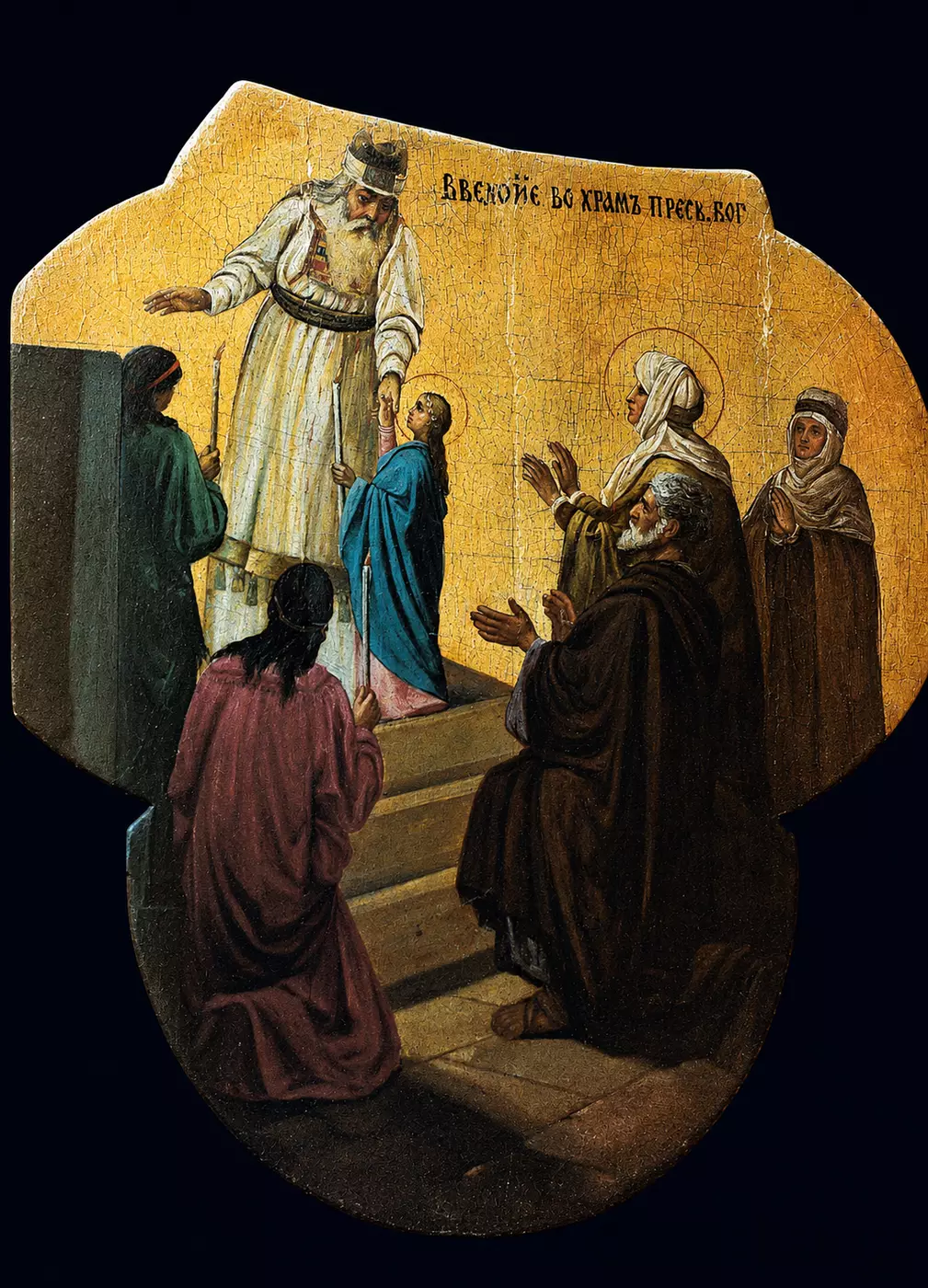
A golden surface filled with fine cracks, marks which time has etched upon the wood, holds fast the moment in which the three-year-old Theotokos ascends the steps of the Temple to be received by the priest Zacharias. This is an icon of the Presentation of the Theotokos, a work of Russian iconography of the eighteenth century originating from Southern Russia, whose painter remains anonymous. The wooden support itself bears today an irregular, almost fragmentary outline, which testifies to damage and, perhaps, to earlier interventions upon the body of the panel. In the upper part is preserved the Slavonic inscription «Введеніе во храмъ Пресв. Бог», that is to say, the titular inscription which names the feast. The composition belongs to a long iconographic tradition which, as contemporary research surrounding post-Byzantine art has pointed out, did not cease to develop with the fall of Constantinople in 1453, but continued to nourish workshops far beyond the old boundaries of the empire, among them those of the Russian countryside. The figures who frame the central event — the parents of the young girl, the virgins with the candles, the women in the posture of supplication — compose a narrative whole dense with detail, one which deserves to be examined carefully, step by step, as testimony to a visual language shaped over centuries.
The Icon of the Presentation of the Theotokos as a Work of Post-Byzantine Art
At the centre of the golden field, there where the surface has cracked into a dense network of fine fissures, stands Zacharias, tall, in a white priestly vestment bearing upon the breast a rectangular ornament in red and dark hues. He wears a curious, tall headdress with a dark-coloured, almost sharpened crown, bound with a white band about the forehead, an element which the painter evidently devised in order to render the archaic, Judaic priestly dignity of the figure. He bends forward, his right hand extended in a gesture of reception, while with the other he already holds the hand of the young Virgin, who ascends the last steps clothed in a pale blue maphorion over a pink tunic, with a slender halo about her head. Her body has nothing of the childlike about it save its small size, a conscious choice of Orthodox iconography, which prefers to show the future Theotokos and not merely a three-year-old girl.
Around this scene there unfolds a second, denser narrative. On the left, a woman in a dark green mantle with a red ribbon in her hair holds upright a lit candle, turned towards a dark, rectangular mass which might signify the entrance to the Holy of Holies. Lower down, kneeling and shown almost entirely from behind, a second young woman in a deep red garment also holds a candle. These two figures recall the attendant virgins of tradition, those who, according to the hymnographer, do not merely go before bearing light but prefigure the “noetic lamp,” the Theotokos herself, who is destined to illumine those who sit in darkness. Seemingly unconnected, the two scenes — that of the reception and that of the procession — are bound together in meaning through precisely this symbolism.
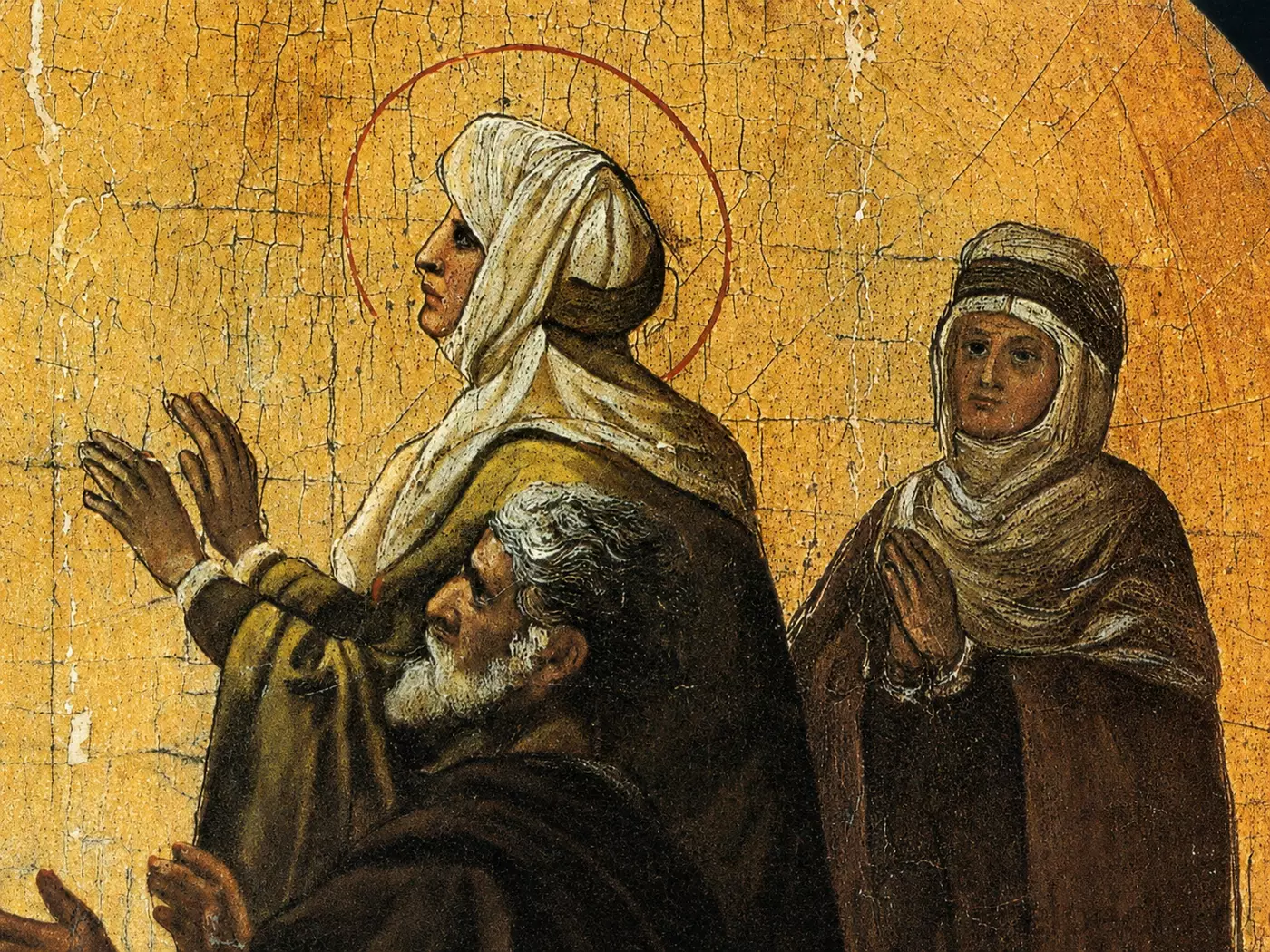
The Prayer of Saint Anna and the Women of the Temple
To the right of Zacharias, on a second plane, a woman with a white kerchief wound about her head and a red halo raises both hands in supplication, her gaze turned upward and to the left, there where the reception unfolds. This is most probably Anna, the mother of the young Theotokos, whose posture draws upon the older iconographic typology of supplication, with the palms open upward as a sign of total devotion. Beside her, without a halo, a second woman in a brown mantle and a light-coloured head-covering holds her hands joined at the height of her breast, in a gesture more tranquil, less ecstatic — perhaps one of the women of the Temple who look on at the scene. Her gaze does not seek the heavens as the first woman’s does; she looks forward, almost towards us. Between them, in the lower part of the composition, may be discerned the crown of the head of an elderly man with greying white hair and beard, kneeling, his back turned towards the viewer, his hands likewise raised. His position, between the two women and beneath them, together with his age, leads to his identification with Joachim, the father of the girl, who in tradition accompanies Anna at the ceremony without, however, taking the leading part in it. The chromatic contrast between Anna’s white kerchief, Joachim’s dark brown, and the neutral, almost beige garment of the third woman creates a graduated scale which leads the gaze towards the centre of the icon, without ever drawing it entirely away from there.
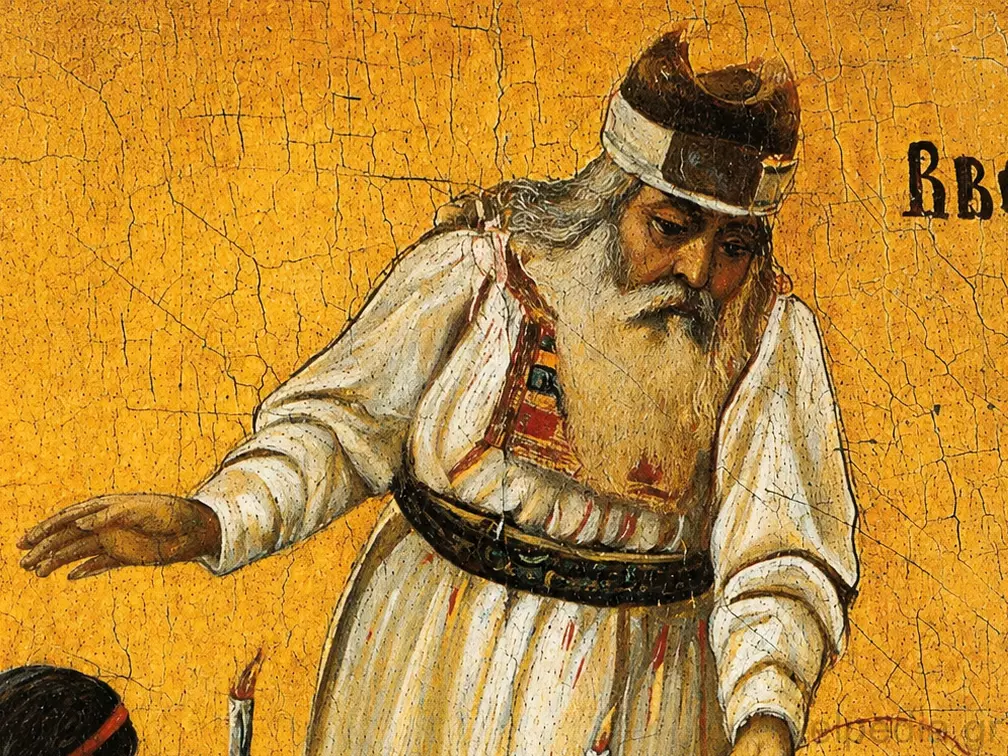
The Face of Zacharias and His Priestly Vestment
In close detail, the face of Zacharias reveals particulars which easily escape notice in a general view. His headdress, with its dark, almost pointed section and its white encircling band, recalls the mitre of a high priest as imagined by the Russian iconographic tradition, far from any historical accuracy yet faithful to the need to declare, visually, priestly authority. His face, deeply lined, with a beard falling in wavy white plaits, looks downward, to where the young Theotokos stands — outside the frame in this particular detail, yet present through the very direction of his gaze. In the opening of the tunic may be discerned a rectangular ornament in red and dark colour, an element which might allude to the ephod of the ancient priests, while a dark girdle tightens the waist above the folds of the white fabric. On the right, a portion of the Cyrillic inscription remains visible, a reminder that the script itself functions here as part of the icon and not merely as its caption.
At the lower edge of this detail two small candle-flames may be discerned, traces of the procession of virgins discussed above. The technical execution, with its fine outlines upon the face and the almost linear rendering of the beards, follows conventions which Russian iconography inherited and adapted across the centuries after the fall of Byzantium, without, however, losing fidelity to the theological content of the subject. The golden field, cracked across its entire surface, functions not merely as an abstract ground but also as the material imprint of a long life — that of the object itself across time, from the workshop in which it was born to the hands of those who have preserved it to this day.
(Translated from the Greek original by K. Pappas.)

