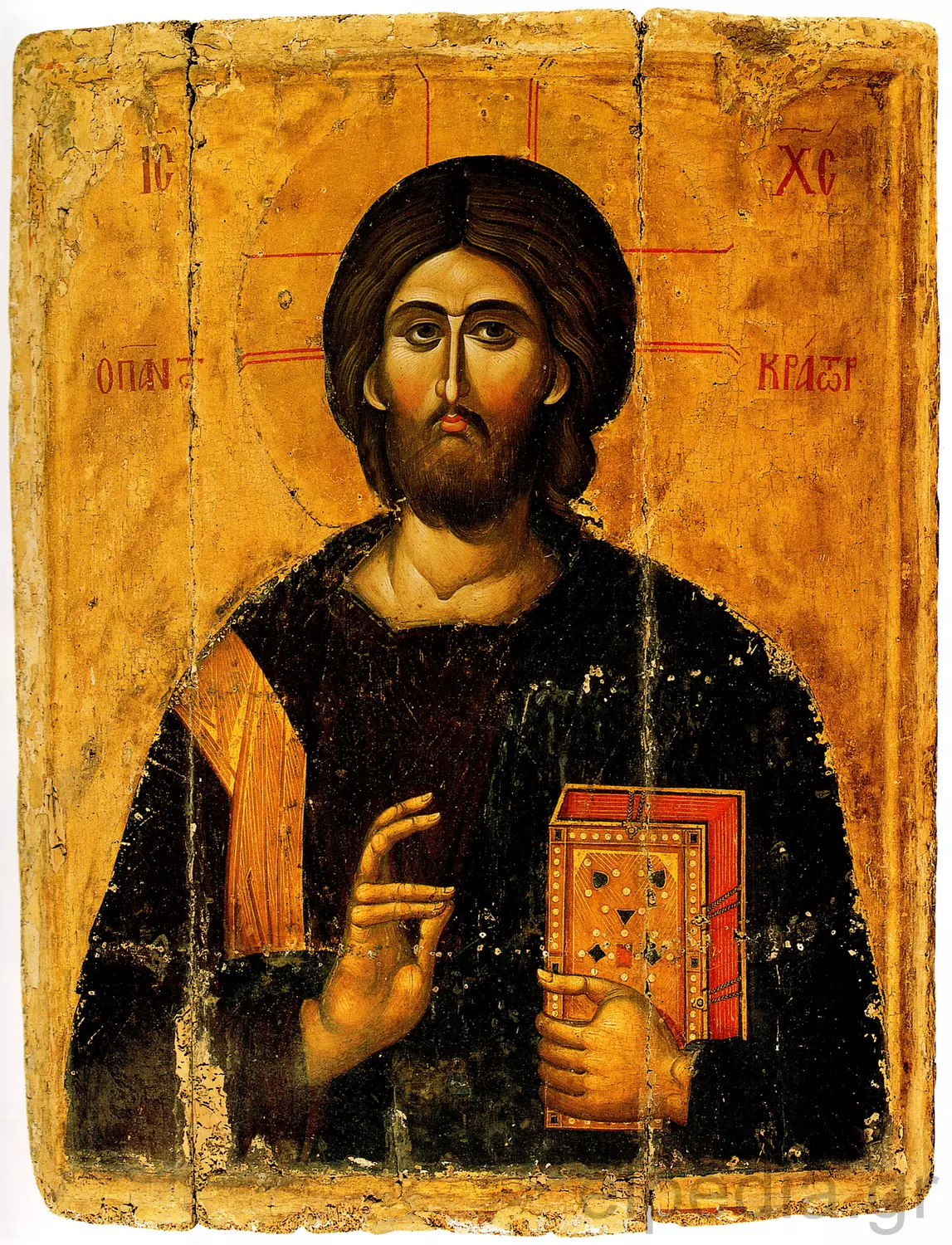
A figure with a solemn gaze, hair falling straight to the shoulders and a brown beard, looks steadily at whosoever stands before it, clothed in a dark-coloured himation upon a wooden surface 1.30 metres in height. This is a large-scale icon of Christ Pantocrator, that is, of Christ as sovereign and judge of the entire world, the work of a painter who remains anonymous, crafted in the final years of the fourteenth century and preserved today in the monastery of Saint Catherine at Sinai. The artisan faithfully followed a model born in Constantinople, the capital which defined the iconographic standards throughout the empire. The relationship between the title and the image of the Pantocrator has occupied international research for decades, inasmuch as the inscription HO PANTOKRATOR which accompanies the figure functions as an integral part of the iconographic scheme itself, almost equally as important as the very features of the face. At Sinai, a monastery which has salvaged the richest core of portable icons of the Byzantine period globally, this icon coexists with works centuries older, retaining however its own character, an intuitive, almost melancholic disposition in the expression of the eyes which differentiates it from stricter examples of the same type.
The Image of the Pantocrator as a Work of Byzantine Art
The dimensions of the wooden panel, larger than those customary in portable icons, betray from the outset the seriousness of the commission. Three boards, joined vertically, compose the surface where the figure is spread out, and their joints are still clearly discerned beneath the gold background which has, to a great degree, worn away. Such a size points to the use of a despotic icon, placed in all likelihood in a prominent position of a church or chapel, destined for public veneration rather than for private devotion.
Icons of such size were usually placed in the despotic tier of the templon, the wooden or marble barrier which separated the sanctuary from the rest of the church, at a height accessible to the gaze of the believer who approached for the veneration. The scale of the figure, almost life-size from the waist up, created a sensation of immediate presence, vastly different from the distance which a smaller composition imposes, one destined for personal and not for collective use.
The Face and the Gaze
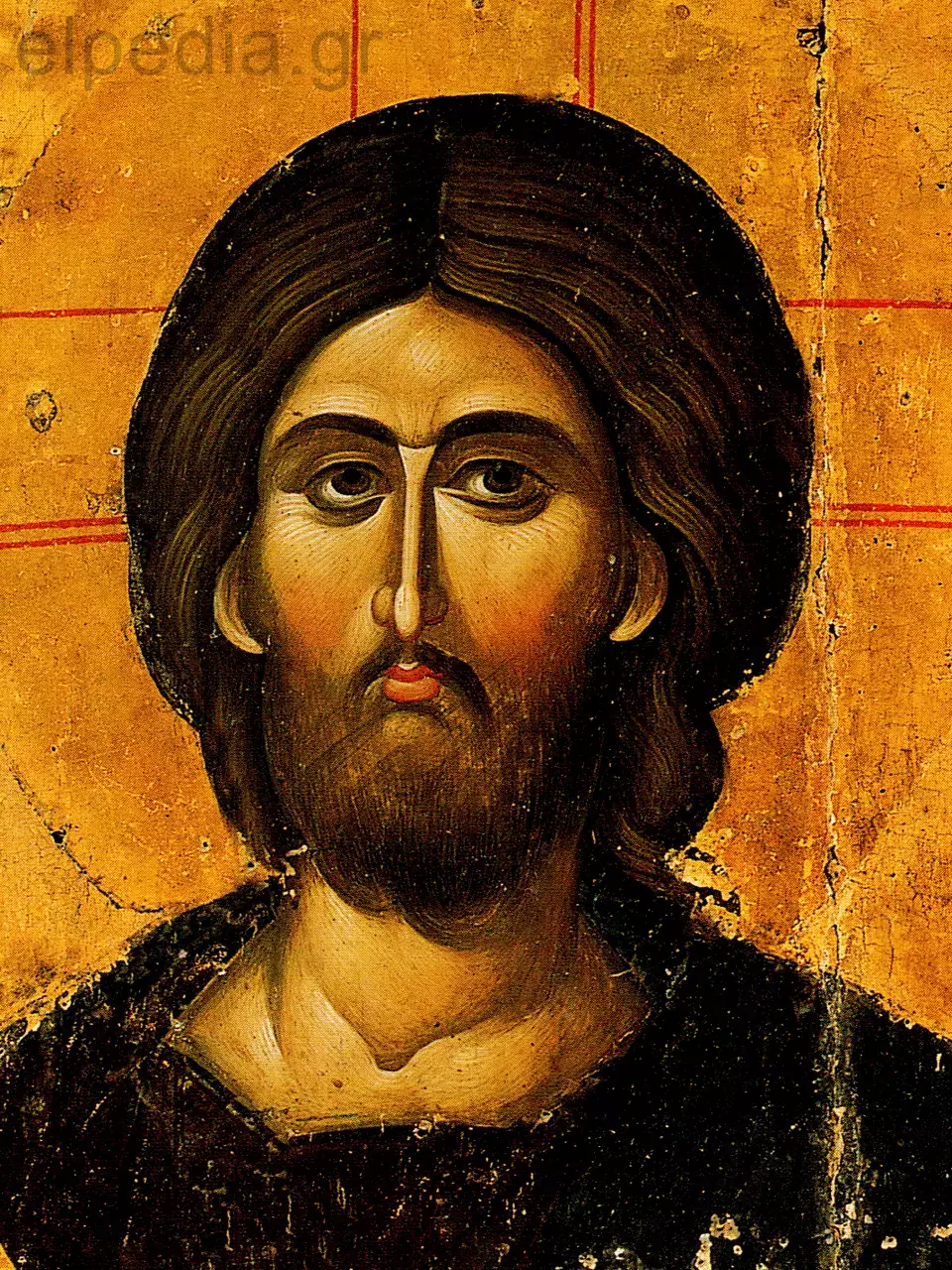
The hair falls in soft waves on either side of a parting in the centre, brown with darker highlights at the ends, while the beard, short and rounded, follows a similar hue, warmer however, almost reddish at the edges of the jaw. The eyes, disproportionately large for the scale of the face, gaze at the viewer with a steadiness that never reaches severity, the glance slightly turned towards His right, something which imparts to the figure an inwardness difficult to render in words, perhaps even a trace of sorrow, almost imperceptible, hidden behind the eyelids. This is not the vigilant, scrutinising gaze that one encounters in older types of the Pantocrator. There dominates here something milder, a meekness which is perhaps connected to the spiritual currents of the epoch.
The Gesture of Blessing
His right hand is raised before the chest, with the thumb, the ring finger and the little finger joined, while the index and the middle finger remain extended, a form of blessing which tradition connected with the trihypostatic nature of the Holy Trinity. The size of the hand, appreciably larger than natural proportion with the rest of the figure would dictate, reinforces the gravity of the gesture, positioned thus so as to visually dominate the centre of the composition. The origin of this specific arrangement of digits goes back to older Roman rhetorical models, where an analogous gesture declared the right of speech, before passing into Christian iconography as a symbol of blessing and teaching. This emphasis upon the gesture, in combination with the epoch of the icon’s crafting, the final decades of the fourteenth century, when the ideas of Hesychasm had permeated the monastic environment of the East, led certain scholars to discern here a more mystical reading of the blessing, closely connected with the theologically cultivated space from whence the icon originated.
The Himation and the Chiton
The chiton which He wears is dark, in a hue of brown with a subdued purple reflection, and bears upon the shoulder a broad, golden mark, the well-known clavus of late Roman and Byzantine garments, which descends angled as far as the elbow. The edges at the opening of the sleeve, at the point where the right wrist emerges, are soft and rounded, without the hardness of line that one would expect from later copies. The himation, deep blue as to its basic hue but almost black in the shadows, covers only the left shoulder and leaves free the right part of the body, precisely at the point from whence the blessing hand extends.
Colour and Technique of Execution
The technique follows the customary practice of Byzantine egg tempera upon a wooden base prepared with successive layers of gesso. The face and the hands were built up in overlapping layers of colour, from a dark-coloured, greenish underpainting to the final, light-coloured highlights on the protruding points, a method which gives to the skin the characteristic, almost transparent plasticity of the fine Byzantine icons of the epoch. The gold leaf in the background, spread over a red preparation which is discerned today at the points where the metal has detached, declared material wealth and simultaneously immaterial light, an idea central to the Byzantine conception of the image. The colours of the garments, deep and limited in number, serve an economy of means frequent in the workshops of the region, where quality was judged less by the luxury of the materials and more by the virtuosity in the drawing and in the modelling of the volumes.
The Closed Book of the Gospels
The left hand embraces the book of the Gospels from its spine, in a posture which points to a real, everyday holding of an object. The cover, deep red, is framed by a golden band with a dense row of small white circles, an imitation of precious stones or pearls sewn onto fabric or metal, while in the centre are arranged dark, almost black stones in the shape of a cross, with a fifth, reddish one, standing out in the middle. A small metal clasp is discerned at the side, a functional element which reinforces the impression of a real, tangible object.
Inscriptions and the Traces of Time
In the two upper corners of the composition are read the contracted IC and XC, the established abbreviation of the name Jesus Christ, while lower down, on either side of the halo, are discerned the letters HOPAN and KRATOR, which comprise the inscription HO PANTOKRATOR, fundamental for the identification of the iconographic type. The halo stands out indistinctly today, not so much from its original brilliance as from thin red lines of drawing which have been revealed beneath the now worn gold background, traces of the preparatory work of the painter prior to the gilded coating.
Six centuries and more of wear have left their mark upon the entire surface: flakings, fissures along the lengths of the joints between the boards, sections where the painted layer has been lost entirely, leaving the wood uncovered. And yet, this very wear transforms the icon into a precious document for the study of Byzantine art, inasmuch as it reveals stages of the construction which would remain invisible upon an intact surface.
The elegance of the composition and its aristocratic character point to a model of Constantinopolitan descent, which the painter of Sinai reproduced faithfully, in all likelihood through an intermediary copy rather than from direct autopsy of some original work of the Capital. This affinity is documented by the comparison with another icon of Christ, of the middle of the same century, which is also preserved at Sinai and has been connected with the art of Constantinople: common iconographic arrangement, kindred style, with the differences being located principally in the ethos of the face, more vigilant and almost severe in the older version, more introverted and evocative in ours.
The same broad, curving sleeve—a detail which seems small yet is repeated with consistency in this entire series of works—is found also in an older, pre-eminent example of metropolitan art, in the mosaic of Christ Chalkites within the Deesis of the esonarthex of the monastery of Chora, a work of the early fourteenth century. The survival of this detail until the post-Byzantine years, in known later icons of the same type, demonstrates how firmly the iconographic rule held sway over its local variations.
The iconographic type is not exhausted in these two examples. An entire series of icons of the fourteenth century reproduces the same Christ in bust, with the meek and philanthropic ethos dominating; among them also the renowned icon of the Pantocrator which is preserved today in the Hermitage, originating from the Pantokrator monastery of Mount Athos and dedicated there by two brothers, officials of the imperial court.
At Sinai, where the dryness of the desert and the isolation of the monastery protected for centuries fragile works of art from destructions which elsewhere left minimal traces, this icon of the Pantocrator remains one of the many testimonies of an epoch during which Constantinople was gradually losing its political power, yet its workshops continued to produce models which travelled far beyond the now narrow borders of the state, as far as the most remote monasteries of the desert.
(Translated from the Greek text by K. Pappas)

