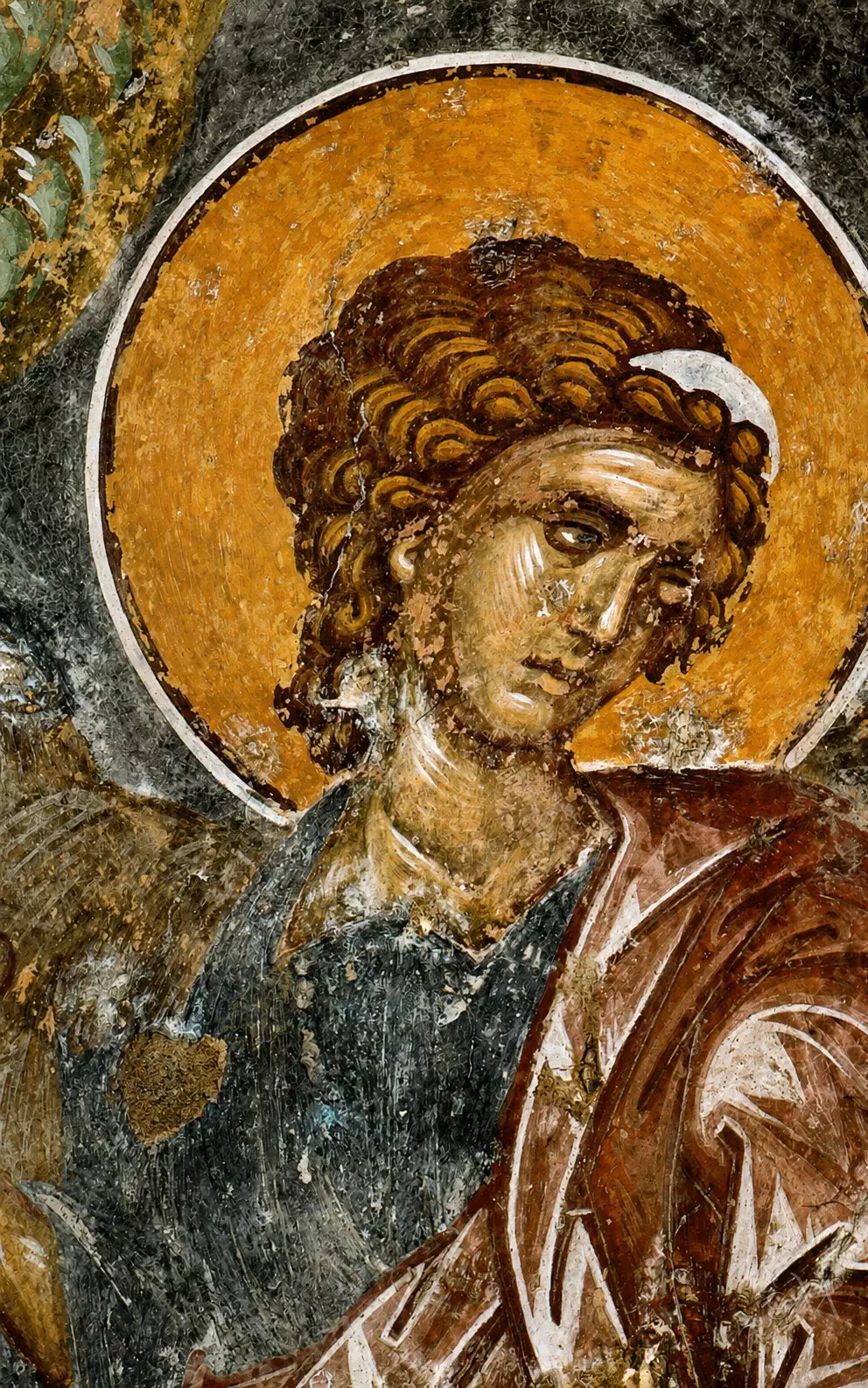
A youthful face, framed by thick curly hair bound with a white ribbon, emerges within a halo of deep ochre. This is the archangel who once held his place in the southern section of a composition of the Ascension, painted in a Byzantine church by a hagiographer whose name has not survived. The Ascension, one of the twelve great feasts of the ecclesiastical year, depicts the moment at which Christ is elevated into the heavens before his disciples, forty days after the Resurrection. In the established Byzantine composition, Christ is positioned high up, within a circular glory borne by two winged angels, while lower down dominates the frontal figure of the Theotokos, praying, with two angels on either side of her addressing the multitude of the apostles, usually divided into two semi-choirs.
The figure examined here belongs precisely to this schema, within the southern semi-choir, among apostles who watch in astonishment the departure of their Master. There survives today the upper section of the figure, the head, part of the wing and a portion of the garment, sufficient however for the painterly quality of the whole to be clearly delineated. Painted with watercolour upon damp lime plaster, according to the technique that dominated Byzantine mural painting, the figure bears no written inscription legible today that might permit its identification with a specific archangel, Michael or Gabriel, something which in any case does not alter its value as a document of a painting tradition of many centuries.
The figure of the Archangel of the Ascension in Byzantine art
The head inclines slightly, with the gaze directed downwards and to the side, in a contemplative expression that departs from the usual frontality of angelic figures. The hair, almost deep red in its shadow, is organised into thick, symmetrical locks that cover the ears and are restrained by a white ribbon, an element that refers back to more ancient models of winged figures of Hellenistic origin, such as those of Nike, which Byzantine art adapted unto the iconography of angels. The torso bears a dark-coloured, almost grey-green chiton, over which falls a rosy himation with dense folds, illuminated with white, rapid brushstrokes that render the movement of the fabric.
At one edge of the composition is discerned a portion of the wing, rendered with grey-green, linear brushstrokes that refer to the plumage of a real bird rather than to a conventional decorative element. The ground of the halo, in a vivid ochre that reaches orange, embraces the figure with light that is uninterrupted by an outline, except for the thin white line that demarcates it, a technique customary in mature Byzantine fresco painting, where the gold of the mosaics is replaced by the warmth of the ochre. The deterioration is apparent. Cracks traverse the plaster layer, flaking has removed portions of the colour around the ear and at the lower part of the neck, traces of time that do not however negate the clarity of the design.
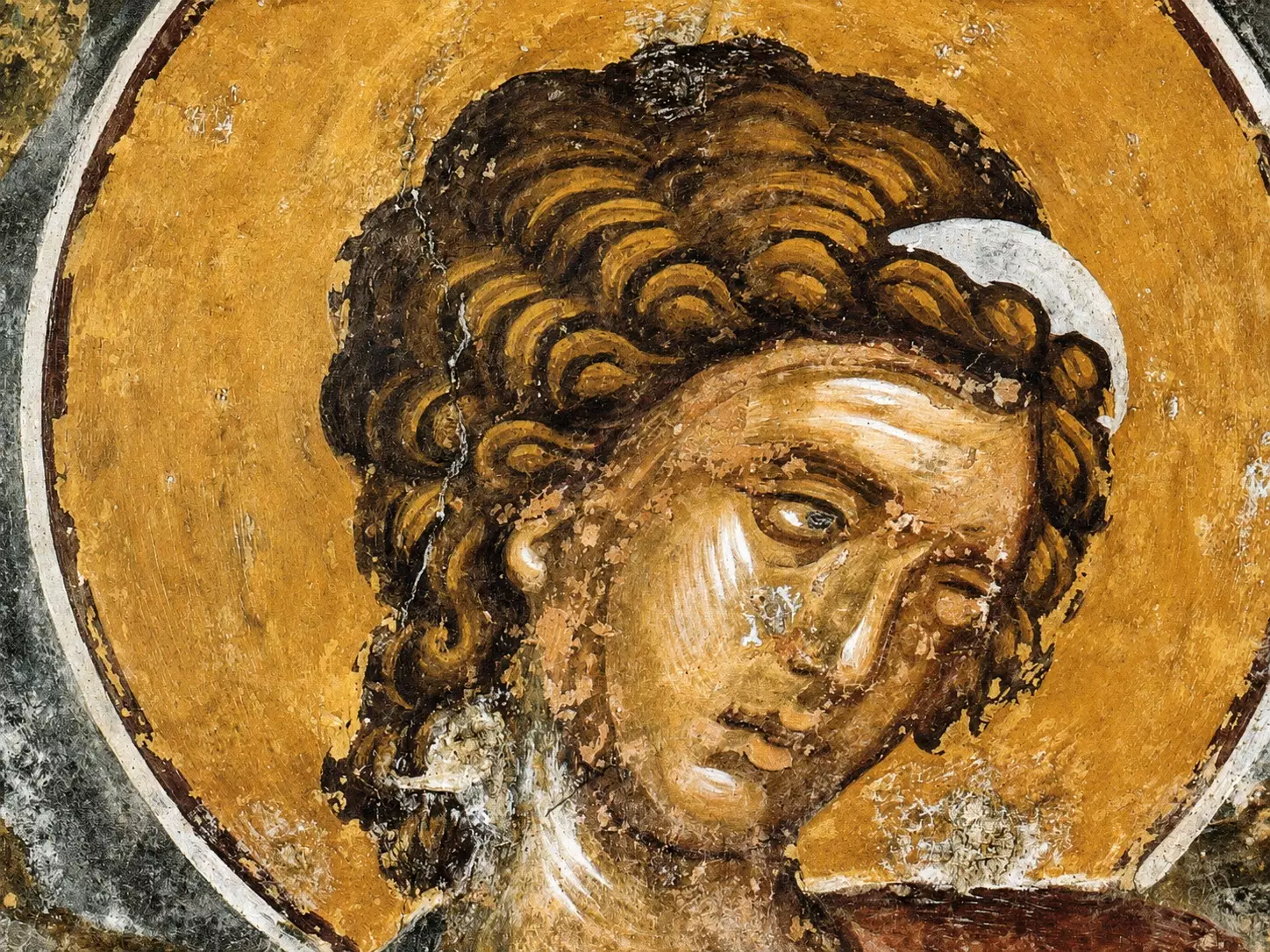
The face of the Archangel of the Ascension in detail and the hagiographic art of the era
Drawing closer to the face, the technique of the painter is revealed with greater precision. The eyes, almond-shaped, with heavy eyelids, look obliquely downwards, giving the figure an inwardness that is not frequently encountered in the angels of the Deesis or the Glory, where the gaze is usually directed towards the viewer or towards the divine person they serve. The eyebrows, arched and dark, almost meet above the root of the nose, which is drawn straight, long, with a slight swelling at the point of the nostril. The mouth remains small, the lips tight, without the smile that is sometimes attributed to youthful angelic figures of the era.
On the cheeks is discerned the method of the proplasmos, a dark-coloured underpainting upon which are built, with successive and increasingly luminous layers, the volumes of the face, a technique that Byzantine hagiographic art inherited from late antiquity and preserved essentially unaltered for centuries. The linear rendering of the locks around the forehead, dense and almost decorative, is contrasted with the softness of the illuminated surfaces on the face, two styles that coexist within the same work without clashing. An angel who seems no longer to address anyone, only the depth of his own halo.
(Translated from the Greek text by K. Pappas.)


