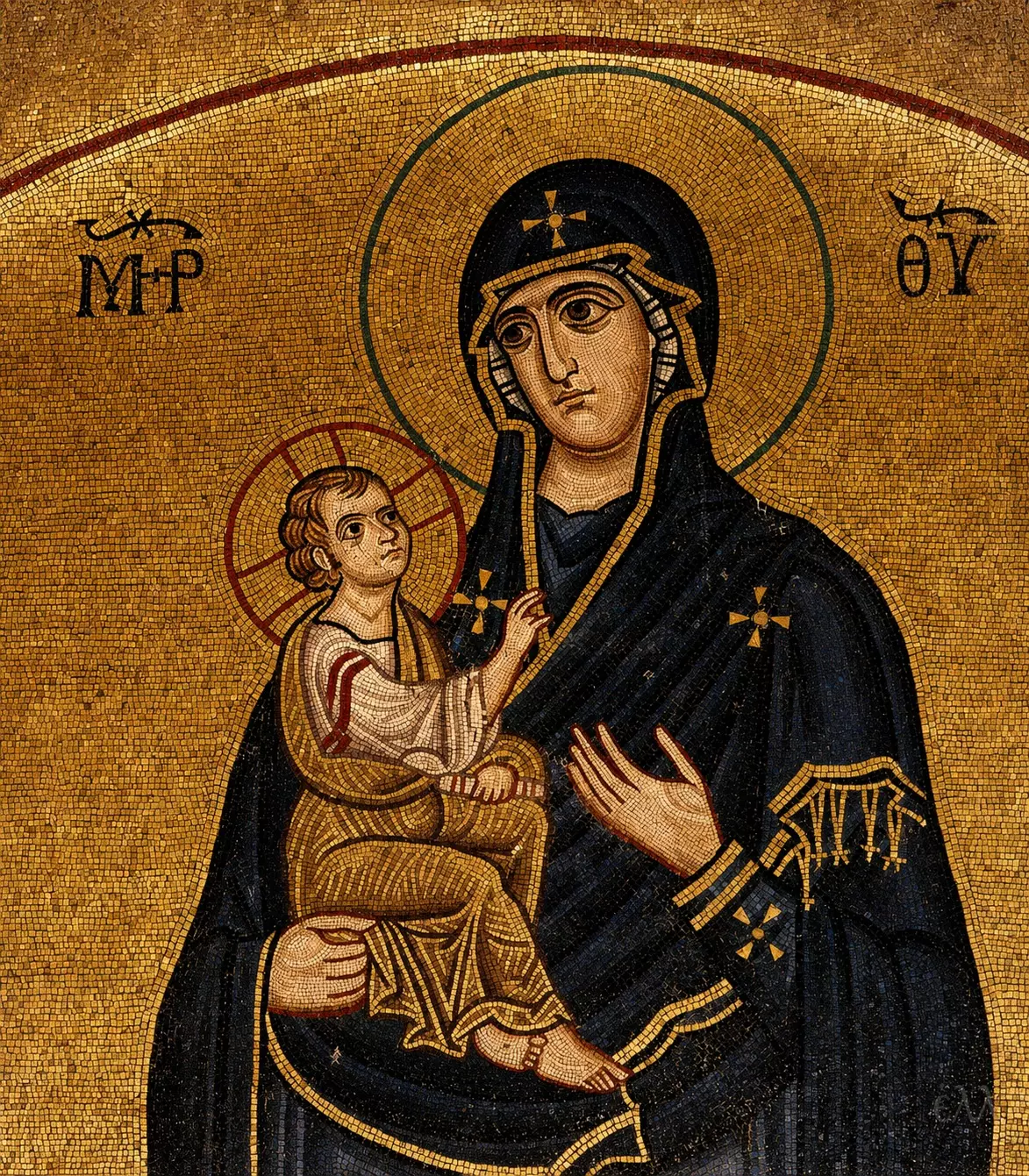
In the katholikon of the Monastery of Hosios Loukas, on the western foothills of Mount Helicon, a mosaic from the first decades of the 11th century depicts the Virgin in one of the most widespread types of Middle Byzantine iconography, that of the Hodegetria. The composition occupies the eastern tympanum of the south arm of the church, high above the level of the marble revetments, where the light reflected upon the gold background gives the figure an almost immaterial character. It is specifically the variant known as the Dexiokratousa, with the Child seated upon her right arm, a scheme with a long presence in Byzantine art, both in portable icons and in wall paintings.
The construction of the katholikon itself is placed approximately in the same period, with one part of scholarship attributing it to the abbot Philotheos around 1011 and another proposing a date in the 1030s or 1040s. Whichever version may ultimately be correct, the mosaic ensemble of the church predates those of Nea Moni on Chios and Daphni, a fact that makes it one of the earliest and most complete examples of monumental painting from the period preserved today in the Greek lands. No artist’s name accompanies the composition, as is also the case with almost all the mosaics of the age, works produced by teams of craftsmen trained according to the models of the Constantinopolitan tradition that scholarship has called the Macedonian Renaissance. The Theotokos emerges almost half-length from the gold background, her gaze turned towards the Child with an intensity that the viewer perceives before being able to name it.
The Hodegetria of Hosios Loukas: Composition and Gaze
The head of the Virgin inclines slightly towards the Child, with her eyes, deeply shadowed and somewhat asymmetrical, as is customary in the mosaic technique of the period, following his movement rather than looking directly at the viewer. This is a variation that distinguishes her from other contemporary renderings of the same type, in which the mother usually keeps her head upright and her gaze detached. Here, the relationship appears more immediate. The Child sits approximately at the level of her waist, with his right hand raised towards her breast, at the point where the edge of the maphorion folds into a deep pleat. The gesture cannot easily be read as a blessing. It appears rather as a touch, a moment of contact between mother and son that the composition preferred to depict in place of the strict, hieratic distance found in other representations.
Before her breast rises her free left hand, with the palm turned outwards. The very name Hodegetria, she who shows the way, appears here to find a literal expression, as her hand turns towards the viewer like an offering, rather than as a simple bodily pose. The maphorion, almost black in colour with deep blue highlights, bears a small golden cross upon the shoulder, and perhaps others at points that the composition does not allow us to distinguish clearly. This scheme, already established from the first centuries of Christian iconography, signifies the virginity of the Theotokos before, during, and after the birth, a meaning that a believer of the period would have recognised immediately, without the need for verbal explanation.
The background, uniformly golden, depicts no specific place. Every trace of material space has been removed, leaving the two figures to stand within a light without origin, without shadow, without geography.
The Christ Child and the Art of Chrysography
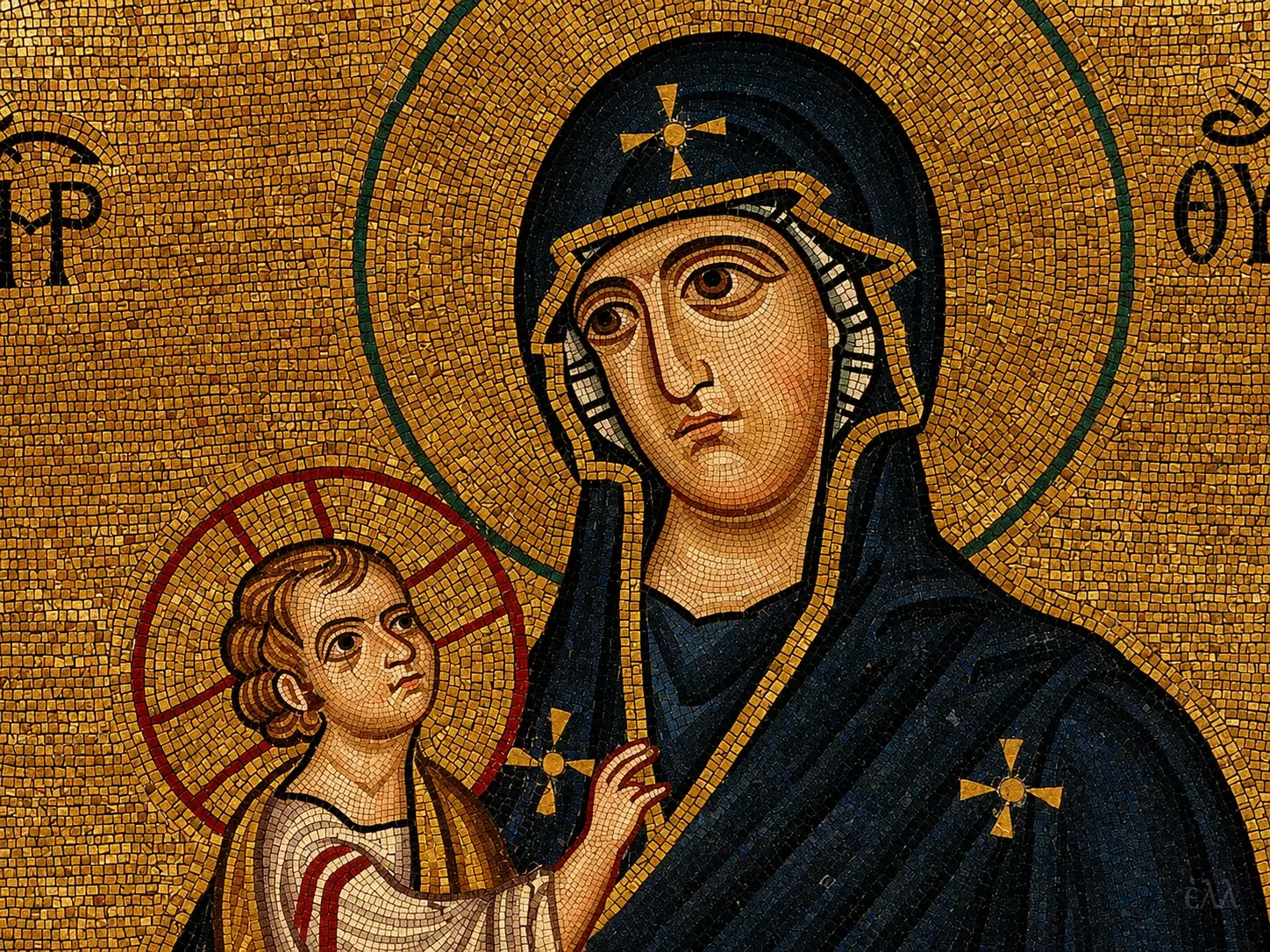
Christ, young in age but not in expression, wears a white tunic with a red band upon the shoulder, the familiar clavus that in ancient dress indicated rank and that Christian iconography retained as a sign of royal descent. Over his legs spreads a fabric marked with golden lines, a technique known as chrysography, which in Byzantine art does not function only decoratively. It signifies the uncreated light, that which proceeds from the very person of the God-Man and does not belong to the order of the visible world.
His halo differs from that of his mother. It bears a cross inscribed within it, an element exclusive to the divine nature, which no saint is entitled to share, however great his or her holiness may be. The curly hair, in a reddish-brown shade, frames a face turned upwards, towards the mother, with an expression difficult to render in words, something between the trust of a child and the knowledge of a person who already knows what is to follow. One of his hands touches the maphorion of his mother. The other is not visible upon the surviving surface, probably concealed behind her body or simply lost through the deterioration of the mosaic. His feet, bare and slightly pink in colour, project beneath the fabric, showing how close the infant body still remains to its human, mortal dimension, despite the divinity declared by the cross-inscribed halo.
The Byzantine Tradition of the Hodegetria and the Inscriptions
On the two sides of the Virgin’s halo can be read the letters ΜΗΡ and ΘΥ, an abbreviation of the phrase Mother of God, an inscription that accompanies almost every Byzantine representation of the Theotokos and functions at once as an identity and as a confession of doctrine, since the title itself refers to the decision of the Third Ecumenical Council concerning the Virgin as Theotokos. The type of the Hodegetria became associated from an early date with a tradition according to which its first icon was the work of the Evangelist Luke, a tradition without historical documentation but with immense diffusion throughout the Byzantine Empire.
In the katholikon of Hosios Loukas, the figure does not occupy the central position that she would have held in the apse of the sanctuary. She is placed instead in the tympanum of a lateral compartment, something that does not diminish her importance, but shows how the iconographic programme of the church multiplied the appearances of the Theotokos at more than one point within the space. An 11th-century pilgrim passing beneath this arch would immediately have recognised the person and known the story attributed to her. Perhaps, however, he would not even have noticed the gaze that the mother directs towards her child, that small deviation from the rule which today, at a distance of almost nine centuries, appears as the most human element of the entire composition.
(Translated from the Greek text by K. Pappas.)


