
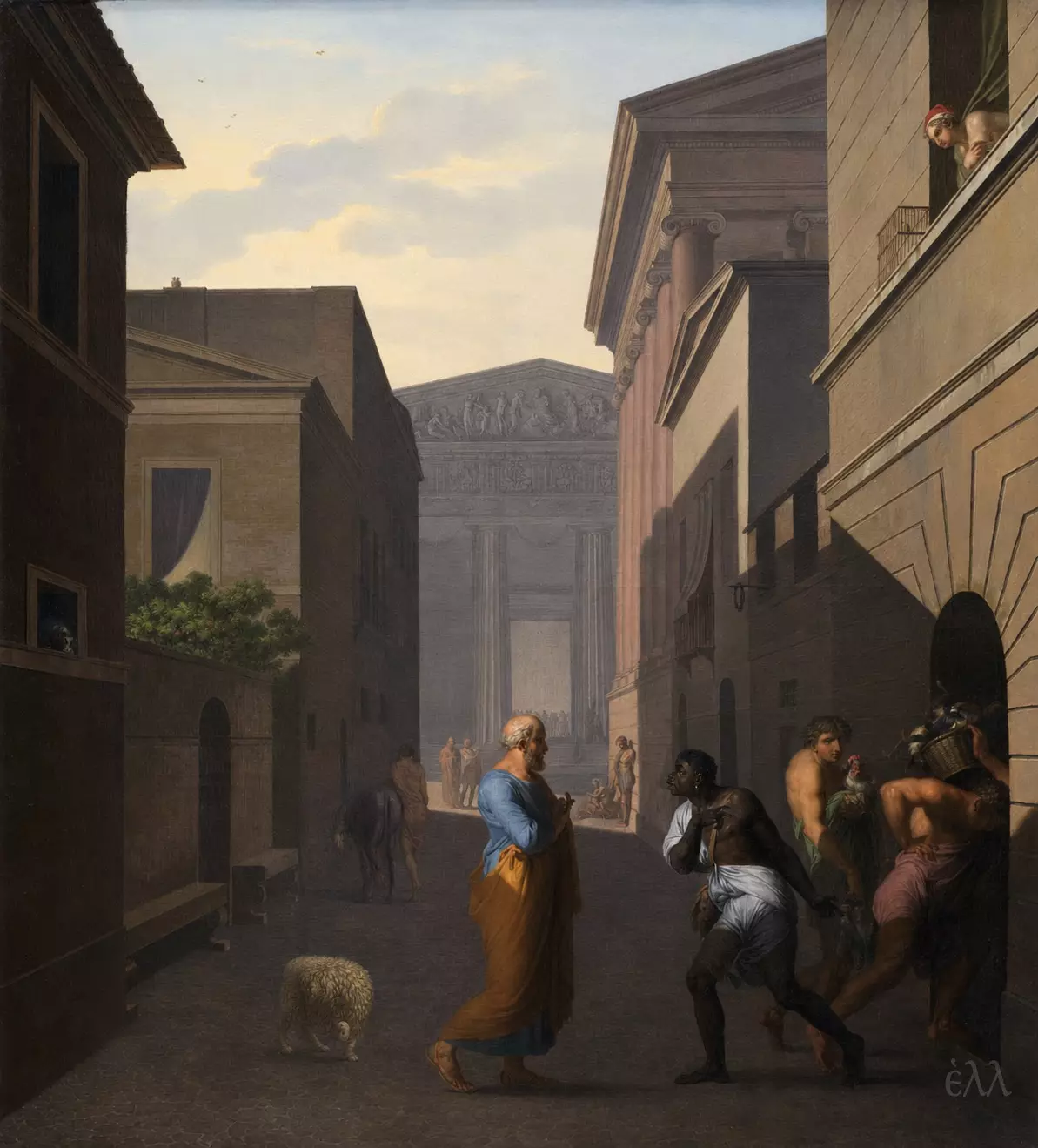
An old man with sparse beard and graying hair strides briskly along a narrow street, wrapped in a blue chiton beneath an ocher, almost golden garment, while a small white dog follows almost glued to his feet. This is Simon, the central figure of Terence’s Latin comedy Andria, as conceived by Nikolai Abildgaard in 1803, in oil on canvas measuring 158 by 142 centimeters, a work now held in the Statens Museum for Kunst in Copenhagen. The painter, born in Copenhagen in 1743 and deceased in Frederiksdal in 1809, was one of the most decisive figures of Danish Neoclassicism, a teacher of an entire generation of artists and a man of rare familiarity with ancient literature.
The scene unfolds on a street that seems carved from the mass of ancient Rome, with buildings of strict, almost austere geometry narrowing toward the distance, where a temple with a façade of Ionic columns and a relief pediment appears, half hidden in smoky, bluish light. On the right, a man with dark skin, dressed in a white undershirt, turns toward the old man with a gesture of puzzlement, his hand raised near his head, while behind him other bent, half-naked figures carry loads, one of them with a huge woven basket on his back, turning toward an arched entrance. Higher up, on a balcony, a woman with a red headscarf leans out and watches the scene, while birds cross a pale, almost milky sky, with a few clouds laid out horizontally. This is not merely an idealized representation of antiquity; above all, it is a scene of everyday life, where imposing buildings and humble passersby share the same space.
Simon and Sosia in the shadow of the Roman city
In Terence’s comedy, Simon is a father anxious about his son’s marriage, and Sosia his freedman, the man to whom he entrusts his thoughts before sharing them with anyone else. Abildgaard chooses not to paint the moment of confession indoors, as tradition more usually would have done, but to move it into the street, among messengers, pack animals, and curious glances from the windows. The old man advances with his gaze fixed ahead, his hands almost clenched against his chest, as though carrying something within him that he has not yet said; the younger man opposite, by contrast, has his body drawn taut backward, his movement half-open, poised to withdraw.
Architecture as stagecraft
The narrative force of the painting owes much to architecture. The buildings do not function merely as a backdrop; they organize the gaze, leading it deep into the composition, toward the temple faintly lit at the end of the street, and at the same time bringing it back to the figures in the foreground, where the story is truly taking place. This is a composition drawn from the long tradition of Dutch and Italian architectural painting, an art Abildgaard came to know during his years in Italy and translated into his own northern European idiom, with more restrained light, darker colors, and a heavier atmosphere. The placement of every secondary figure, from the man leading the horse to the woman on the balcony, is not accidental; each adds a layer to the sense of a city that lives, trades, and gossips while two people at its center discuss something more serious than their haste suggests.
The small dog at Simon’s feet, a detail that could easily be overlooked, gives the scene an intimate, almost tender note, offsetting the monumentality of the surrounding buildings. It is in such small, seemingly insignificant observations that Abildgaard shows how carefully he had studied the masters of broad, narrative scenography before returning to Denmark and devoting himself to works with a strong didactic and literary foundation.


