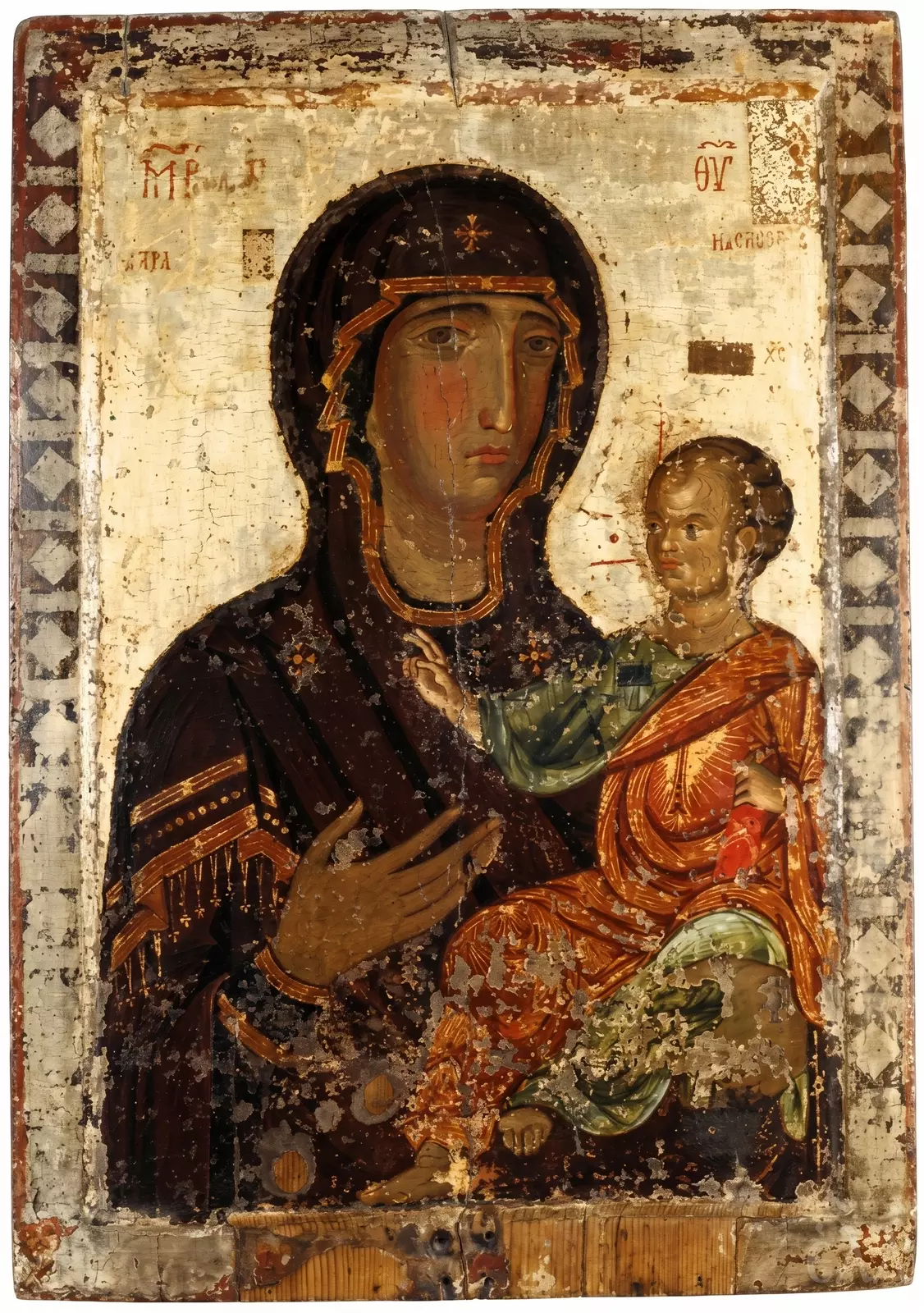
The Theotokos Hodegetria icon known by the distinctive epithet Panagia Arakiotissa belongs to the final decades of the twelfth century and comes from the church of Panagia tou Arakos at Lagoudera, Cyprus. Measuring 103.5 × 73.5 cm and now preserved in the Byzantine Museum of the Archbishop Makarios III Foundation in Nicosia, the panel once had a processional function. Its reverse bears a foliate cross, while traces of nails along the lower edge have been associated with the attachment of the icon to a carrying pole. With a corresponding icon of Christ Pantokrator from the same church, the work formed a pair, an association that places the two images within a deliberately conceived devotional setting.
Against the broad gold ground, the Theotokos rises almost to the full height of the panel, her dark maphorion enclosing the long oval of the face and descending in weighty folds across the shoulders. Christ rests on her left arm. Across her breast Mary raises her right hand and directs attention towards him in the familiar gesture that defines the Hodegetria type. The Child blesses with his right hand and holds a closed scroll; his upright bearing, concentrated gaze and mature physiognomy give the diminutive figure something of the authority ordinarily associated with representations of Christ Pantokrator. Mother and Child turn subtly towards one another, though their eyes follow separate directions. From that slight disjunction comes much of the composition’s inward tension.
The Theotokos Hodegetria Icon and Late Komnenian Painting
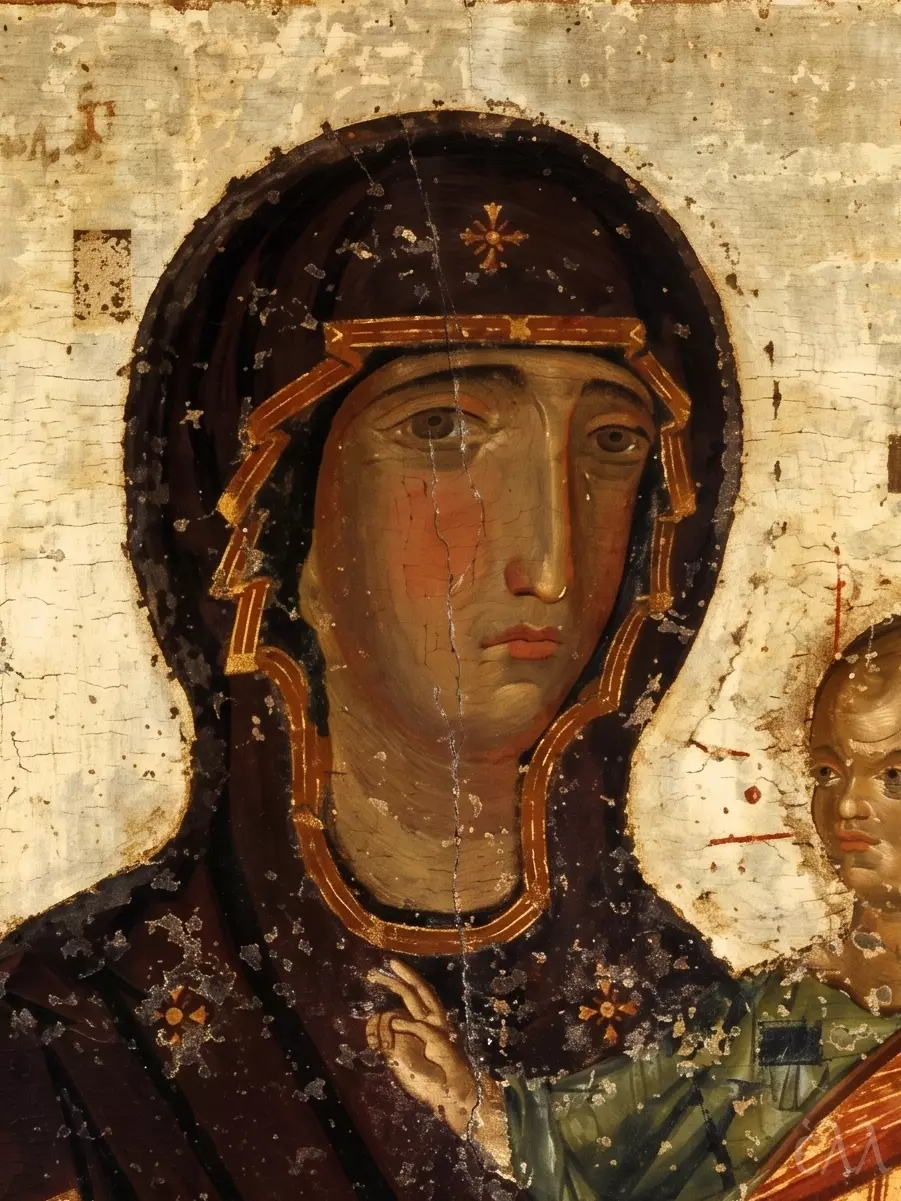
The title Hodegetria derives from the celebrated Marian image once kept at the Monastery of the Hodegoi in Constantinople. By the Middle Byzantine period its compositional formula had become one of the most widely transmitted representations of the Virgin and Child. In the Arakiotissa panel, however familiar the underlying structure, the treatment acquires a marked psychological character. Mary’s large eyes are withdrawn and grave, the mouth tightly controlled; the expression carries the melancholy frequently associated with Marian images shaped by an awareness of Christ’s future Passion. Christ, meanwhile, appears unusually self-possessed. His body has the scale of a child, yet the painter allows scarcely anything infantile to enter his demeanour.
Such qualities sit comfortably within the artistic world of Panagia tou Arakos. The church received an extensive mural decoration in December 1192, an ensemble of exceptional importance for the study of late Komnenian painting in Cyprus and of artistic currents linked with Constantinople. The panel, commonly dated around the same period, has been attributed together with its companion Christ icon to Theodoros Apsevdis, the painter associated with the decoration of the Enkleistra of Saint Neophytos near Paphos. The attribution remains a scholarly proposal rather than securely documented authorship. The broader iconographic setting of the Lagoudera decoration is examined extensively in the Nicolaïdès study.
Across the surviving surface, the pictorial language depends strongly on line. The narrow nose of the Theotokos extends almost continuously from the brow; the eyes are almond-shaped and strongly bordered, while delicate accents around the eyelids and cheeks organise a face whose modelling remains restrained. A broad chromatic mass against the gold field is formed by the dark maphorion. Christ’s garments introduce warmer red-orange passages alongside green, their sharper folds active within the comparatively stable silhouette of his mother’s body. Considerable abrasion and paint loss affect the panel, particularly across the lower portion and the garments, yet enough survives to preserve the original relationship between dark drapery, warm flesh tones, coloured clothing and the luminous background.
An unusual ornamental border also distinguishes the icon. Along the vertical sides, successive lozenges are set within a narrow geometric framework, interrupted by horizontal divisions. This treatment belongs to the object itself rather than functioning as an illusionistic architectural enclosure. The sacred figures remain projected directly upon the gold ground, with little suggestion of physical depth. The result is visually compressed. Mary occupies nearly the entire pictorial field, Christ held close against her body, their halos entering the surrounding luminosity without a landscape or architectural setting between figure and ground.
The gesture of the Theotokos deserves particular attention because it governs the image without theatrical emphasis. Her right hand, elongated and slightly bent at the wrist, crosses the dark maphorion and indicates the figure she supports. Within the Hodegetria tradition this gesture establishes Christ as the central object of attention even though Mary dominates the panel by scale. Through displacement the arrangement works: the larger figure directs the eye towards the smaller one, while Christ carries the blessing gesture and scroll. Their faces, brought close without a direct exchange of glances, preserve the emotional distance characteristic of the image.
The processional character adds another dimension to this tightly organised composition. Carried beyond the fixed position of an iconostasis or church wall, the panel could enter a changing relationship with space, light, clergy and congregation; the painted cross on the reverse ensured that its second face also presented an appropriate sacred image. Its considerable dimensions would have given the Virgin and Child a strong visual presence during such use. Once returned to a stationary position, the gold field and frontal figures again resolved themselves within the severe rectangular limits of the panel, the worn lower edge still preserving physical evidence of that earlier life.
(The translation was edited by N. Jones.)