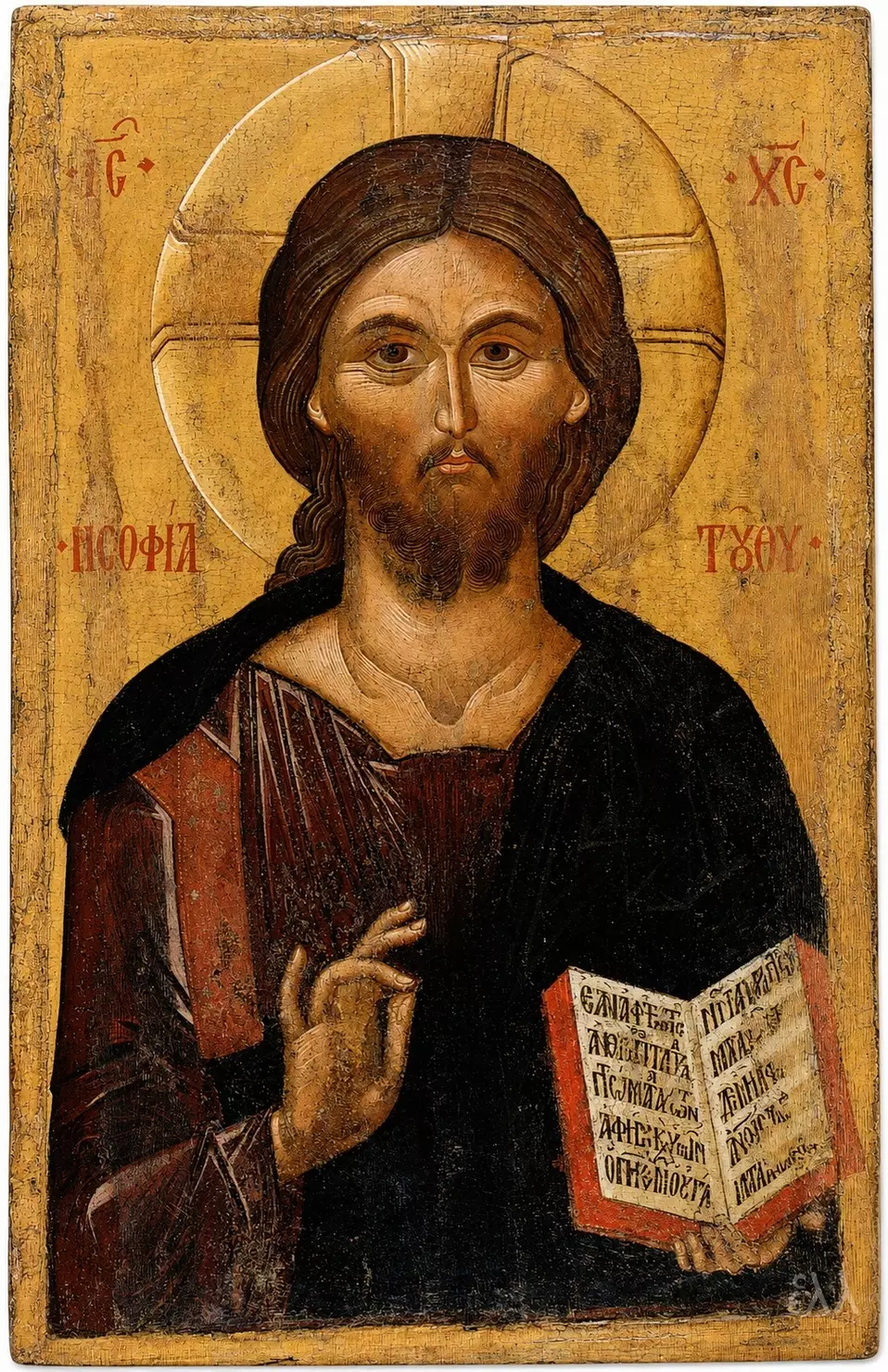
Among the monumental panel icons of Late Byzantine Thessaloniki, the Christ the Wisdom of God icon occupies an unusual position. The anonymous work, attributed to a Thessalonian workshop and dated to the late fourteenth century, presents Christ in a bust-length variation of the Pantokrator type. It is preserved in the Museum of Byzantine Culture in Thessaloniki under inventory number BEI 503. The museum records dimensions of 157 × 105 × 5 cm and identifies the medium as egg tempera on wood, while its exceptional scale places it well beyond the dimensions of most portable devotional icons.
Its provenance connects the panel with the church of Hagia Sophia in Thessaloniki. The possibility that it once belonged to the church’s templon is strengthened by several features: its large scale, the specific title inscribed beside Christ, and a leaf-bearing cross recorded on the reverse. Within the sanctuary, if the panel stood on the templon, that reverse would have remained visible from behind the screen. The icon therefore possessed two articulated faces and participated in the architectural and liturgical space of one of Thessaloniki’s major Byzantine churches.
At the centre, Christ faces directly outward, his right hand raised before his chest in blessing and his left supporting an open Gospel book. The Greek inscription identifies him as Jesus Christ, the Wisdom of God. Across the open pages appears Matthew 6:14–15, a passage concerning forgiveness: the heavenly Father forgives those who forgive the transgressions of others (Matthew 6:14–15). According to the published catalogue, this is the only known use of this particular Gospel passage in an image of Christ Pantokrator, giving an already uncommon icon a further element of individuality.
Christ the Wisdom of God Icon and the Pantokrator Type
The composition retains the authority and severe frontality associated with the Pantokrator. Christ occupies almost the entire surface. His shoulders extend broadly across the lower part of the panel, while the upright head, open Gospel and blessing hand organize the figure around a firm vertical axis. In Byzantine monumental decoration, the Pantokrator was closely associated with the highest zones of the church, especially the dome, a visual convention that provides an important background to this unusually large panel version.
Against the warm ochre field, the dark garments produce a strong concentration around the head and torso. A deep, nearly black himation passes across Christ’s shoulders; beneath it appears a dark red chiton with muted violet and brown tonalities. Fine linear highlights follow the garment folds, particularly around the right shoulder and exposed upper chest. The palette is restrained, earth-bound, densely modulated. Within this narrow chromatic range, small shifts of value carry much of the modelling.
The cross-inscribed halo is especially unusual. Its ochre tones remain close to the background field, while the arms of the cross are built through opposed triangular passages of lighter and darker colour. The resulting optical effect gives the cross a shallow, almost relief-like projection. The exhibition catalogue compares this treatment with halos on Macedonian icons of the thirteenth and fourteenth centuries and notes technical affinities with an icon of the Virgin Eleousa now also in the Museum of Byzantine Culture. Both works may have emerged from the same Thessalonian workshop.
The inscriptions have considerable visual weight. Above the shoulders appear the abbreviated name of Christ, while the larger red lettering Η ΣΟΦΙΑ ΤΟΥ ΘΕΟΥ extends across the ochre field. Such elements belong to the established epigraphic language of Byzantine icon painting: identifying inscription, nomen sacrum, cruciform halo, open Gospel book, gesture of benediction.
The Open Gospel and the Meaning of Divine Wisdom
Matthew 6:14–15 introduces forgiveness and judgment directly into the image. The words function as an integral part of the composition. Placed in Christ’s hand and clearly exposed toward the viewer, they form a textual counterpart to the frontal gaze and blessing gesture. Compassion, moral responsibility, divine judgment: these ideas gather within a single figure.
The title Wisdom of God deepens that association. Byzantine theological tradition understood Divine Wisdom in relation to Christ as the Logos, and the museum interprets the title of this panel as carrying eschatological and soteriological meaning. In the fourteenth-century catalogue entry, the distinctive handling of light and volume is further discussed in relation to contemporary theological debates and the Hesychast movement. That relationship is presented as a scholarly interpretation of the painting’s visual language, particularly its conception of divine light, within the intellectual climate of Late Byzantine Macedonia.
The Face: Modelling, Hair and Expression
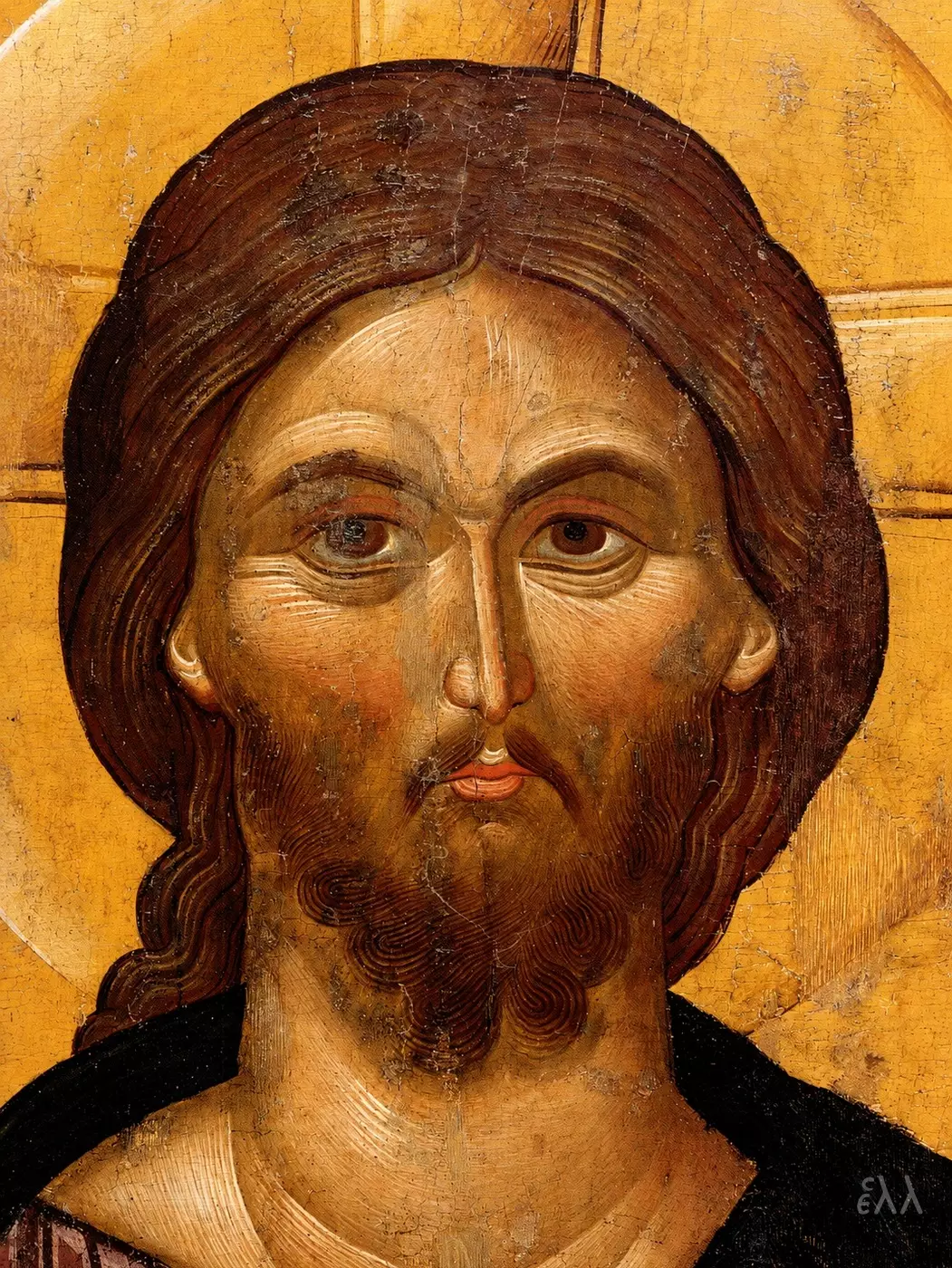
Seen at closer range, the face reveals how carefully the painter constructed this imposing presence. A warm brown base supports successive passages of ochre, pale flesh colour and sharply drawn white highlights. Across the forehead, cheeks and neck, illumination is distributed in fine parallel strokes and compact hatching. Long highlights run beneath the eyes; shorter ones follow the cheekbones and the bridge of the nose. Colour and line work together, sometimes separating into clearly visible marks instead of dissolving into a continuous tonal transition.
The face itself is long and strongly structured. Below the high cheekbones, it narrows toward the lower cheeks, while the straight nose descends through the central axis to a small mouth defined by reddish contours. A pale accent touches the lower lip. The beard divides into dark curling strands, each described through repeated linear turns; above it, the moustache curves closely around the mouth. Hair falls symmetrically from a central parting and descends in heavy brown locks beside the face, its surface articulated by narrow parallel lines.
These features have led scholars to connect the panel with an anti-classical and highly expressive current in late Palaiologan painting. The catalogue emphasizes the pronounced cheekbones, tense forehead, powerful eyes and strongly defined facial structure, while also drawing attention to the sophistication of the modelling and the careful handling of the hair. Similar tendencies appear in several contemporary icons from Veroia, though the Thessaloniki panel is regarded as the more accomplished work and may have provided a model for related Macedonian production.
Age, visible in the fine craquelure crossing the forehead and flesh and in the scattered abrasion interrupting the painted surface, has become inseparable from the present appearance of this modelling. Around the brow and eye, larger damaged areas expose disruptions in the original paint layer. These marks belong to the material history of the panel and remain distinct from the forms supplied by the painter; losses, cracks, abrasions retain their actual irregular shapes without requiring imaginary reconstruction.
The Eyes: Damage and the Rhetoric of the Gaze
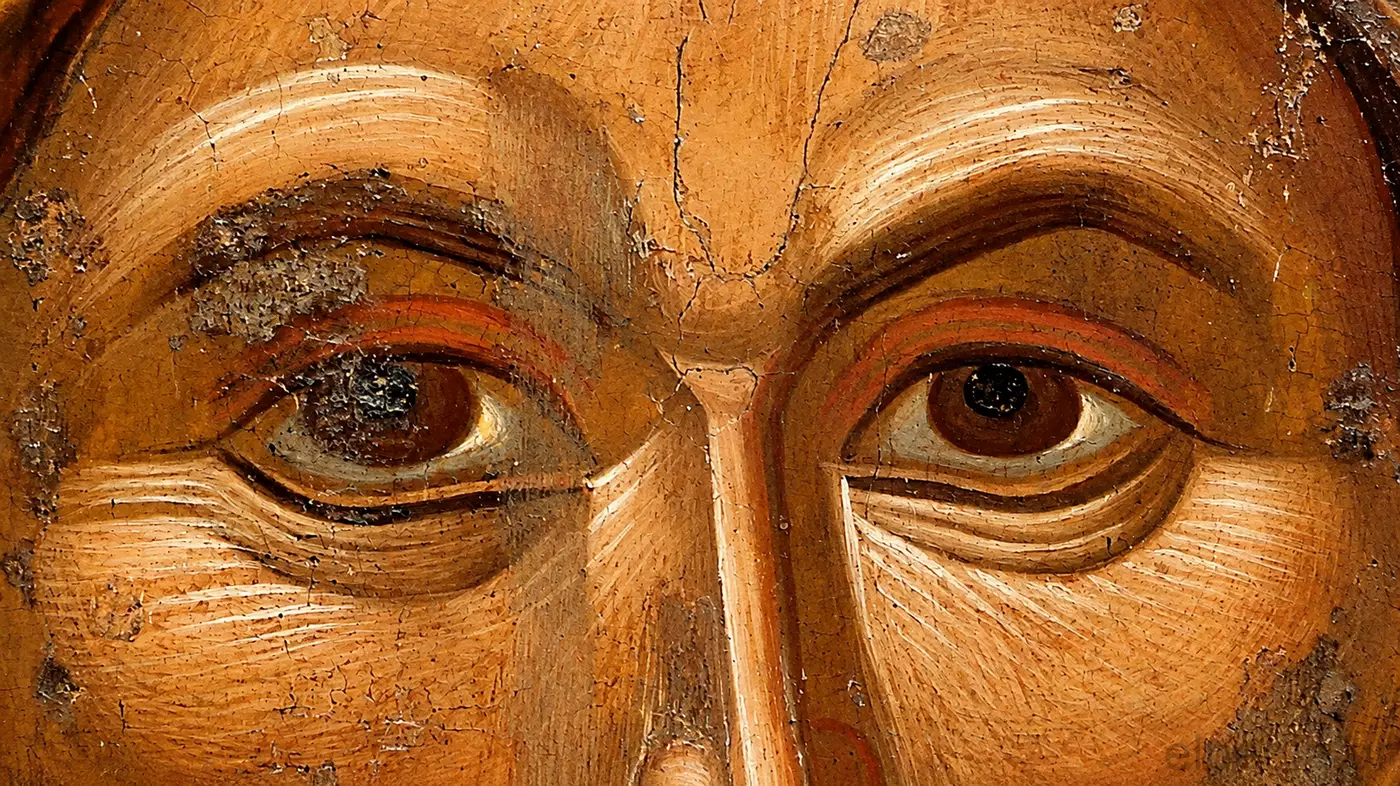
At extreme close range, the eyes become almost a composition in themselves. Heavy arched brows rise above broad almond-shaped forms. Red lines along the upper lids warm the transition between the eyes and surrounding flesh, while narrow white strokes beneath the lower lids build a dense pattern of light. Several of these highlights extend outward toward the temples, following the changing planes of the cheeks.
Christ’s right eye, appearing on the left side of the composition, is significantly affected by surface loss and abrasion. Damage crosses the brow, upper eyelid and part of the eye itself, fragmenting the continuity of the original modelling. His left eye survives more clearly: the dark pupil, brown iris, pale sclera and firm upper outline remain readily legible. Fine cracking continues across both eyes and the bridge of the nose.
The asymmetry created partly by preservation intensifies an already forceful facial conception. Each eye participates in a broader system of line and modelling: strokes radiating outward from the sockets, pupils confronting the frontal axis, highlights gathering beneath the lids, the brow compressing the space above them. Published analysis specifically singles out these unusually large, expressive eyes and connects their pictorial emphasis with Christ’s title as the Wisdom of God.
A Thessalonian Icon of Late Palaiologan Painting
The Museum of Byzantine Culture places the work within a trend of painting that developed in Macedonia during the second half of the fourteenth century. The more detailed exhibition catalogue narrows its artistic setting to a Thessaloniki workshop and relates its technique to other regional panels through the ochre background, cinnabar inscriptions, dark contour lines, pink accents on the lips, limited drapery highlights and dense linear illumination of the flesh.
Within that setting, the scale of the panel remains striking. The broad torso, enlarged head and direct gaze possess the visual force required of an image intended for an important ecclesiastical interior. At that scale, the painter nevertheless retained extraordinary attention to minute elements: separate hairs in the beard, thin highlights beneath the eyes, slight tonal shifts across the forehead, narrow lines around the fingers, individual letters filling the open pages of the Gospel.
Its theological title, rare Gospel text and unusually forceful physiognomy give the Christ the Wisdom of God icon a particular place within late Palaiologan painting. The panel brings together the established Pantokrator type and a highly specific Thessalonian artistic language, preserved on a wooden support five centimetres thick and measuring more than one and a half metres in height, from the late fourteenth century.
(The translation was edited by E. Wilson.)