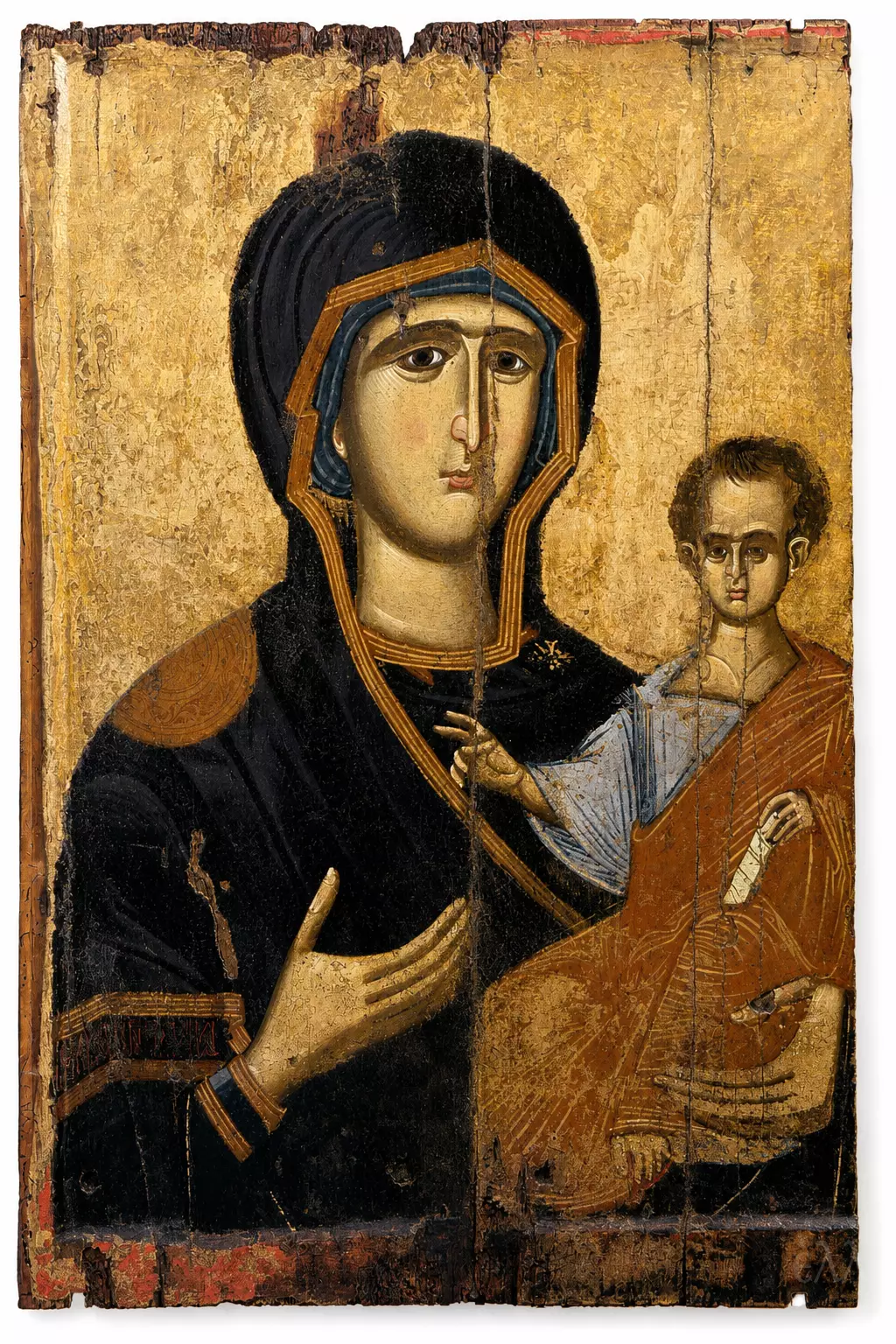
The Panagia Hodegetria icon with Saint Barbara, preserved in the Museum of Byzantine Culture in Thessaloniki, is a large double-sided panel whose two painted faces belong to successive moments in the later history of Byzantine painting. The museum dates the object broadly from the second half of the fourteenth century to the early fifteenth century and records its dimensions as 119 × 77 cm, with a thickness of 3 cm. Executed on wood in egg tempera, it is associated with a workshop active in the Macedonian region. The Hodegetria on the front bears an early fifteenth-century repainting, while the image of Saint Barbara on the reverse is assigned to the second half of the fourteenth century.
On the front, the Theotokos appears half-length against a gold ground, holding the Christ Child at her left side. Her dark maphorion spreads across much of the panel, concentrating attention on the pale oval of the face and on the long hand that emerges below. Christ, smaller in scale yet given a distinct frontal presence, raises his right hand in blessing; according to the museum description, his left holds a rolled scroll. Across the surface, age is plainly visible: vertical splits in the wooden support, broad areas of abrasion, exposed ground, losses along the borders, worn passages in the gilded field — the structure of the image nonetheless holds through all of this.
Between the free hand and the doctrinal purpose it serves lies the whole logic of the type, and it is worth pausing on that logic before returning to the panel itself.
Panagia Hodegetria Icon: Composition and Gesture
The Hodegetria was among the most widespread Marian iconographic types in Byzantine art. Its name derives from the celebrated image associated with the Hodegon Monastery in Constantinople, and the Thessaloniki museum notes the tradition of its Tuesday procession through the streets of the capital. In the established type, the Virgin supports Christ while directing attention toward him with her free hand; the gesture is central to the composition and became one of the most recognisable formulas of Byzantine representations of the Theotokos and Child. The Metropolitan Museum of Art likewise identifies this gesture as a defining feature of Hodegetria imagery.
In this panel, the gesture is unusually restrained. The Virgin’s right hand rises from the lower part of the arrangement and turns inward across her body, the palm open and the long fingers separated with deliberate clarity. Its direction leads toward Christ, while the hand also carries the quiet character of supplication. Above it, the face establishes a different rhythm — nearly frontal, elongated, severe in outline, with large almond-shaped eyes, a narrow nose and a small mouth. The gaze is steady yet slightly withdrawn. A thin band of warmer colour follows the edge of the maphorion around the face, enclosed in turn by a darker blue inner border. Around the head, the dark circular nimbus has a strong graphic presence against the worn gold field.
On the right side of the pictorial field, from the Virgin’s perspective, Christ’s body is supported closely against her. His head is comparatively small and the features sharply concentrated: high forehead, narrow cheeks, compact mouth, dark hair falling in short strands. A pale blue garment is crossed by a warm reddish-brown mantle whose linear highlights describe the folds in repeated, almost calligraphic strokes. The right hand is raised near the centre of the scene in the established gesture of benediction. Because the Virgin’s hand and Christ’s blessing hand appear close to one another, the middle of the icon becomes a field of gestures — one presenting, one blessing — set between the two faces.
Scale reinforces the hierarchy. The Theotokos dominates the panel physically, her head and shoulders forming the principal mass, while Christ remains fully legible within the space at her side. No extensive setting interrupts the relation between the figures. Gold, dark drapery, faces and hands: the pictorial vocabulary is concentrated, and the shallow space keeps the sacred pair close to the surface of the panel.
Colour, Surface and the Early Fifteenth-Century Repainting
The present appearance of the front cannot be separated from its later repainting. The Museum of Byzantine Culture dates this intervention to the early fifteenth century and points to the integral wooden frame as evidence for an earlier stage of the painted surface. That distinction matters, because what survives is a layered object: the panel belongs materially to an earlier history, while the visible Hodegetria preserves the work of a later painter who renewed the image while retaining its established iconographic identity.
Across the gold ground, irregular patches of abrasion create a mottled surface. Fine scratches and broader losses interrupt the upper field; several vertical fissures descend through the panel, one passing across the Virgin’s head and face, another continuing through Christ’s figure. Near the top and bottom edges, the wood is more heavily exposed. The frame itself, narrow and structurally continuous with the panel, has suffered losses and darkening, yet traces of red remain along parts of the border. These marks belong to the material life of the object and are particularly evident because the design depends on large, relatively unbroken areas of gold and dark pigment.
Within the figures, the paint handling alternates between broad masses and fine linear articulation. The Virgin’s maphorion is almost black in its deepest passages; subtle lines and surviving decorative details emerge only gradually from that dark field. Her face is built from pale ochre flesh tones, olive-green shadowing and light highlights placed along the nose, brow and upper cheek. The transition from shadow to light remains controlled, with the strongest accents reserved for the bridge of the nose and the area around the eyes. On Christ, denser lines define the drapery and create a more animated surface, especially across the blue sleeve and reddish mantle.
At the Virgin’s shoulder, a broad ochre form carries faint ornamental patterns, much diminished through wear. Small gold details remain near the upper chest. Lower down, the open hand is one of the best preserved light areas of the arrangement, its fingers clearly delineated against the dark garment. Broad darkness around the body, light concentrated in face and hands, gold behind — from these few chromatic elements the painter built much of the image’s visual force.
Understood within the long material history of Byzantine icons, the repainting itself takes on a clearer sense: images could remain in ecclesiastical use for generations, receiving interventions as painted surfaces aged or devotional needs changed. In this case the museum’s dating allows a more specific sequence to be recognised: an older panel, its integral frame preserved, and a renewed Hodegetria surface from the opening decades of the fifteenth century. The intervention belongs to the object’s historical existence and has become inseparable from what is now seen.
Saint Barbara on the Reverse and the Double-Sided Format
The reverse adds a second subject and an earlier pictorial phase. According to the museum, Saint Barbara is represented half-length in the style of the second half of the fourteenth century, richly dressed in reference to her noble status, holding a cross as the attribute of martyrdom and turning the open palm of her left hand toward the viewer in prayer. The documented chronology therefore places the saint’s image before the repainting of the Hodegetria on the opposite face.
That sequence gives the bilateral icon particular interest. Two-sided sacred images formed part of Byzantine artistic practice in several media, and surviving examples show that artists could conceive the two faces as related components of a single object. In the Thessaloniki panel, the pairing joins one of the most authoritative Marian image types with the individual figure of a female martyr. The available museum information does not specify the icon’s original church, its precise liturgical placement, or the circumstances under which the two subjects were combined, so its original setting remains open.
Saint Barbara’s presence also introduces a markedly different iconographic emphasis from that of the front. The Hodegetria is structured through the close relationship between Mother and Child, through the coordinated gestures of presentation and blessing. On the reverse, the single half-length martyr is identified by dress, cross and prayer gesture. One face depends upon a tightly organised two-figure arrangement; the other, on the concentrated presence of an individual saint.
The museum places the icon within the production of a workshop in the Macedonian region, a significant attribution for an object preserved in Thessaloniki. Its chronology crosses the boundary between the later fourteenth and early fifteenth centuries, a period in which established Byzantine iconographic types continued to be renewed through workshop practice, repainting and repeated use. On the surviving Hodegetria face, the painter preserved a strongly hieratic structure while allowing a degree of softness in the flesh modelling and greater linear animation in Christ’s drapery.
Material history remains unusually visible. Splits divide the support vertically, gilding has been extensively abraded, pigment has disappeared in passages, and the edges retain evidence of long wear. Yet the principal relationships are still readable with precision — the large dark silhouette of the Theotokos, her pale face, Christ at her side, the two hands gathering attention near the centre. On the opposite face, an earlier Saint Barbara belongs to the same wooden object, carrying its chronology back into the second half of the fourteenth century.
(The translation was edited by A. Orfanos)