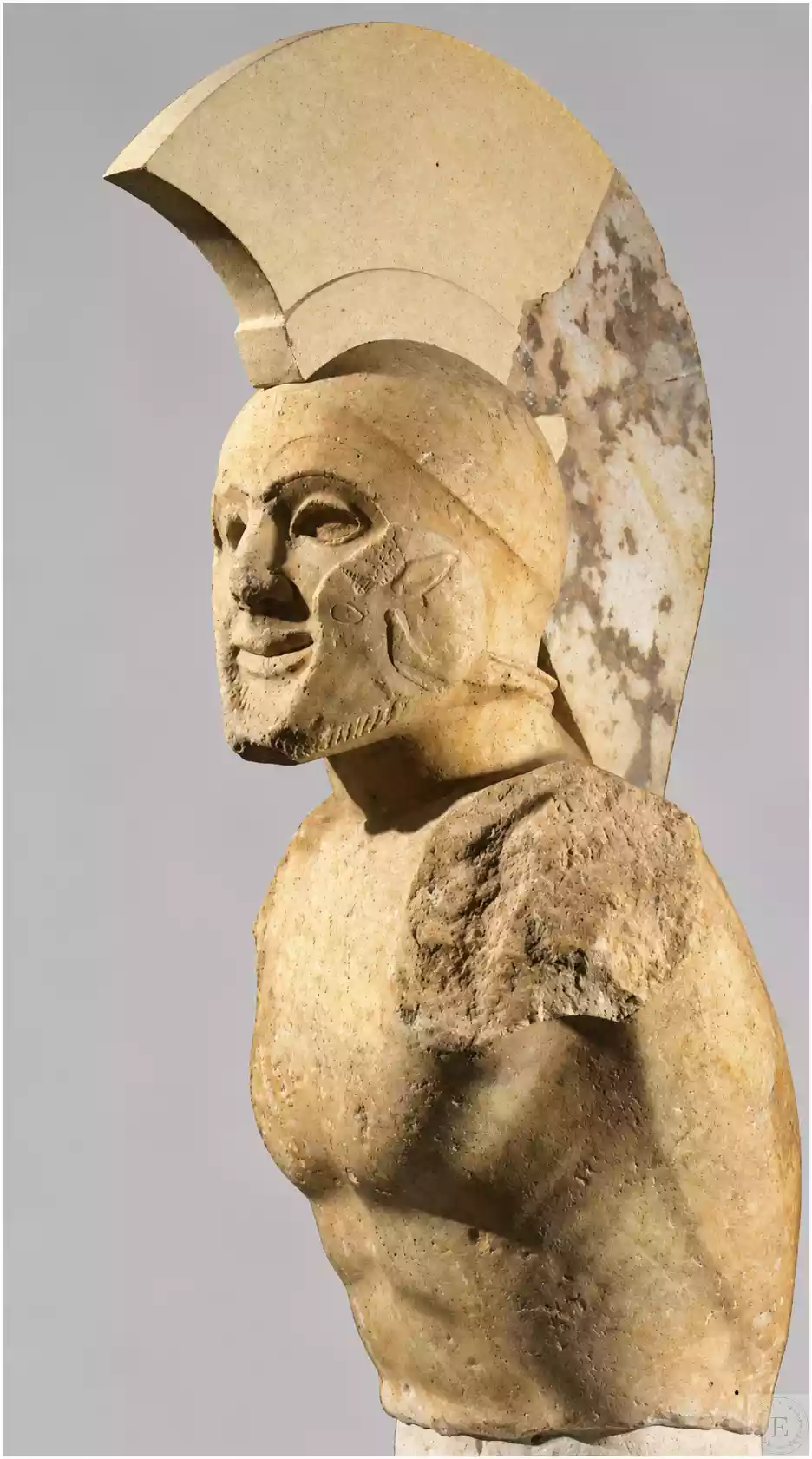
 Marble hoplite known as “Leonidas”, c. 480–470 BC, from the acropolis of Sparta. Archaeological Museum of Sparta. The identification with the king of Thermopylae is conventional.
The picture is familiar from school. The ancient Greeks were divided into four great tribes, the Dorians, the Aeolians, the Ionians and the Achaeans, and each had its own dialect, its own regions and its own mythical founding ancestor. The scheme is ancient in origin; we already find it in texts of the 6th and 5th centuries BC. It has one problem, however, which the ancients themselves had noticed: the earliest surviving texts of Greek literature all but ignore it.
What Homer says about the ancient Greek tribes
The Iliad and the Odyssey are the oldest works of Greek literature that we possess. Older historical syntheses placed them very early, even in the 10th century BC, and Herodotus reckoned that Homer had lived about four hundred years before his own time. Current scholarship usually dates them to the 8th or the early 7th century BC, as the culmination of a long oral tradition. However one counts, they lie centuries away from the world they describe.
Let us make a simple count. The Aeolians, as a people, appear nowhere in the epics. The Aeolus of the Odyssey is the master of the winds and has nothing to do with any tribe. There are no Dorians in the Iliad. In the Odyssey they are mentioned only once, when the disguised Odysseus describes Crete to Penelope as an island of many tongues, home to Achaeans, Eteocretans, Cydonians, Pelasgians and “Δωριέες τε τριχάϊκες” (“and the Dorians, trichaïkes”; Od. 19.177). The epithet is still interpreted in different ways. Of Dorians in the Peloponnese, not a word. Homer’s Sparta is the city of Menelaus, an Atreid.
And the Ionians? A single line. In the battle at the ships, in Book 13, the “Ἰάονες ἑλκεχίτωνες” appear, the Ionians with their long, trailing tunics, alongside Boeotians, Locrians, Phthians and Epeians (Il. 13.685). A few lines further on it becomes clear that these are the Athenians of Menestheus. Here the name works as the designation of a local contingent, on an equal footing with the others in the same list.
With the Achaeans the opposite happens. Their name turns up on almost every page. Together with “Danaans” and “Argives”, it denotes the whole army besieging Troy. Yet Homer also knows a much narrower usage. In the Catalogue of Ships, listing the men of Achilles from Phthia and Hellas, he writes: “Μυρμιδόνες δὲ καλεῦντο καὶ Ἕλληνες καὶ Ἀχαιοί” (“and they were called Myrmidons and Hellenes and Achaeans”; Il. 2.684). Homeric Hellas is a region of southern Thessaly, and the Hellenes are one of its peoples.
Pelasgians and Hellenes in Thucydides and Herodotus
The historians of the 5th century BC had already spotted the gap. In the first book of his History, Thucydides uses precisely the Homeric evidence to argue that the name “Hellenes” spread little by little. It began with Hellen, son of Deucalion, and with his sons, who grew powerful in Phthiotis, and passed from city to city. Homer, he observes, nowhere calls the whole body Hellenes, only the followers of Achilles. Nor does he use the word “barbarians”, since there was not yet a common name against which the others could be defined.
Herodotus, a little earlier, gives a bolder version. In his opinion the Dorians had been a Hellenic people from the start, a much-wandering one, which moved from Phthiotis to Histiaeotis, from there to the Pindus, to Dryopis and finally to the Peloponnese. The Ionians, the Athenians first among them, were by contrast of Pelasgian origin and learned Greek later (Hdt. 1.56–58). As for the language of the Pelasgians, he admits himself that he can only guess.
It is worth seeing how little material lay behind this theory. In the epics the Pelasgians are a scattered name: the “Pelasgian Argos” of Thessaly, the Zeus of Dodona who is called Pelasgian, Pelasgians in Crete and Pelasgians among the allies of the Trojans. In the hands of the 5th-century historians, these sporadic mentions became the name of an entire pre-Greek population. On how exactly the names “Hellas” and “Hellenes” prevailed in the interval between Homer and Herodotus, the sources are sparing. There is, however, one important exception.
Hellen and his sons: a genealogy built up step by step
This is the “Catalogue of Women”, a genealogical epic that the ancients attributed to Hesiod and that survives only in fragments. Most scholars place it in the 6th century BC, although the dating is debated. There we meet the familiar genealogy for the first time. Hellen has three sons, Dorus, Xuthus and Aeolus, and Xuthus in turn fathers Achaeus and Ion. The four tribes now fit into a family tree with a common ancestor.
This genealogy was not neutral, and Athens showed as much quite clearly. In Euripides’ “Ion”, staged during the years of the Peloponnesian War, Ion is no longer the son of Xuthus but of Apollo and the Athenian Creusa, while Dorus and Achaeus are foretold as the future children of Creusa and Xuthus. The Ionians, and Athens with them, acquire divine descent and precedence. The Dorians, which is to say mainly Sparta, become the younger siblings of the family.
Modern scholarship has given weight to this side of things. Jonathan Hall and other scholars argue that in the Archaic period Greek identity was loose and “aggregative”. An Argive or a Milesian felt himself first a citizen of his city or a member of a tribe, and far less a Hellene. A strong common consciousness took shape mainly after the Persian Wars, with the figure of the “barbarian” as its counterweight. Tellingly, Herodotus has the Athenians define Greekness in terms of common descent, language, shrines and sacrifices, and shared customs (Hdt. 8.144). That definition belongs to the 5th century.
The dialects as witnesses
If the genealogies are constructs, the dialects are something more tangible. Linguists distinguish four dialect groups in ancient Greek. Ionic-Attic was spoken on the coasts of Asia Minor, in Euboea and in Attica, Aeolic in Lesbos, Boeotia and Thessaly. Arcadocypriot is attested in inscriptions from Arcadia and Cyprus. The West Greek group comprises Doric and the Northwest Greek dialects, and Doric was heard in Laconia, the Argolid, Corinthia, Crete, Rhodes and the colonies of Sicily and southern Italy.
The match with the tribes works fairly well for the Ionians, Aeolians and Dorians. The Achaeans, once again, do not fit the scheme. There is no “Achaean” dialect in the way that there is a Doric one. Arcadocypriot, which survived in the Arcadian highlands and in distant Cyprus, is often regarded as an echo of the language of the Peloponnese before the Dorians settled there. Further back still lies Mycenaean Greek, known from the clay tablets in Linear B (c. 1400–1200 BC) from Knossos, Pylos, Mycenae and Thebes, deciphered by Michael Ventris in 1952. They are mostly accounting documents and lists of names, and they say very little about the tribes.
Dorians or Achaeans? The case of Sparta
Ancient tradition had the Dorians come down into the Peloponnese together with the descendants of Heracles, the Heraclidae, eighty years after the Trojan War, as Thucydides notes (1.12). Archaeology has not found the traces of a great, single invasion at the end of the Mycenaean world, and when and how the Dorian communities settled remains an open question. What is certain is that in the Classical period Sparta was regarded as the Dorian city par excellence.
And yet a king of Sparta could deny that he was a Dorian. Herodotus relates that when Cleomenes I went up to the Acropolis of Athens, around 508 BC, the priestess of Athena rose from her throne and forbade him to enter the sanctuary, because entry was not permitted to Dorians. He replied: “ὦ γύναι, ἀλλ’ οὐ Δωριεύς εἰμι ἀλλ’ Ἀχαιός” (“Woman, I am not a Dorian but an Achaean”; Hdt. 5.72). As Heraclidae, the royal houses of Sparta claimed a descent older than that of the people they ruled. Cleomenes was the half-brother of Leonidas, the king who fell at Thermopylae in 480 BC.
On the acropolis of Sparta, in the excavations of the British School at Athens in the 1920s, the marble torso of a hoplite with a helmet and a tall crest was found, a work of around 480–470 BC, now on display in the Archaeological Museum of Sparta. Early on it was named “Leonidas”. The identification is conventional and rests on no inscription or other secure evidence. The record of the plaster cast that the British School donated to the Museum of Classical Archaeology in Cambridge notes that fragments of a leg, a shield and a helmet were found near the torso, and that most of the crest is a restoration.
A name that survived
Of the four names, the one that Homer used for everyone had the strangest fate. In historical times Achaea was the name of a strip along the northern coast of the Peloponnese, and Achaea Phthiotis that of a region of southern Thessaly, near Homeric Phthia. The cities of Peloponnesian Achaea founded the Achaean League, which in the Hellenistic period spread over almost the whole Peloponnese, until the Romans dissolved it in 146 BC. When Augustus organized southern Greece as a separate province in 27 BC, he gave it the name Achaea.


