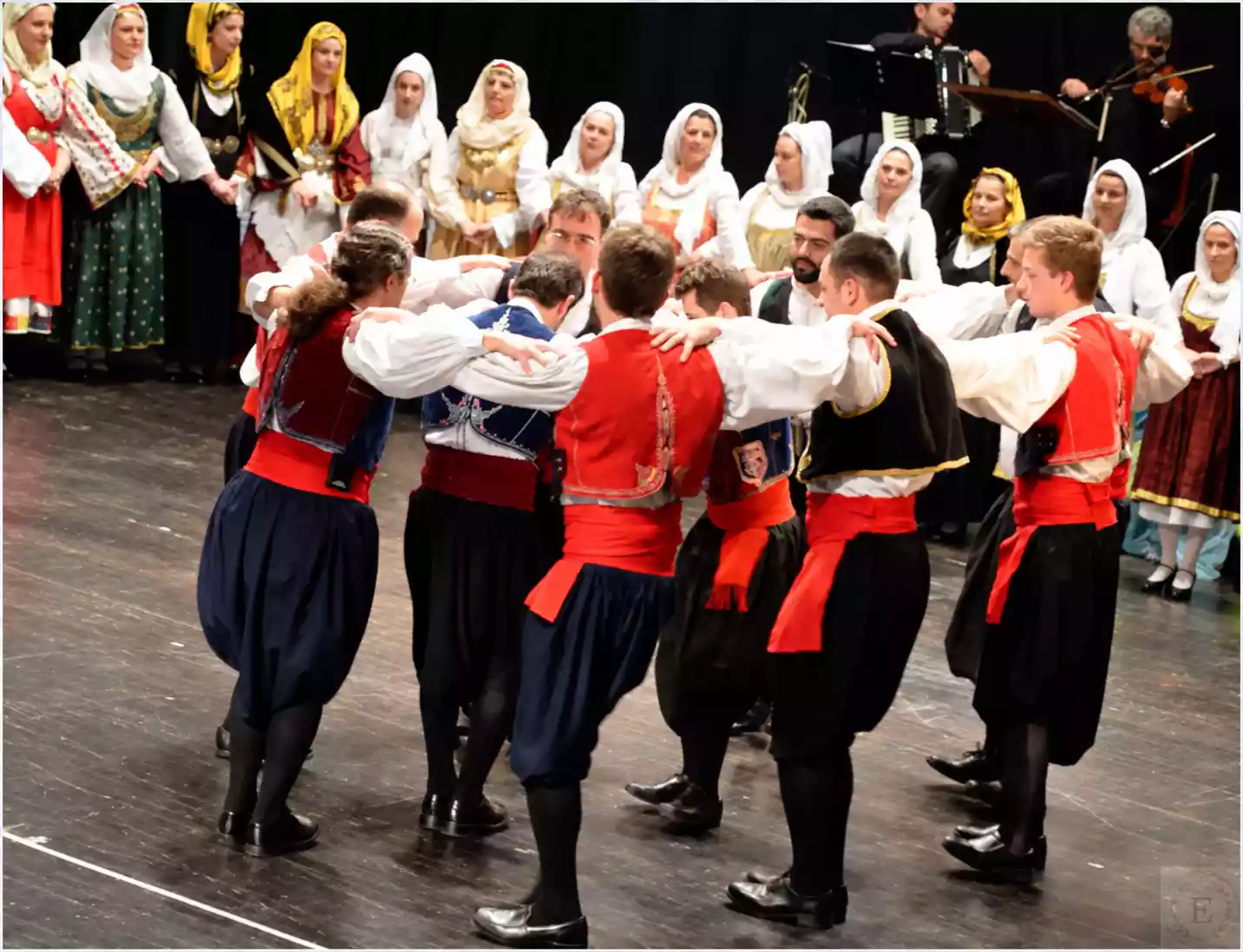
 A traditional dance presented on stage, with a ring of men in the foreground and a fiddle and accordion behind. The identity of the dance has not been established.
In the villages of southern Karystia, the Kavontoritikos ties the local dance repertoire to a musical tradition that later spread across the Aegean, while keeping traces of the older way of playing the tsambouna. The tune can also be heard as played by the fiddler Nikos Oikonomidis (2001), in the Domna Samiou archive. Not far away, at Antia on the slopes of Mount Ochi, people cultivated the sfyria, a way of rendering speech in whistles so as to talk across distances. Looked at together, the two shed light on the different uses of sound in the rural world of southern Euboea: music to carry the feast, whistled speech to serve the business of the day.
A two-beat pulse and the movement of the ring
The Kavontoritikos is set in 2/4. In her explanatory note for the Samiou archive, Miranda Terzopoulou describes it as an even, lively circle dance in which the dancers join hands in a crossed hold. She also mentions that satirical verses, at times rather bold ones, are slipped in as the celebration wears on. The recording itself is catalogued under the title Nikos Oikonomidis (2001); Terzopoulou’s accompanying commentary dates from 2018.
When listening, it helps to keep metre and melodic movement apart. Over the recurring two-beat pulse the player unfolds his phrases with accents and ornaments, and these can make the playing denser or more headlong. To call the tune “asymmetric” would therefore confuse matters as far as its metrical organisation is concerned.
The tsambouna and the toubi
The tsambouna belongs to the bagpipe family. The player blows into the bag and, squeezing it with his arm, feeds the sounding pipes, so that the sound flows without a break. One particular instrument is described in the record Tsambouna (373), from the collection of the Hellenic Folklore Research Centre of the Academy of Athens: its bag is of goatskin and its pierced pipes are of cane. The object comes from Kalymnos. It is a useful example of how the instrument is made, though its island origin should be kept distinct from that of the Euboean instruments.
In the older accompaniment of the Kavontoritikos we find the tsambouna and the lyra, together with a percussion instrument referred to as a toubaki or daouli. Against the unbroken sound of the wind instrument, the drumbeats mark out time for the dancers. Later the fiddle and the laouto moved to the centre of the performance, as the note accompanying the recording Nikos Oikonomidis (2001) also explains.
At Kapsala in 1976, Domna Samiou recorded Thodoris Bougioukos playing a “tsambouna with zourna”, a local variant with an added bass pipe, and accompanied him herself on the daouli. According to the archival note, Bougioukos had made the instrument himself, having learnt the craft from his grandfather. The recording appears in the field journey Euboea, Karystos.
From the Kallianiotikos to the Aegean fiddle
The path from local playing to wider circulation is examined in Zachariou’s study, a master’s dissertation submitted by Dimitrios Zachariou to the Department of Music Studies at the University of Athens in 2021. Its abstract places the tune in the Arvanite villages around Agios Dimitrios and Kallianou, where it went by the names “Kallianiotikos” and “Gaida”.
The music is built from short phrases set side by side and recombined, within what the older instruments could manage. Once it passed to the fiddle, part of this motivic inheritance survived, while new elements entered, made possible by the instrument’s wider range and different technique. This is one of the main threads of the dissertation, as presented on openarchives.gr.
As early as 1976, in Agios Dimitrios, Samiou recorded the Kavontoritikos played on two fiddles and a laouto. The same field journey includes an Arvanite song and a shepherd’s tune on the floghera, alongside the tsambouna recordings. The material from Euboea, Karystos captures this coexistence at that particular moment.
Networks of professional musicians, and records, helped establish the Kavontoritikos in the Cyclades and more widely in the Aegean. The dissertation also points to the part played by dance associations in introducing the tune to younger generations, as its abstract on openarchives.gr notes.
The sfyria of Antia
At Antia, in south-eastern Euboea, the sfyria served for communication over distances the ordinary voice could hardly cover. It rests on everyday spoken Greek, whose linguistic distinctions and intonation it renders in whistles. In 2019 the practice was entered in the National Inventory of Intangible Cultural Heritage of Greece, and the relevant entry describes its use by men and women alike, above all in work out in the fields.
An experienced whistler can convey whole sentences. In the phonetic research of Julien Meyer, whistled speech is treated as a way of rendering language within a narrow frequency band. Of the rich acoustic signal of the voice, selected features are kept, enough for a practised listener to recognise the message. Understanding presupposes familiarity both with the practice and with the language on which it is based, as the scholarly article on Cambridge Core explains.
Comparable forms of whistled speech have been recorded in very different language communities around the world. Meyer’s comparative overview in Annual Reviews considers them in relation to the languages they render and to the setting of communication in which each practice developed.
Two traditions in one place
The Kavontoritikos and the sfyria can be studied side by side as expressions of the culture of southern Karystia. Their proximity invites a cultural reading of sound in local life; any direct musical or historical dependence of one practice on the other remains undocumented in the sources used here.
The passing on of knowledge follows particular human paths. Bougioukos had learnt to make the tsambouna from his grandfather, according to the archival material in Euboea, Karystos. For the sfyria, the official entry records the decline of everyday use and the difficulty of handing it on to the young, together with efforts at organised teaching. In August 2015 Panagiotis Tzanavaris taught six young whistlers from the area in a series of lessons, as reported by Intangible Cultural Heritage of Greece.


