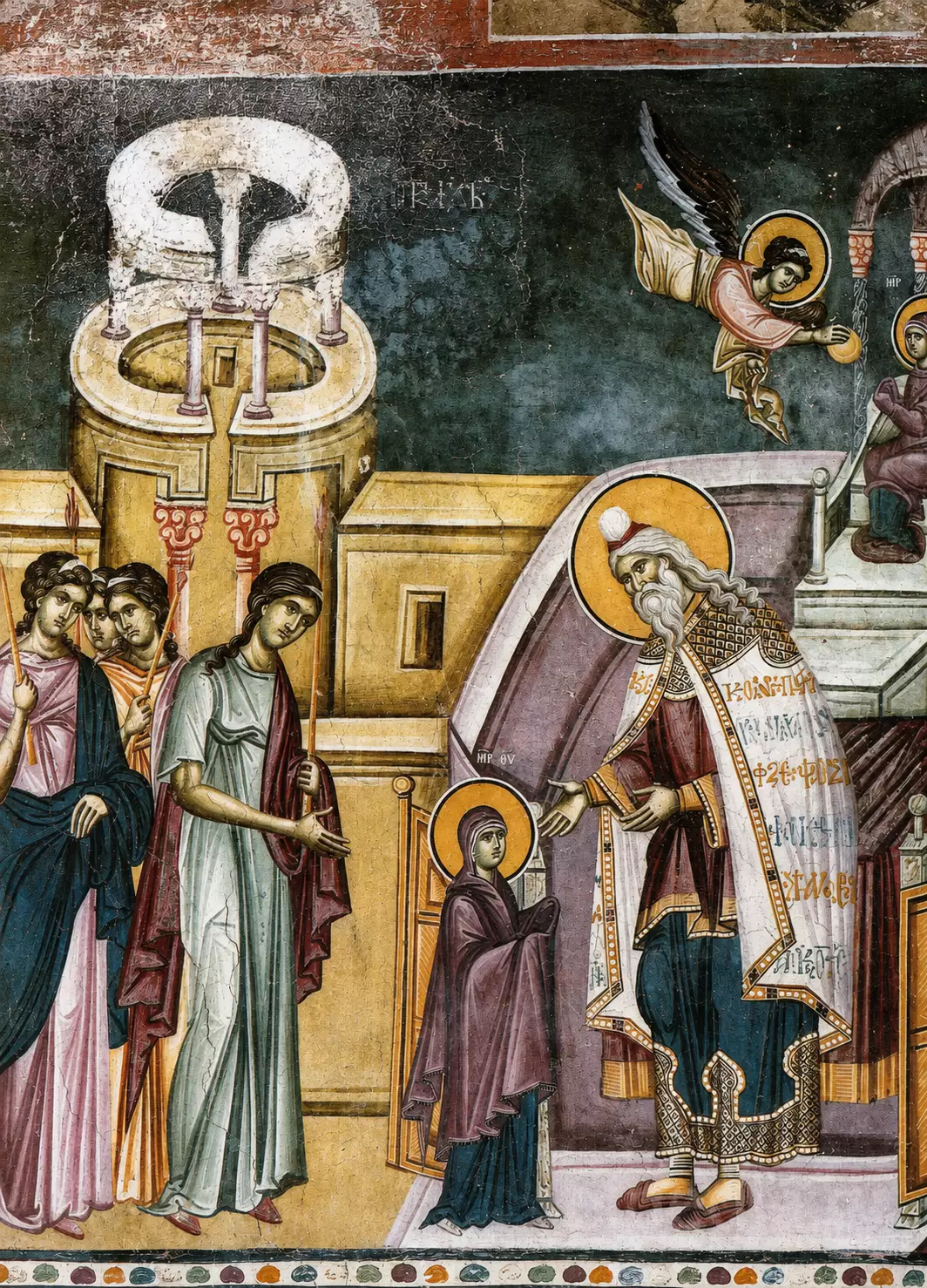
The Entry of the Virgin into the Temple, painted around 1313–1314 by Michael Astrapas and Eutychios in the King’s Church at Studenica Monastery, belongs to one of the most accomplished surviving programmes of Palaiologan monumental painting. The small church, dedicated to Saints Joachim and Anne, was founded by the Serbian king Stefan Uroš II Milutin in 1314 and decorated soon afterwards by the two painters from Thessaloniki. Its dedication gave particular relevance to an extensive cycle devoted to the childhood and life of the Virgin. UNESCO identifies this cycle among the leading achievements of Byzantine art and regards the paintings of the King’s Church as a mature expression of the artists’ style.
Studenica itself had a considerably older history. Founded in the late twelfth century by Stefan Nemanja, it had already become a major dynastic and ecclesiastical centre long before Milutin added his comparatively modest chapel; the monastery’s earlier historical context has been examined in relation to Nemanja’s rule and his connections with Constantinople. Into this established monastic environment Milutin introduced an artistic language closely connected with Thessaloniki and the wider Palaiologan world. Michael and Eutychios had worked on several royal commissions, and the Studenica paintings belong to the later, highly refined phase of their activity. The monastery itself records that these wall paintings have retained their original appearance without later overpainting.
The subject comes principally from the Protoevangelium of James. Joachim and Anne, having dedicated their daughter to God, bring the young Mary to the Temple; the priest receives her, while a related episode recounts her life within the sacred precinct and her miraculous nourishment by an angel. Byzantine painters frequently compressed these consecutive moments into the same pictorial field. The terminology is equally specific: both “Presentation of the Virgin” and “Entry of the Virgin into the Temple” are established art-historical designations for the subject.
The Entry of the Virgin: figures, gesture and sacred architecture
Across the lower part of the composition the story advances from left to right. A closely gathered group of female figures approaches from the left, their bodies overlapping so that individual movement becomes a measured procession. Their garments vary in pale rose, blue-green, violet and darker tones, while the heads, turned toward the centre, establish a succession of glances directed toward the child. One taller woman immediately before the group extends an arm toward Mary. The gesture does not propel the child forward with any obvious force; it establishes the direction of the narrative and, at the same time, preserves a narrow interval around her small figure.
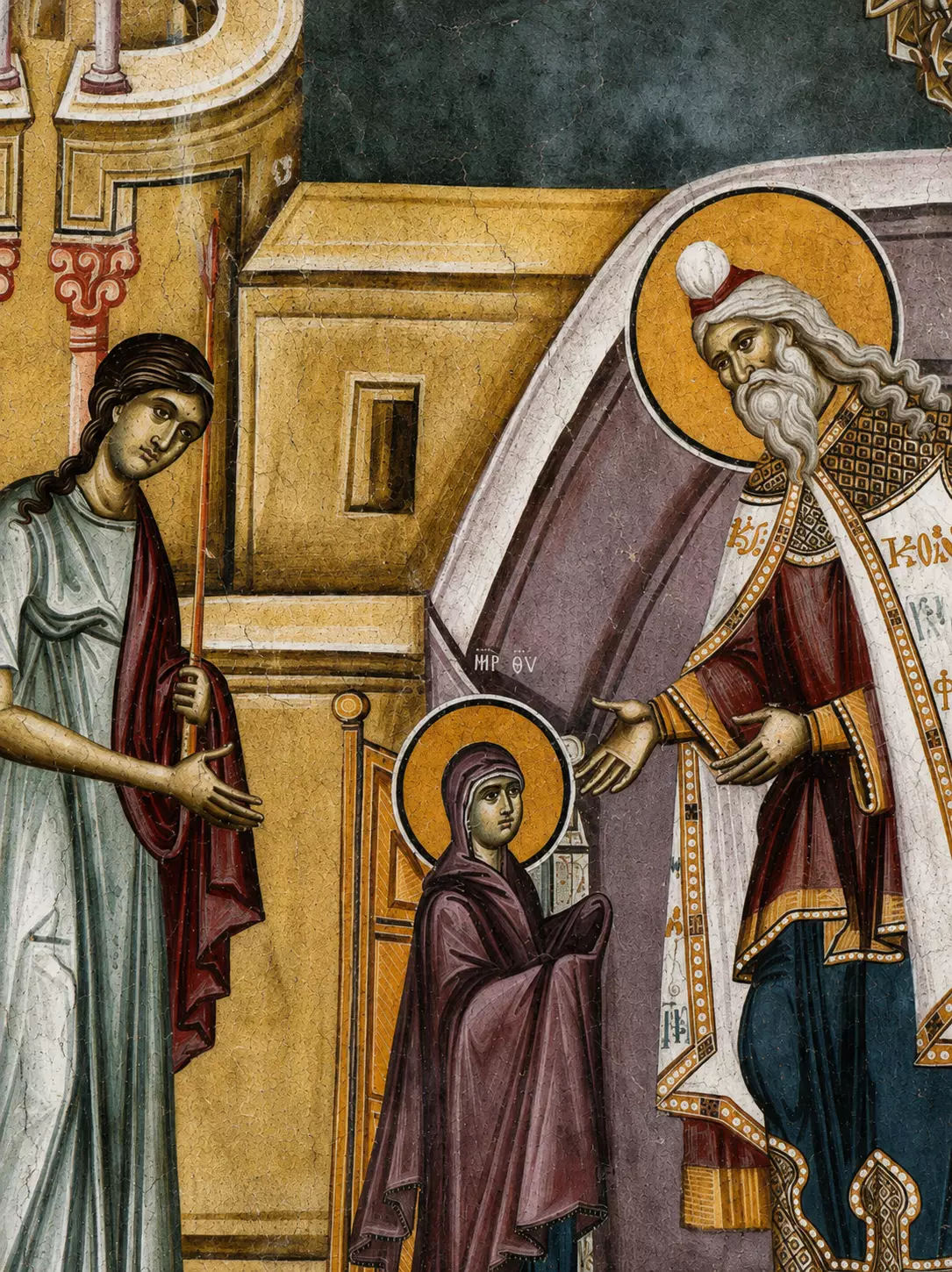
Mary occupies that interval. She is conspicuously smaller than the adults around her, yet neither her scale nor her youth reduces her visual importance. Wrapped in a dark purple maphorion over a blue-green garment, she stands almost erect beneath a broad golden halo. Beside her head appears the abbreviated title ΜΡ ΘΥ, the conventional Greek contraction for Mother of God. The inscription therefore identifies the child through the status she will possess in the Christian narrative, allowing future and present to coexist within the image. Such temporal compression is characteristic of Byzantine sacred representation: the child approaching the Temple is already designated by the title attached to the adult Theotokos.
Opposite her, Zechariah bends slightly from the waist. His long white hair, curling beard and strongly articulated facial features give the priest the appearance of advanced age, while his large halo separates the profile from the purple architectural mass behind him. His vestment, predominantly white and edged with richly patterned bands, is covered by painted letter-like forms and ornamental markings. The artists devote considerable attention to the surface. White, red, ochre, black, small geometric units—the garment almost becomes an independent decorative field before the eye returns to the hands.
Those hands provide the compositional hinge. Zechariah extends both toward the child, palms open, and the woman opposite answers him with another outward movement. Between the two adult gestures stands Mary, physically diminutive but placed at the point toward which the neighbouring arms, faces and directional lines converge. The arrangement is quiet. There is no violent motion and very little theatrical display; instead, the artists allow small changes of posture to carry the narrative. In the enlarged detail, this restraint becomes especially clear: Zechariah’s head inclines, Mary looks upward, and the accompanying woman lowers her face toward the child, three different scales of figure meeting in three directions of attention within a single encounter.
Behind them rises an elaborate architectural setting that does considerably more than identify the Temple. Ochre walls, narrow openings, columns and a circular structure at the left establish a constructed urban interior, while the large sloping violet form behind Zechariah creates an emphatic diagonal through the otherwise predominantly vertical composition. Nowhere do the buildings attempt a consistent reconstruction of Jerusalem. They articulate pictorial space—shallow, layered, deliberately discontinuous—and mark successive zones through which the story can unfold.
At the upper right the sequence changes time. Mary appears again, now seated beneath an architectural frame, while an angel approaches from the left across the dark background. This is the episode of the Virgin nourished in the Temple, an event that was regularly paired with her Presentation in Byzantine cycles of her childhood. Comparable iconographic traditions combine the reception of Mary by Zechariah with her subsequent nourishment by an angel, allowing two stages of the story to be read almost simultaneously. The second Mary is separated spatially from the procession below, but not compositionally: the diagonal structure directs the eye upward, transforming the wall into a sequence of connected storytelling spaces.
Colour reinforces these distinctions. The warm ochres of the buildings contrast with the deep blue-green field above and with the large violet plane beside Zechariah. Against them, halos form compact discs of yellow-gold, while pale garments carry narrow highlights over darker modelling. Faces possess a degree of volume unusual in more severely linear Byzantine modes: the cheeks swell gently, shadows gather beside the nose and under the eyes, and highlights define forehead, brow and cheekbone without dissolving the contour. UNESCO specifically notes the density of the forms, volumetric treatment of the faces, bright highlights and work executed a secco in the King’s Church. This documented technical evidence permits greater precision than the indiscriminate use of “fresco” for every painted wall surface, a distinction fundamental to professional art-historical terminology.
The refinement is especially evident in the drapery. Long folds run down the pale garment of the woman beside Mary, broken by shorter angular accents around the arms and waist; Zechariah’s clothing, heavier and more ceremonial, is divided by patterned borders and broad areas of white. Mary’s own clothing has fewer internal divisions, and her silhouette consequently remains compact, almost iconic, against the far more elaborate surfaces surrounding her, even as scale, colour and line each move in a slightly different register around her stillness.
The Legacy of the Entry of the Virgin at Studenica
This control, which shapes every register of the composition, is characteristic of the King’s Church as a whole. Milutin’s commission brought artists trained in the Thessalonian artistic milieu into a Serbian royal foundation, one instance of the extensive movement of artists, iconographic models and stylistic forms across the Balkans during the Palaiologan period. UNESCO records Michael and Eutychios as the Salonican masters responsible for the programme and singles out their Cycle of the Life of the Virgin for particular distinction. The result stands apart from a provincial reduction of metropolitan forms, and equally apart from a mere exercise in architectural illusion: the scene is densely populated, the buildings improbable yet carefully ordered, the figures elongated without losing corporeality.
Most revealing remains the child at the centre. Around her the adults lean, extend their hands, form a procession; above, another moment of her story has already begun. Mary herself scarcely moves. Small against the buildings, enclosed by the gestures of those who receive and accompany her, she supplies the still point from which the entire composition takes its rhythm.
(The translation was edited by F. Kalimeris.)