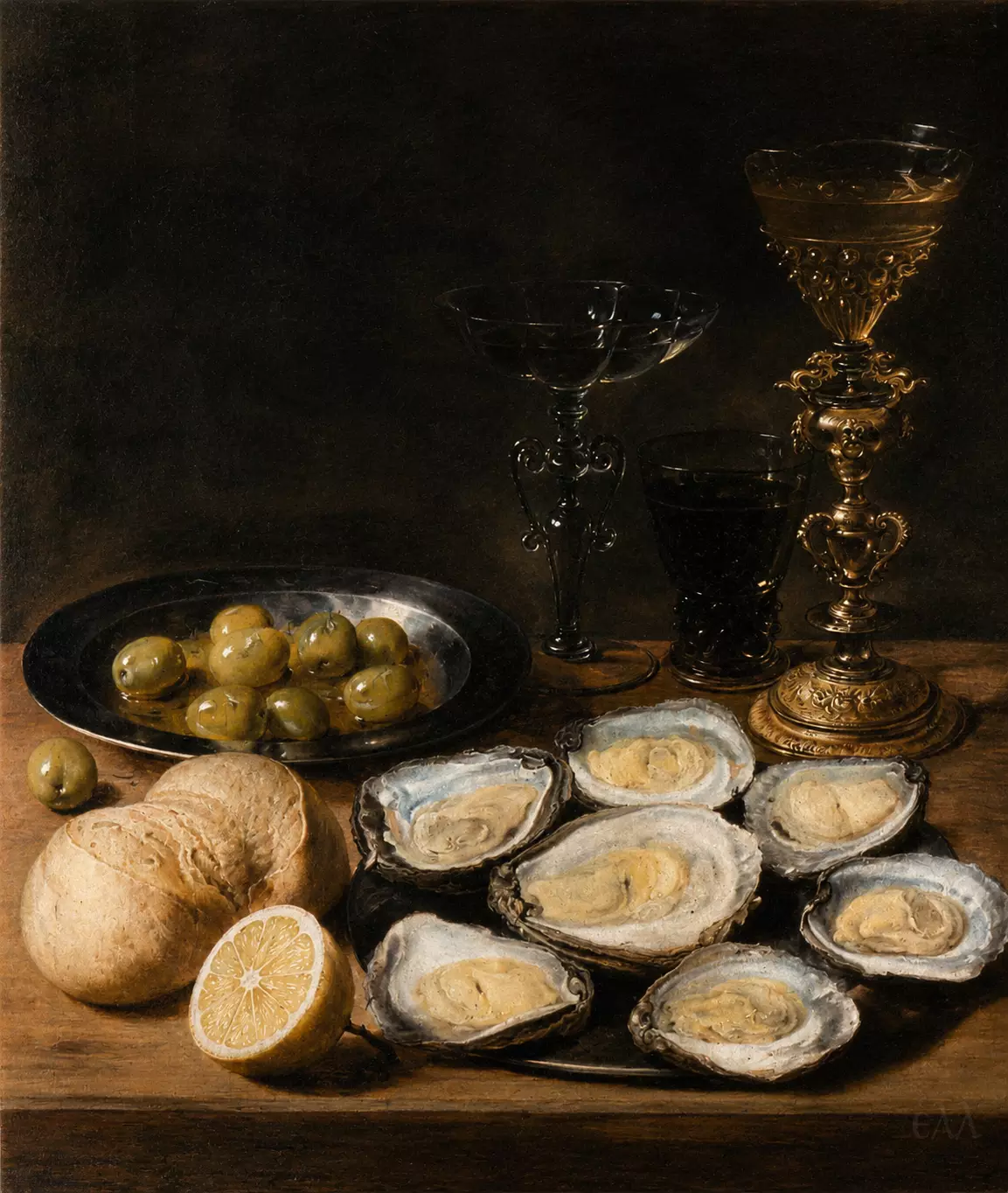
A compact table carries almost the entire visual weight of Alexander Adriaenssen’s Still-Life with Oysters, painted in the 1630s and now in the Národní Galerie, Prague. The oil painting, executed on an oak panel measuring only 44 × 36 cm, belongs to the intimate scale of seventeenth-century cabinet painting, yet its small dimensions do little to diminish the physical presence of the objects. Oysters opened in their rough shells occupy the foreground. Beside them lie a loaf of bread and a halved lemon; farther back, a shallow dish contains green olives, while drinking vessels and an elaborate metal cup rise against a background so dark that portions of their contours almost disappear.
The first impression is one of restraint. Adriaenssen limits the chromatic range to browns, ochres, subdued greens, grey-whites and brief metallic glints. Light is concentrated low in the composition, touching food, shell, bread and polished surfaces before weakening rapidly towards the upper part of the panel. Nothing is dramatically isolated. Instead, each material catches illumination differently: the oyster flesh is moist and softly modelled, the shells irregular and chalky, the bread dry and porous, the lemon dense and pale beneath its cut rind, so that a modest meal turns gradually into an exercise in looking.
Still-Life with Oysters and the Antwerp Table
Across the lower half of Still-Life with Oysters, objects accumulate without producing confusion. Their positions are carefully staggered. The bread occupies a substantial mass at the lower left, its rounded form partly balanced by the dark elliptical dish behind it. A lemon half, turned outward so that its segmented interior is fully exposed, interrupts the browns with a sharper note of yellow. The oysters then spread laterally across the foreground and centre, their open shells overlapping one another and establishing an irregular sequence of pale forms.
This arrangement is dense, but the density is controlled. Adriaenssen does not depend on rigid symmetry; instead, visual equilibrium grows from unequal groupings: bread and olives to one side, oysters expanding across the centre, taller vessels forming a vertical counterweight behind them. The tabletop provides the horizontal base. Above it, space becomes progressively less tangible.
The oysters are especially important to the handling of light. Their concave shells create small enclosed spaces within the larger pictorial field, each one producing its own alternation of shadow, grey rim and creamy interior. Some edges appear sharply described, others soften as they approach neighbouring forms. The effect is cumulative. Shell after shell catches enough light to remain distinguishable, yet none possesses the hard contour that would separate it completely from the group, as repetition itself is turned by the painter into a source of variety.
Behind them, the drinking vessels introduce a second, darker register of material. Glass is not described through continuous outlines so much as through isolated reflections. A highlight, a narrow gleam, the suggestion of a rim: these fragments allow transparent or darkened forms to emerge briefly from the background. The tall ornamental vessel at the right operates differently. Its silhouette is more elaborate, and reflected light picks out the projecting details of its stem, handles and ornamented body. Against the near-black field these minute accents have unusual force.
Light, Surface and a Restrained Palette
The darkness surrounding the upper vessels is not empty space. It is an active component of the composition. Broad passages of brown-black suppress secondary information, allowing Adriaenssen to move the viewer’s attention downwards and forwards. From this depth emerge small points of reflected light. The eye must adjust, search, return.
Such tonal concentration brings the Prague panel visually close to the restrained still-life painting developed in the northern Netherlands during the same decades. The painting has indeed been associated stylistically with both Flemish and Dutch seventeenth-century practice, and its subdued palette has been compared with that of painters working in Haarlem around 1630. The comparison is particularly suggestive in the limited colour range, the low tabletop and the preference for subdued illumination over the expansive abundance found in many larger Antwerp still lifes.
Yet Adriaenssen’s concern with physical substance remains pronounced. The bread is bulky. Oyster shells project forward through overlapping edges. The metalwork possesses weight even when much of it is concealed by shadow. What gives the panel life is not colouristic splendour but differentiation: dull beside reflective, porous beside smooth, opaque beside translucent, edible flesh enclosed by mineral shell.
The lemon contributes another kind of pictorial interruption. Cut fruit had obvious value to a still-life painter because its exterior and interior offered different surfaces simultaneously. Adriaenssen turns the exposed face almost directly toward the viewer. Its radial structure is visible, although rendered without microscopic insistence, and its position close to the lower edge makes it appear unusually accessible. Nearby, the coarse surface of the bread carries the opposite character: one form seems moist and sharp, the other dry, soft, irregular, and across a few centimetres of painted oak the artist moves through an extensive tactile vocabulary.
Alexander Adriaenssen and Seventeenth-Century Still-Life Painting
Adriaenssen spent his career in Antwerp, the city of his birth in 1587 and his death in 1661. He had entered the Antwerp Guild of St Luke as a master by 1610–11, and documentary evidence places his still lifes in local collections from at least the 1630s. His range extended beyond oysters and fish to fruit, birds, flowers and game; the Rijksmuseum describes him as one of the most productive specialists in fish still life active in seventeenth-century Antwerp. His work also circulated among significant collectors. Peter Paul Rubens owned two still lifes by him, while works attributed to Adriaenssen entered major Spanish collections during the artist’s lifetime.
That context matters for the Prague painting. Still life in Antwerp had already become an independent field of considerable sophistication, capable of moving between abundance and austerity, luxury and ordinary provisions, elaborate display and the close scrutiny of a few objects. Adriaenssen could work on a far larger scale and fill a composition with fish, game or other produce. In this panel he chooses compression. Much is gathered into a small surface, but almost everything remains within reach of an imagined diner.
Human figures are absent, human activity everywhere implied. Oysters have been opened. Bread has been cut or broken. The lemon has been halved. Drinking vessels have been placed on the table. The scene therefore records a pause within an action whose participants have disappeared. This suspended quality is fundamental to the picture’s stillness. Nothing moves, although numerous objects bear evidence of recent handling.
It would be tempting to convert every item into a fixed symbol. Seventeenth-century food still lifes can certainly support associations with appetite, luxury, sensual pleasure, temperance or transience, and oysters in particular accumulated a long history of cultural meanings. The Prague composition, however, does not require a single allegorical programme to become intelligible. Its strongest argument remains visual: food is perishable, polished vessels preserve fleeting reflections, opened shells expose forms that will quickly alter, and time enters the picture through this physical condition rather than through any overt symbol.
The oak panel itself encourages this concentration. Its relatively small surface suits precise transitions of tone, particularly around the rims of shells and the intermittent reflections on glass and metal. Adriaenssen’s modelling remains economical. He does not attempt to describe every irregularity with equal insistence. Certain forms are sharply exposed to light, others allowed to sink into the surrounding darkness. The upper background is especially sparse, leaving a considerable area with little descriptive incident, so that abundance below gives way gradually to silence above.
One of the painting’s most effective passages lies at precisely that meeting point. The dark vessels behind the oysters are recognisable only in fragments, while the food before them remains materially explicit. Depth is produced without an elaborate architectural interior. Light performs the separation. A bright edge advances, a darkened contour recedes, reflected points briefly recover an otherwise hidden form.
Through these small adjustments Adriaenssen makes an ordinary tabletop unusually demanding to look at. The oysters provide the title and the primary visual motif, but the painting is equally concerned with relationships among substances and surfaces. Shell, citrus flesh, bread crust, olive skin, glass, metal, wood: each occupies the same restricted field, each responds differently to the same subdued illumination, leaving a still life of remarkable concentration, quiet in scale, dark in atmosphere, and materially exact.
(The translation was edited by F. Kalimeris.)