
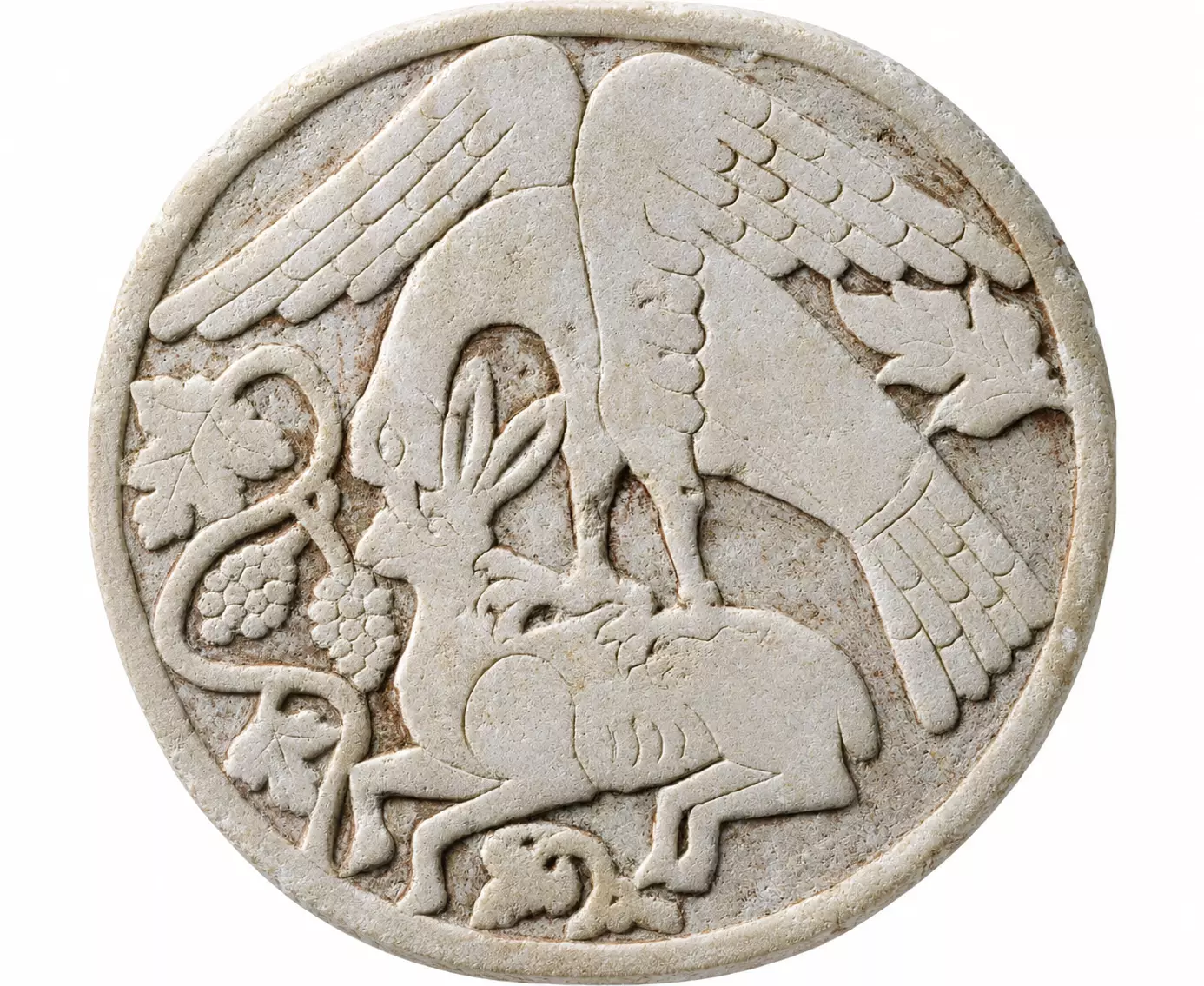
The Hagia Sophia Trebizond omphalion is a thirteenth-century marble floor panel from the church of Hagia Sophia at Trebizond, the Black Sea capital of the Empire of Trebizond. Dated to the period 1238–1263, during the reign of Manuel I Grand Komnenos, the circular slab presents an eagle overpowering a hare amid a vine. The work is now preserved in the Museum of Byzantine Culture in Thessaloniki, where it is exhibited among objects of the Late Byzantine period. It reached Thessaloniki in 1924 with Greek refugees from the Black Sea region.
Within the broad raised border, the eagle occupies almost the entire field. Its wings open upward in a wide arc, following the curvature of the roundel and giving the design an immediate sense of expansion. The head turns sharply in profile; the hooked beak descends toward the prey, while the talons press upon the hare stretched horizontally below. At the left, a vine curls into the remaining space, carrying compact bunches of grapes and broad leaves. Figure, animal and plant ornament are compressed into a single, tightly organised surface.
Hagia Sophia Trebizond Omphalion: Relief Technique and Eagle Motif
The carving is executed in low relief, with shallowly raised forms separated by incised and recessed areas. These hollows were enhanced with a red wax-and-gum filling, a champlevé treatment that would originally have sharpened the contrast between the pale marble and the coloured recesses. The surviving relief relies strongly on contour. Feathers are reduced to repeated, overlapping units; the eagle’s legs and claws to angular linear shapes; the hare to broad, economical cuts. Shallow modelling keeps the surface decorative and legible from above, an appropriate quality for a floor element.
Especially important to the design is the circular format, within which the tips of the wings nearly meet the upper border, while the eagle’s tail and the hare fill the lower zone. At the side, the vine acts almost as a counterweight, its curving stem softening the hard diagonals of beak, legs and feathers. The grapes also locate the combat within a cultivated landscape rather than an empty ornamental field.
Eagle imagery appears elsewhere in the sculptural decoration of Hagia Sophia at Trebizond, including other representations involving animal combat. The repetition suggests that the bird formed part of a broader visual vocabulary associated with the monument and with the Grand Komnenian court. In the omphalion, the immediate effect comes from the compact physical drama of predator and prey, framed by the ordered rhythm of the vine.
Removed from its original pavement and carried across the Black Sea after the population movements of the early twentieth century, the slab acquired a second historical setting in Thessaloniki. Its present museum context preserves both its thirteenth-century origin in Trebizond and its modern provenance, connected with the refugee communities that transported it to Greece.
(The translation was edited by E. Wilson.)