
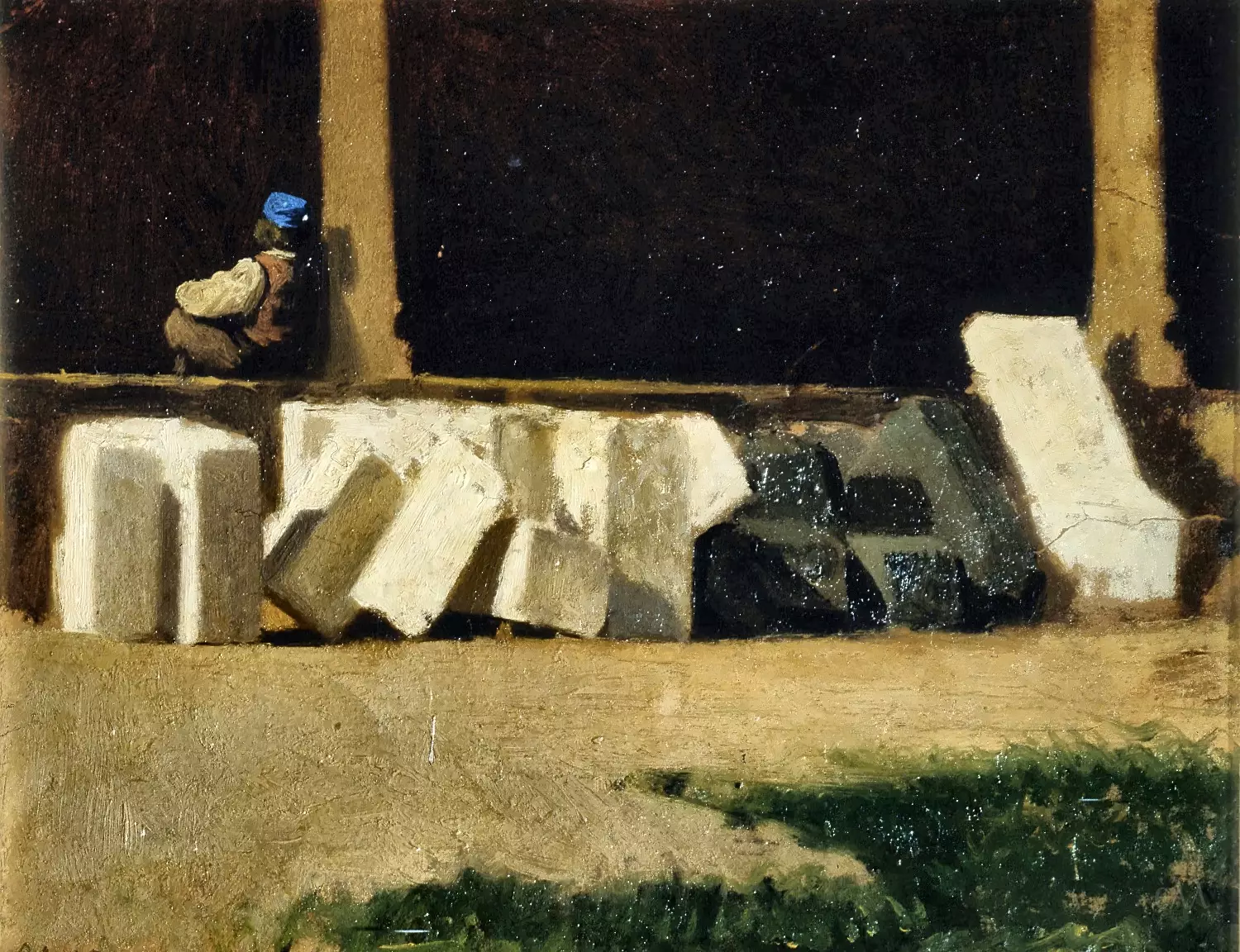
Giuseppe Abbati’s The Cloister of Santa Croce (1861–1862) reduces a building site in one of Florence’s most famous religious complexes to a compact study of light, mass, and spatial order. Measuring 19.3 × 25.2 cm and preserved in the Gallery of Modern Art at Pitti Palace, the small oil painting belongs to the period in which Abbati was closely engaged with the experimental language of the Macchiaioli. The Uffizi identifies the support as cardboard and records the work among the paintings associated with the nineteenth-century works carried out around Santa Croce.
Across the foreground lies an irregular sequence of pale stone blocks, some upright, others tilted, their sharply differentiated faces catching varying degrees of light. Behind them, the cloister architecture is almost swallowed by shadow. A row of vertical supports divides the darkness into broad intervals, and at the upper left a small figure, wearing a vivid blue head covering, introduces the only emphatic note of colour within the otherwise restrained chromatic range.
Large areas Abbati leaves visually spare. Sand-coloured ground, black recesses, cream-white marble, muted brown masonry, a narrow patch of green: the entire painting is built from comparatively few tonal masses.
The subject offered Abbati an unusually direct encounter with the problems that concerned the Macchiaioli: how solid forms become visible through relationships of light and dark, and how a scene can be constructed through broad tonal divisions and concentrated observation. According to the Uffizi, Diego Martelli later recalled that Abbati worked seriously in the cloisters of Santa Croce in 1861, when large slabs of differently coloured marble had accumulated during restoration work. Their clear volumes and strong contrasts of colour and chiaroscuro provided an ideal field for study.
In the painting, those masses occupy almost the entire middle register. Their arrangement appears casual enough to retain the character of a working site, yet pictorially they form a sequence of wedges, rectangles, oblique planes, and broken intervals. One stone leans diagonally against another; nearby forms overlap; farther right, darker blocks gather into a compact mass before the sudden rise of a large pale slab. Across this uneven procession, light functions as a structural agent: it separates planes, flattens some surfaces, thickens others through shadow, and gives each block a distinct visual weight.
The handling is correspondingly broad. Contours are frequently established by adjacent tonal areas instead of continuous drawn outlines. On the white stones, thicker strokes and small irregular touches keep the surfaces from becoming blank geometries; their material presence remains rough, sun-struck, slightly granular. The surrounding darkness is equally active, since black is inflected with olive, brown, and deep green, while the shadowed architecture acquires enough internal modulation to preserve the recession behind the brighter forms.
Geometry, Perspective, and the Weight of Empty Space
Especially striking is the distribution of empty space. The foreground occupies a broad horizontal band with very little incident, while the upper half opens into a nearly black recess punctuated by vertical architectural supports. Between the two, the marble forms create an intermediate zone of compression. Abbati therefore builds depth through large, plainly separated bands — ground, stones, architectural shadow. The Uffizi relates this clear spatial construction to the Macchiaioli’s study of fifteenth-century Tuscan perspective, an interest that could coexist with their insistence on direct observation.
At small scale, the effect is unusually monumental. The blocks have the blunt presence of architecture before architecture, raw material awaiting incorporation into a finished façade. Their identity remains that of contemporary building materials, piled for current works in a changing Florence. The temporary arrangement itself becomes the subject: large stone masses interrupted by gaps, leaning planes, passages of shadow, and exposed surfaces altered continually by sunlight.
This sense of contingency the small human figure strengthens. Set high at the left and partly absorbed by the dark arcade, the person is subordinate to the marble and architecture. The blue head covering catches the eye immediately, but the body is rendered with the same economy as the rest of the scene: a few compact masses, a pale sleeve, brown clothing, a posture turned away from the open foreground. Human presence enters quietly, almost compressed into the vertical framework of the cloister.
The term macchia, initially used with the disparaging sense of a “stain” or “spot,” came to identify a method founded on simplified masses of colour and tonal contrast. The Uffizi places The Cloister of Santa Croce among the clearest demonstrations of this approach, describing the work as a concentrated investigation of sunlight, geometry, and volume.
Abbati’s contribution lies in the discipline of the arrangement. The scene proceeds with almost no narrative action: a dark cloister, a strip of earth, building materials, one worker. From these elements he creates a pictorial structure in which the eye moves from the creamy brilliance of the stones to the deep recess behind them, then outward again toward the warmer foreground. The strongest contrast occurs near the centre, where the pale masses meet the shadowed forms beyond; farther right, the large upright slab interrupts the rhythm with an abrupt, almost vertical flare of white.
Texture, too, belongs to this construction. Thick, abbreviated brushwork gives substance to the marble faces, while smaller touches break their light surfaces into minute variations. The darkest zones remain comparatively broad and dense. Between them runs the narrow horizontal line of the cloister ledge, a modest architectural element that stabilizes the whole arrangement and prevents the scattered stones from dissolving into separate incidents. Vertical piers above, horizontal ground below, diagonals concentrated among the blocks — the composition is held within a simple but firm geometry.
Preserved today in the Gallery of Modern Art at Pitti Palace, the painting is recorded under inventory numbers Gen. 175, Giorn. 41, and Com. 578; the Uffizi also notes a restoration undertaken in 2013. Along the lower edge, the ochre ground remains broad and nearly unbroken before meeting the irregular dark-green patch at the right.
(The translation was edited by A. Orfanos.)