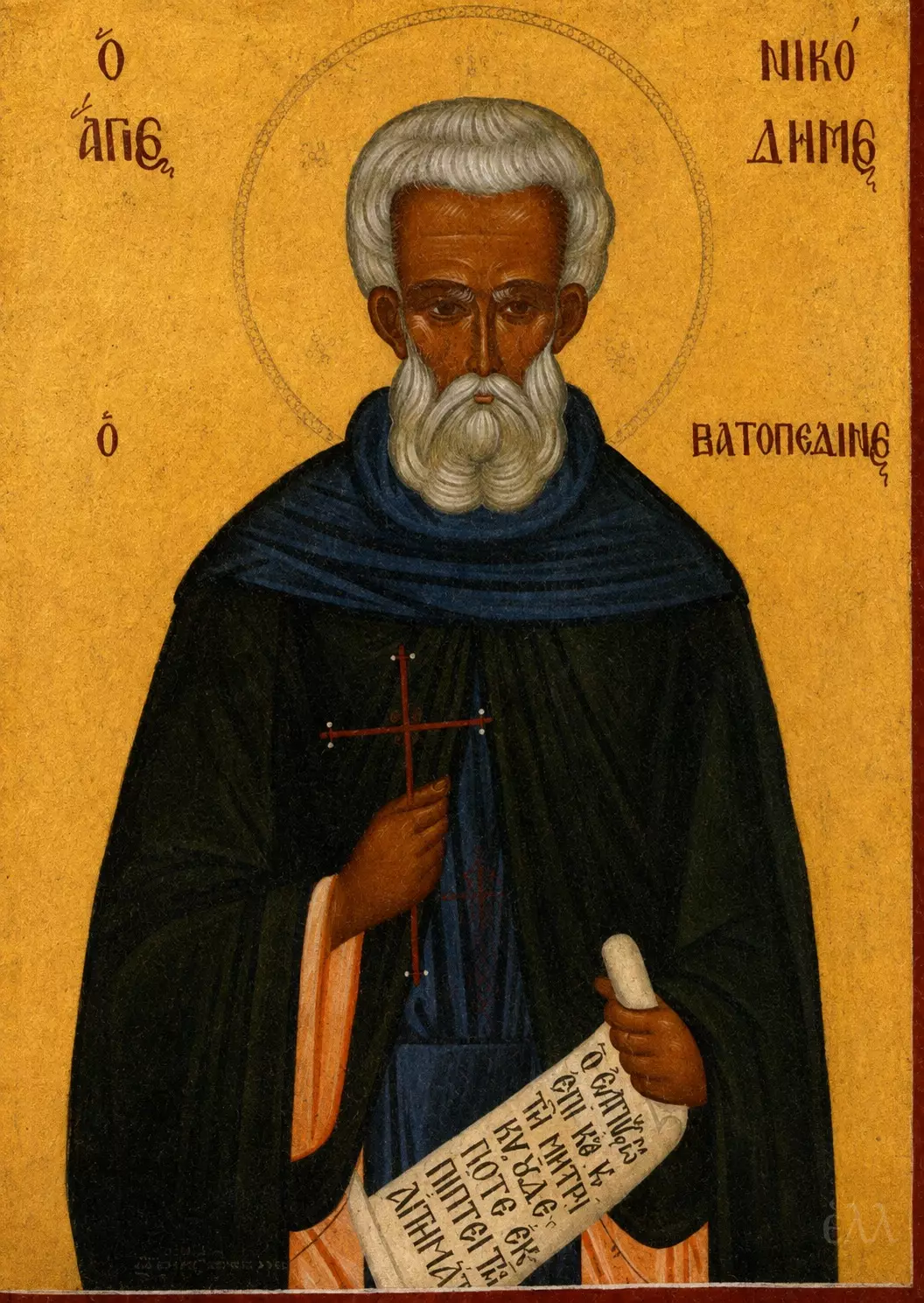
In the years preceding 1322, at the foothills of Athos, near the Vatopedi Monastery, there lived a hermit whom Patriarch Philotheos Kokkinos referred to as a remarkable man in both action and contemplation. Saint Nicodemus the Hesychast began his monastic life much farther away, on the mountain of Auxentios near Chalcedon. Only later, forced by invasions that devastated that region, did he seek refuge on Athos. There he was discovered by Gregory Palamas, struck by his way of life, and became his disciple for three years filled with fasting, vigil, and unceasing prayer. From his teacher’s hands, he received the great schema of the monks. The icon we present here does not originate from that time but is a contemporary portable work from the Holy Monastery of Vatopedi, crafted with respect for the Byzantine technique that defined centuries of iconography at Mount Athos. The painter remains anonymous, as is often the case in the contemporary Athonite tradition, where the work serves the sanctity of the figure, leaving the creator in obscurity. At the top, two inscriptions identify the figure: “SAINT NICODEMUS” and “THE VATOPEDIAN,” indicating the close association of the saint with the monastery that hosted him in the latter years of his life.
The Figure of the Hesychast and the Language of Byzantine Art
In the composition, the aged face prevails, characterized by deep wrinkles on the forehead and around the eyes—marks that the iconographic tradition attributes to those who have spent decades in ascetic practice. Thick white hair falls heavily on the shoulders, while the long beard drops into two distinct points, a detail echoed in many depictions of elders in Byzantine and post-Byzantine iconography. The gaze does not seek out the observer; it looks somewhere beyond, as if immersed in that very alertness referenced by Philotheos. He wears a dark mantle over a blue inner garment, indicative of monastic attire, devoid of unnecessary ornamentation, as simplicity here serves as a marker of ascetic life. In his right hand, he holds a red cross, a persistent symbol in the iconography of hesychasts and saints, while in his left, a scroll is unrolled with text, as typically seen in representations of teachers of mental prayer. The halo is nearly unadorned, typical of later Athonite art that eschews golden excess in favor of a more austere, almost ascetic aesthetic.
The saint’s memory is honored on July 11, a date that the Vatopedi monastery inextricably links with his name, as he spent that period which elevated him to the status of teacher to one of the greatest theologians of Byzantium.
A service in his honor was composed by Charalampos Boussias, indicating that the liturgical memory of him has not remained static over time but has continued to be enriched.
The icon, in turn, continues this tradition through a visual language recognizable since the 14th century, transcending mere archival fidelity.


