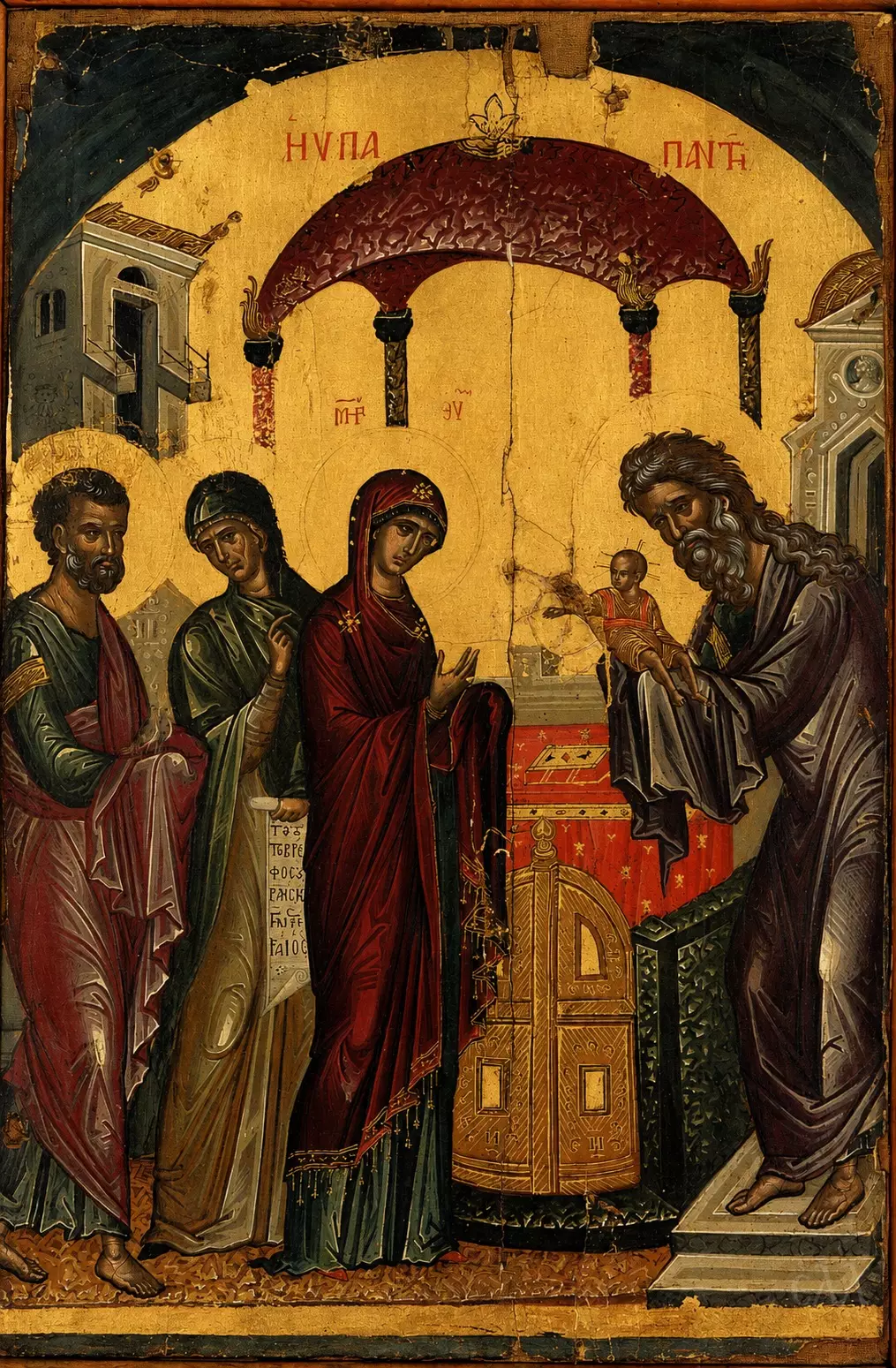
At Stavronikita Monastery on Mount Athos is preserved one of the most characteristic compositions of the Dodekaorton painted by the Cretan Theophanes Strelitzas Bathas around 1546, measuring 0.57 by 0.39 meters. It belongs to the artist’s more mature phase, when the principles of the Cretan school had already crystallized into a stable, tested system, without hesitation. Its subject is the Presentation of the Lord, the feast the Church celebrates on 2 February, forty days after Christmas, in connection with the obligation incumbent on every family in Israel to present its firstborn son in the Temple. Here the painter follows an iconographic type whose roots, according to the relevant scholarship, go back as far as the early post-Iconoclastic years; its defining feature is the placement of the infant in the hands of the elder Simeon rather than in those of his mother, a detail that in effect determines the entire composition. Against a gold ground, beneath a green arched summit, the figures are arranged with a calm that does not exclude, as will be seen, a certain inward tension.
The iconography of Theophanes Strelitzas’s Presentation of Christ in post-Byzantine art
On the right, upon a stepped base, stands Simeon, with long hair falling to his shoulders and a mantle rich in folds; he holds the child with both hands, covered by his own garment, in a gesture of handing him over to the mother who stands opposite. Christ wears a gold-and-red tunic with sleeves, with broad bands descending to the pleated girdle; he turns his head toward the Theotokos and extends his right hand, while the left, holding a scroll, rests on his knee. The bare little feet, slightly bent, give the small figure a liveliness that resists the frontality of the composition. Behind the Virgin emerges the aged prophetess Anna, pointing to the infant, with an open scroll on which the prophecy attributed to her is written; Joseph follows, holding a pair of doves, a detail that directly refers to the injunction of the Mosaic Law concerning the expiatory sacrifice. The Gospel text of Luke is here condensed into image, where every gesture functions almost as a theological comment, not merely as narration. Simeon’s reception of the infant thus becomes visible proof of the Incarnation, since the elder, according to his well-known utterance, may now face death in peace.
The figure of the Theotokos: gaze and gesture
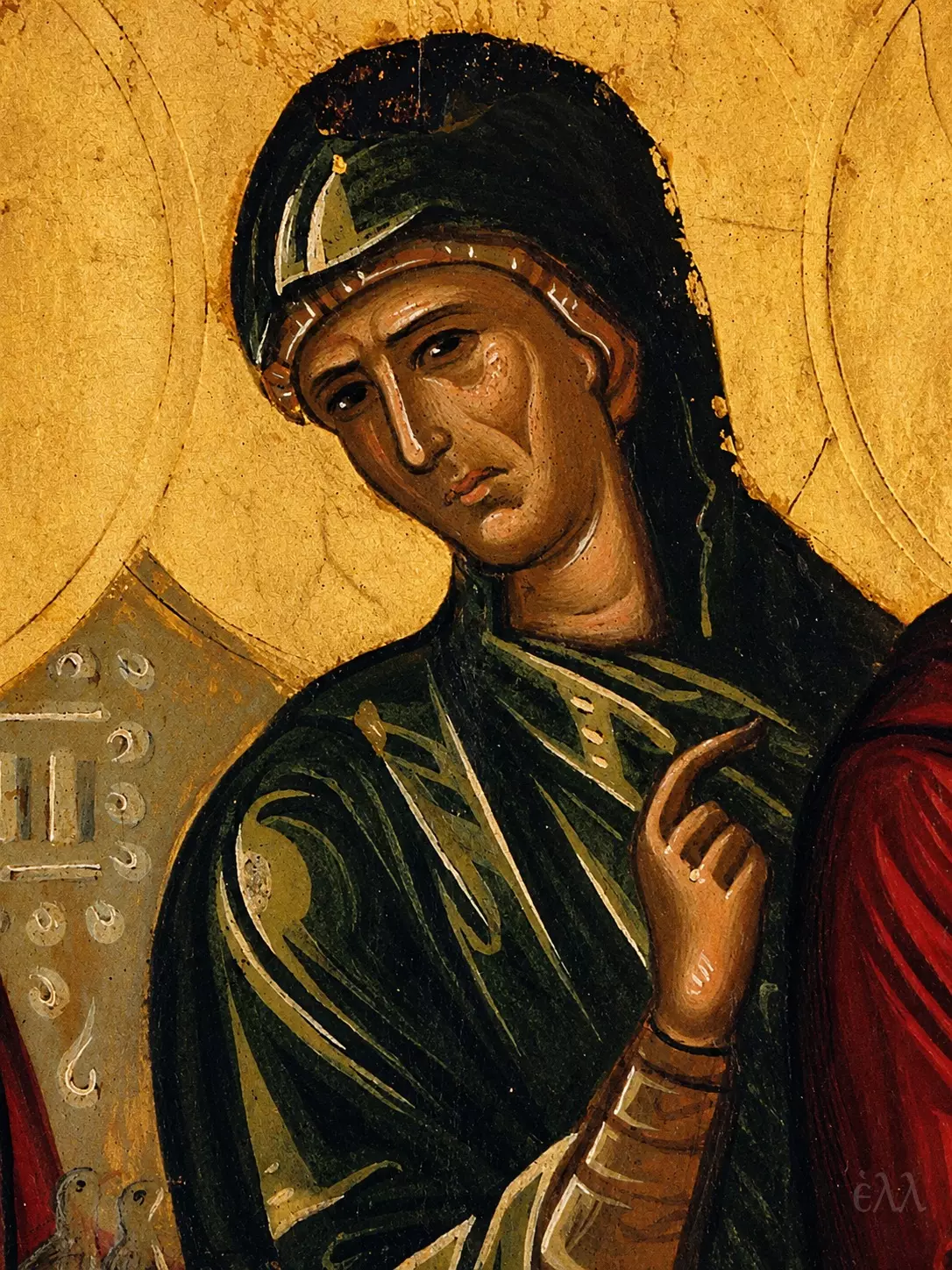
The face of the Virgin, rendered with delicate touches of light over a dark underpainting, retains something of the gravity that the figure of the Mother who knows will later acquire in art. Her gaze, turned obliquely, meets neither the child nor the viewer. The right hand, emerging only slightly from an opening in the many-folded maphorion, rises with half-open fingers in a gesture of speech rather than surprise, as if addressing Simeon or silently commenting on what is taking place before her. The gold background behind the halo leaves no room for anything incidental, and yet the tension in the face escapes the geometry of the composition. In this technique, where every line seems premeditated, Theophanes manages to leave something open, an interpretation that does not close.
This icon, included in the ensemble of the monastery’s Dodekaorton, functions not only as an object of devotion; it also constitutes a first-rate document for the formation of the Cretan pictorial language in the mid-sixteenth century, a moment when the Palaiologan legacy meets a new, more disciplined command of drawing and color.


