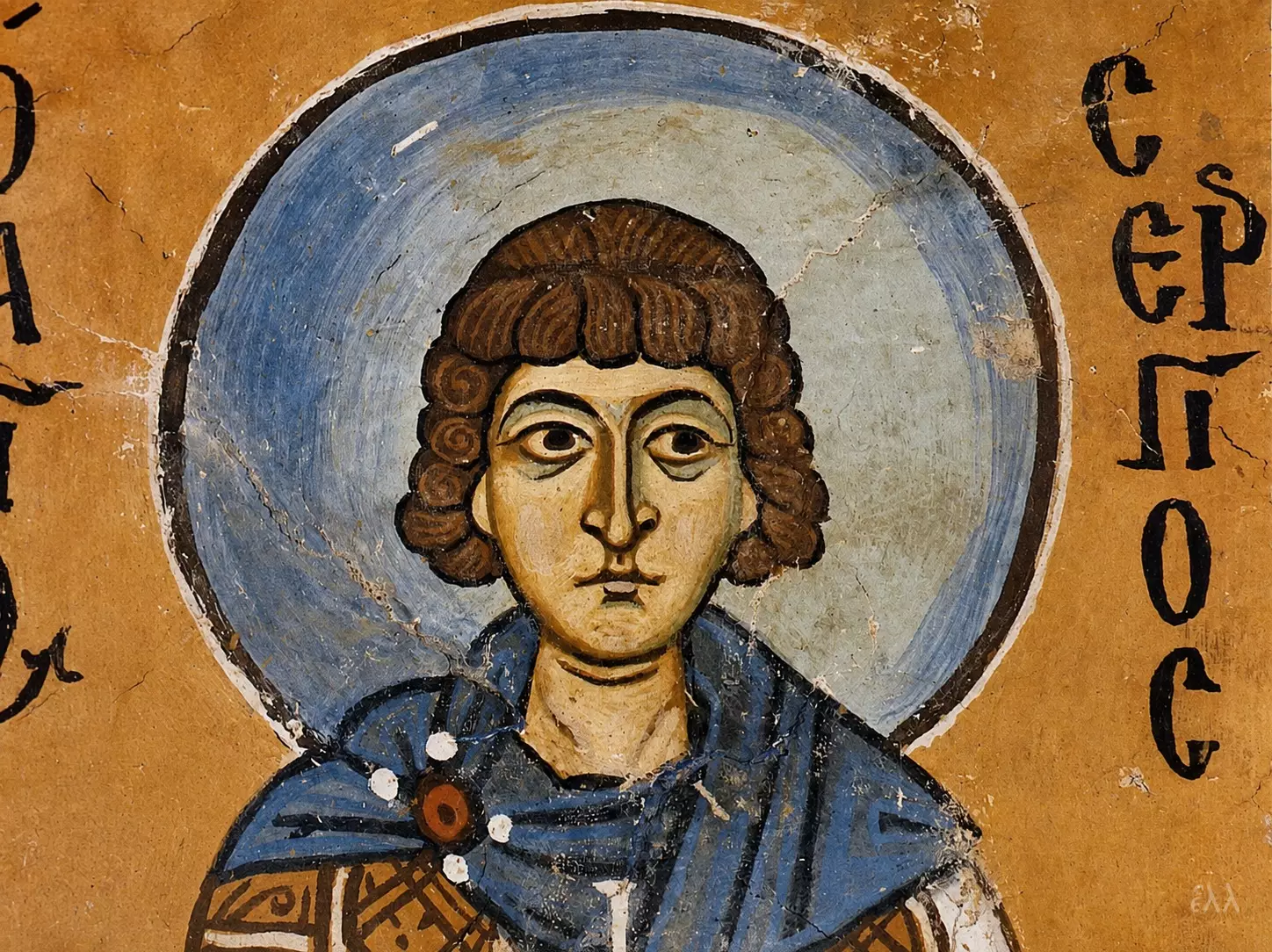
In the south-western chapel of the catholicon at the Monastery of Hosios Loukas, in Boeotia, a triad of military saints dominates the north wall, painted around the third quarter of the 11th century—a period when the monastery was already renowned as one of the wealthiest imperial monastic foundations of the empire. Sergius, Bacchus, and Nicetas, officers of the Roman army executed for their faith in the early 4th century, are depicted standing frontal within dark frames, projecting them as self-contained icons against the yellowish, golden surface of the wall. Standing out among them is Saint Sergius, senior in rank to his two companions, having served as primicerius in the imperial schola gentilium.
The choice to render him with the monumental power of a full-length icon, rather than on a smaller scale alongside other figures, reveals the importance attached by the patrons of the church to the two young martyrs, known throughout the Christian East for their close friendship and joint martyrdom. Their painterly idiom, featuring imitation revetment in the zone below the figures and luxurious decorative elements organizing the surfaces, closely follows the decorative scheme of the mosaics in the main church, reflecting an era when chapel frescoes sought to emulate the brilliance of the costlier medium.
Byzantine Fresco of Saint Sergius: Attire and Gesture
Saint Sergius wears courtly, luxurious dress borrowed from the ceremonial uniform of senior imperial officials. On the shoulders of his light-colored tunic, embroidered paragaudia in a golden hue form a diamond pattern, while a jeweled belt studded with colorful stones cinches his waist. His right hand holds a slender silver cross before his chest, the established emblem of his martyrdom. Raised beside it, his left hand shows an open palm in a gesture of prayer—a symbol of virginity and ascetic purity that accompanied the iconography of many young martyrs. A precious brooch, adorned with pearls, fastens a blue cloak over his left shoulder, its folds falling with geometric rigor over the white garment.
Facial Detail: The Art of Byzantine Portraiture
Framed in close-up, the saint’s face reveals the refined quality of Byzantine portraiture in the late 11th century. His reddish-brown, curly hair forms small coils at the temples, rendered with fine, dark lines against a lighter background. The halo—in a bluish tone with a tonal gradient shifting from a dark outline toward the center—harmonizes with the green shadows around the eyes and the soft flush on his cheeks. His serious, focused frontal gaze heightens the sense of spiritual vigilance that artists of the period sought to impart to holy figures. To the right of the figure, a vertical inscription records the saint’s name, an essential element for his identification within the group of the three martyrs.
Isolated today from the triad that originally accompanied it, this composition nonetheless preserves intact its testimony to a world of visual conventions that Middle Byzantine Greece cultivated with rare consistency, balanced between the imitation of precious mosaic work and the economy of a less costly yet equally ambitious technique.