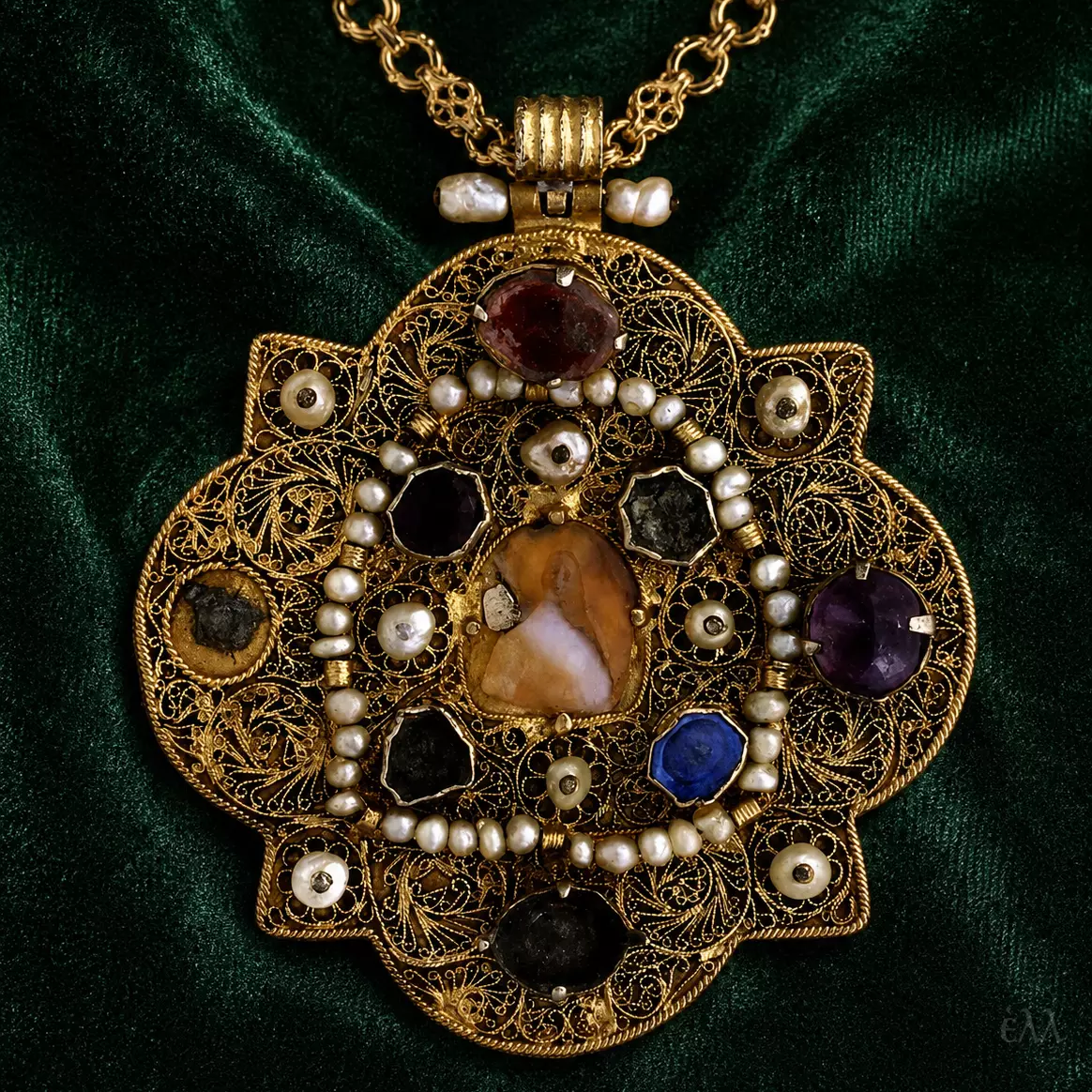
Preserved in the Holy and Great Monastery of Vatopedi on Mount Athos, the Vatopedi Christ enkolpion combines two distinct phases of medieval craftsmanship. At its centre is a twelfth-century agate cameo depicting Christ in bust form; surrounding it is an elaborate gold setting dated to the end of the fifteenth century, worked in filigree and enriched with precious stones and pearls. The documented distinction between the date of the cameo and that of its setting gives the object an unusually layered material history.
The composition develops outward from the small sacred image. Christ occupies the visual centre, enclosed first by the shaped gold border of the cameo and then by a closely arranged circle of pearls. Beyond this inner frame, larger gemstones punctuate a broad expanse of intricate gold filigree. Their irregular shapes and strongly varied colours — deep red, violet, blue, green and darker tones — introduce deliberate points of chromatic emphasis against the fine golden network. Pearls recur between these larger elements, softening the transition from one zone to another.
Vatopedi Christ Enkolpion and Its Gold Filigree Setting
Around the cameo, the goldwork is exceptionally dense. Fine wires form curling, interlaced patterns that fill much of the available surface, while the projecting sections of the outer edge create a radial silhouette. Within this compact structure, gemstone, pearl and filigree function together: concentrated ornament around a clearly established centre.
Quieter in character, the agate carving remains the focal point. Its warm brown and honey-coloured tones stand apart from the brilliant gold surrounding it, while lighter areas within the stone articulate the bust of Christ. The difference in scale is striking. A very small carved image controls an elaborate field of metalwork several times its own size, the later setting directing the eye repeatedly back toward the twelfth-century cameo.
The chronological separation of the two components is especially significant. By the late fifteenth century, the considerably earlier Byzantine cameo had been incorporated into a new and costly setting, preserving the carved image while giving it a different material frame. Gold filigree, pearls and coloured stones transformed the earlier gem into an object of greater visual complexity. The suspension element at the top remains clearly visible, confirming the pendant character of the enkolpion within the remarkable collection of Byzantine and later ecclesiastical metalwork preserved at Vatopedi.