
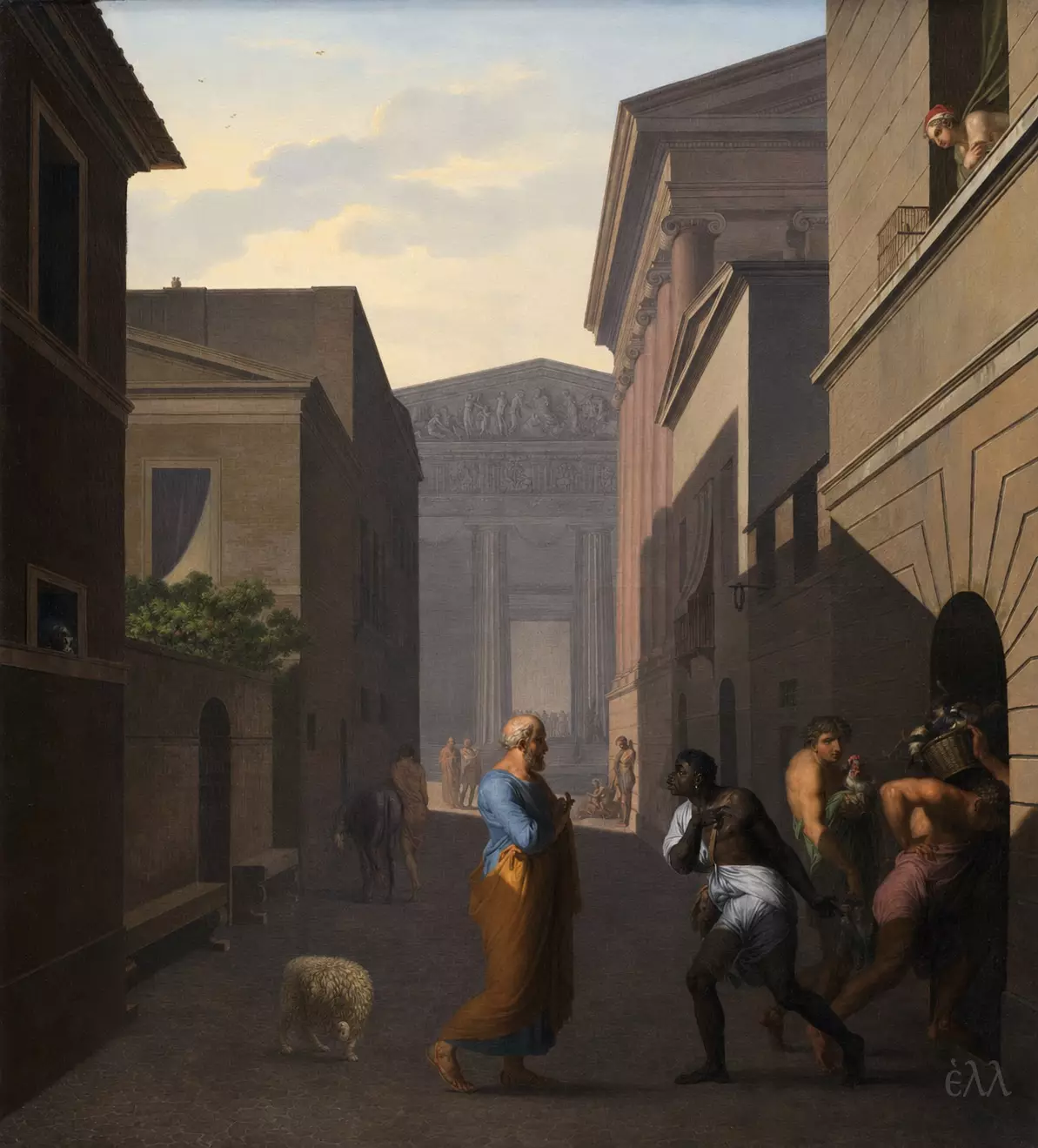
Nicolai Abildgaard’s Simo and his Former Slave Sosia, painted in 1803, transforms an episode from Terence’s ancient Roman comedy Andria into an expansive urban scene governed by architecture, light and measured theatrical gesture. The oil painting, approximately 158 × 142 cm, is preserved in the Statens Museum for Kunst in Copenhagen. It belongs to a group of four large canvases based on Andria that Abildgaard created after 1800 for the residence he shared with his second wife at the Royal Danish Academy of Fine Arts in Charlottenborg.
Surprisingly little of the pictorial field is occupied by the dramatic exchange itself. Near the centre of the street stands the elderly Simo, wrapped in a blue garment and a broad ochre-brown mantle. Facing him, Sosia bends forward with his body turned sharply and one hand raised toward his chest. Around them life continues: a sheep lowers its head in the foreground, figures gather farther along the street, and several working men occupy the deep shadow beside the building at the right. Above them, a figure leans from an opening. At the end of the receding street, monumental columns and a pedimented temple façade rise through a pale atmospheric haze.
In Terence’s Andria, Simo is troubled by the relationship between his son Pamphilus and the young woman associated with Andros. Abildgaard selects the moment in which Simo draws Sosia into the intrigue surrounding a proposed marriage, asking him to participate in the pretence that preparations for the wedding are being accelerated. The Statens Museum for Kunst identifies Sosia in Abildgaard’s interpretation as Simo’s Black cook and former slave. A climactic theatrical incident is therefore avoided by the painter. Conversation, suspicion and calculation provide the action.
Around this restrained exchange, the built fabric becomes unusually prominent.
Simo and his Former Slave Sosia: Terence Recast in Neoclassical Painting
The street narrows through a carefully constructed recession of façades, cornices, projecting walls and alternating passages of illumination and shadow. At the far end, the temple establishes a strong axial destination, its light grey surface softened by distance. Considerable spatial credibility is given to the imagined Roman setting by the perspectival construction, while the foreground buildings remain severe and almost geometrical. Along the right side especially, sunlight striking the upper masonry creates large planar shapes, followed abruptly by a deep band of shade at street level.
Into this ordered setting Abildgaard introduces small disruptions. The sheep, isolated beside Simo, lowers the visual register toward ordinary street life. Farther back, a pack animal and scattered pedestrians reduce progressively in scale. On the right, muscular semi-nude figures engaged in physical activity belong to another social and visual world from Simo’s composed, enveloping drapery. The man leaning through the upper opening adds still another level of observation. Street, household, labour and private intrigue overlap without requiring a crowded composition.
Colour reinforces the hierarchy. Against the muted browns, greys and ochres of the surrounding buildings, Simo’s blue garment forms one of the strongest chromatic accents in the painting, whereas Sosia’s white drapery catches considerably less light, emerging irregularly from the shadowed foreground. Behind them, the sky opens into delicate yellow, blue and grey tonal transitions. This gradual atmospheric lightening toward the distance gives the street depth while allowing the massive classical structures to lose some of their material weight.
An additional historical dimension is carried by the identification of Sosia. The museum relates his appearance to a medal designed by Abildgaard in connection with the Danish decree against the slave trade. It also points to a deliberate chain of associations: Sosia is a freed slave within the play, while Terence himself was traditionally understood as an African who had experienced enslavement before obtaining his freedom. Recent scholarship has revisited the same connection while drawing attention to the racialized conventions through which Black subjects were represented in Abildgaard’s period.
For Abildgaard, antiquity consequently supplied more than costumes and architectural forms.
The ancient comedy offered material through which contemporary ideas, personal circumstances and historical references could enter the supposedly Roman world. Created during the painter’s mature years, the Andria sequence also emerged after his renewed engagement with large-scale painting at the beginning of the nineteenth century.
Within Simo and his Former Slave Sosia, the Neoclassical discipline of perspective and monumental structure coexists with a distinctly intimate dramatic problem. Simo stands nearly still; Sosia’s inclined body supplies the answering movement. Behind them, the long street carries the eye toward the distant temple, while the human episode remains anchored in the shadowed foreground, among animals, workers, open windows and the ordinary activity of the city.
(The translation was edited by P. Alexiou.)