
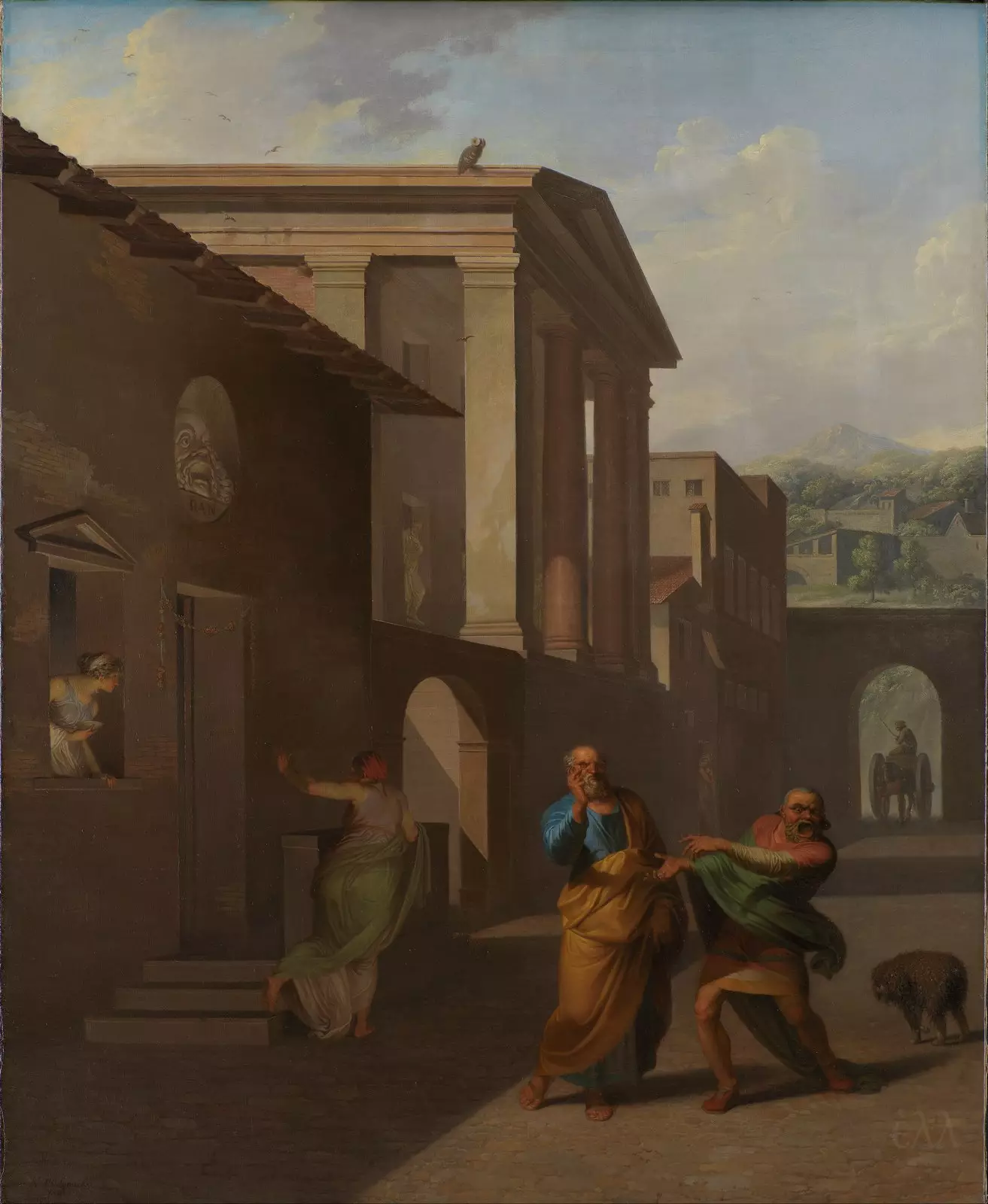
Nicolai Abildgaard‘s The Midwife Taking Leave of the Girl from Andros, painted in 1801, translates a brief episode from Terence’s ancient comedy Andria into a large, carefully staged narrative painting. Executed in oil on canvas and measuring approximately 158 × 129 cm, the work belongs to the Statens Museum for Kunst in Copenhagen. The museum identifies it as the first of four paintings based on the play, conceived for Abildgaard’s residence at the Royal Danish Academy of Fine Arts at Charlottenborg and later given as a wedding gift to his second wife, Juliane Marie.
The subject occurs during the increasingly tangled deception surrounding the pregnancy of Glycerium, the “girl from Andros.” The midwife Lesbia has attended the birth and leaves the house while Simo, already suspicious of the entire affair, interprets what he has heard as part of a scheme. Beside him stands Davus, whose involvement in the dramatic intrigue gives the exchange its comic tension. Terence’s text identifies Lesbia as the midwife and places Simo and Davus together during this episode; the museum’s Danish title likewise specifies Simo’s disbelief in the childbirth. An instant after an action has taken place is what Abildgaard selects: childbirth remains unseen, the midwife is already moving away, and the disagreement between the men turns the street into a theatrical arena.
Across the lower half of the canvas, Abildgaard distributes the figures in separated yet interdependent groups. At the centre, the elderly Simo is immediately recognisable by his grey beard, blue garment and sweeping yellow drapery. His raised hand touches the side of his face while his body turns slightly away from Davus, who approaches from the right in a short tunic and a green cloak. Davus reaches across Simo’s body, creating a sharp diagonal that interrupts the older man’s vertical stance. Their gestures appear conversational, urgent, defensive—the physical language of two characters negotiating a situation whose meaning remains unsettled.
The Midwife Taking Leave: Composition and Gesture
Toward the left, the midwife moves beside the steps and dark façade, her body turned away from the principal pair while one arm rises toward the house. A second female figure leans from an opening farther left, observing the movement below. Through glances, turns and spatial intervals Abildgaard builds the episode’s telling: individual figures occupy distinct zones, yet their actions remain tied to the same event concealed within the building.
Architecture dominates much of the composition. A massive classical portico rises above the street with square supports, columns, entablature and a strongly projecting roofline. Pale architectural surfaces catch the daylight; beneath them, the lower façades sink into broad passages of brown and near-black shadow. Against these darker masses, the figures register as concentrated accents of blue, yellow, red and green.
The setting carries a deliberate theatrical character. On the left wall appears a large mask-like relief, an appropriate visual echo of the comedy from which the subject derives. High above, an owl perches on the entablature, introducing a further classical association through a bird traditionally connected with Athena and Athens. Small elements accumulate quietly: a sculptural figure set against the architecture, birds scattered through the sky, distant buildings, a cart and driver framed within the far arch.
Architecture and Theatrical Space
Beyond the street, a pale mountainous landscape opens under an expansive blue sky. The recession is gradual. Buildings diminish along the road, the vegetation grows lighter, and the distant hills dissolve into cooler atmospheric tones, giving depth to an architectural environment whose foreground remains comparatively compressed.
Abildgaard concentrates colour around the dramatic exchange. Simo’s saturated yellow drapery forms the strongest chromatic mass in the foreground, set against the blue of his garment and the deep brown architecture. Davus combines muted red, green and earthy flesh tones, while the midwife’s green drapery catches sufficient light to detach her silhouette from the shadowed street. Above them, pale blue and softly modelled clouds create a cooler, more spacious register.
The handling is controlled, the contours clearly defined, the bodies given substantial volumetric modelling. Architectural verticals and horizontals establish stability; across them move curved bodies, extended arms, turning heads, diagonally arranged draperies. Simo and Davus form the immediate focal point, though the eye repeatedly travels leftward toward the midwife, upward along the portico, then through the distant arch and landscape.
Especially effective is the distribution of light. The bright columns and entablature rise almost independently above the darker buildings, while the figures emerge from intermediate zones of illumination. The city itself is thus made to participate in the drama: illuminated and obscured spaces, passages and openings, public street and unseen interior.
The Statens Museum for Kunst connects the four Andria canvases with a change in Abildgaard’s personal life around 1800, when his relationship with Juliane Marie encouraged a renewed engagement with themes of love. The paintings were made for the couple’s official residence at Charlottenborg. The museum also places the series within a broader network of references to Terence and notes that Abildgaard eventually incorporated himself, his wife and their child into the final painting of the sequence.
Within The Midwife Taking Leave, the literary source is carried most strongly through timing. Abildgaard chooses a moment dependent upon speech, overhearing and misinterpretation, mechanisms central to Terence’s comedy. The birth remains beyond sight. Into the pictorial field come its consequences: the midwife departing, Simo reacting with suspicion, Davus responding to him, another woman watching from the house, ordinary movement continuing farther down the street.
Such compression of storytelling suits Abildgaard’s large format. The classical architecture supplies order and scale; human gesture introduces uncertainty, humour and movement. Even the wide sky and distant road extend the action beyond the principal figures, while at street level the entire misunderstanding hangs upon something that has happened behind a closed architectural boundary.
(The translation was edited by D. Manou.)