
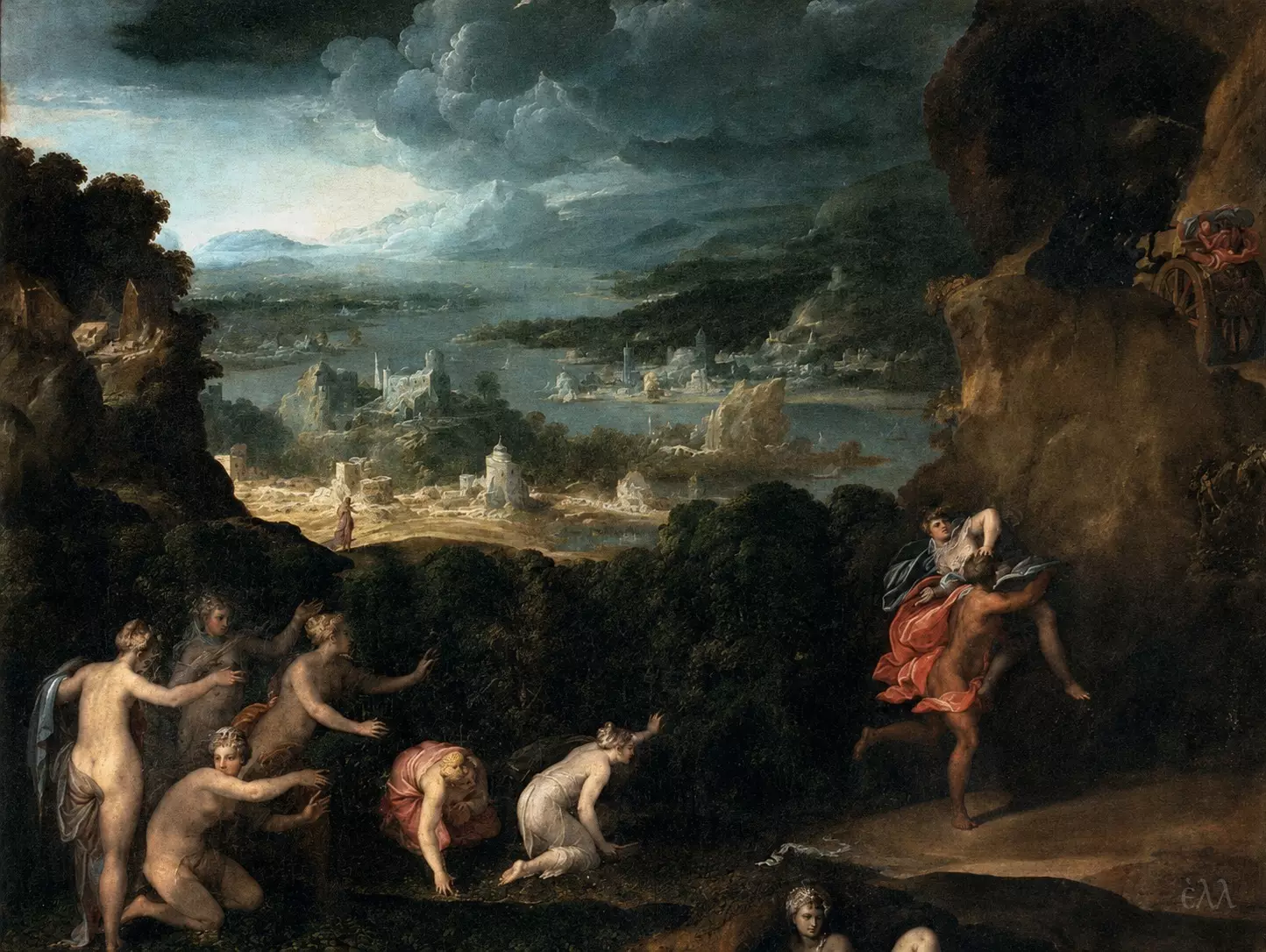
Niccolò dell’Abate‘s The Rape of Proserpine, generally dated around 1570, transforms one of the most violent episodes of classical mythology into an expansive landscape painting in which human action occupies only a fraction of the pictorial field. Executed in oil on canvas and preserved in the Musée du Louvre, the work belongs to dell’Abate’s French period, when he was active at Fontainebleau and had developed a distinctive approach to mythological subjects set within extensive natural settings. The Louvre currently dates the painting more broadly to the third quarter of the sixteenth century, 1550–1575, and records dimensions of 196 × 215 cm.
At first sight, the scenery commands attention. A broad body of water winds into a remote valley, settlements and isolated buildings marking successive stages of recession. Mountains fade toward the horizon beneath a restless sky whose heavy masses of cloud darken the upper part of the composition. Closer to the foreground, vegetation thickens into dense woodland while monumental rock formations rise abruptly around the figures. Sharply, within this setting, human scale contracts: Proserpine’s companions gather among the plants, some bending toward the earth, while the principal episode unfolds beside the looming rock face.
Myth within the Mannerist Landscape
Dell’Abate organizes the myth around a striking imbalance of scale. Pluto carries Proserpine away across the foreground, the movement of his extended stride reinforced by the twisting position of her body. Her pale flesh and light drapery catch the available light against the dark mass of the surrounding rock and woodland. Pluto’s stronger red garment provides the principal chromatic accent in this part of the canvas. Above them, partly absorbed into the shadowed cliff, another group and a chariot appear at the edge of the action, extending the narrative upward through a steep diagonal.
Across the foreground, the companions of Proserpine respond in dispersed movements. One figure reaches outward; another stoops close to the ground; others turn suddenly from the flowers they had been gathering. Their elongated bodies, carefully varied poses, and small heads belong to the refined figure language associated with sixteenth-century Mannerism. Several bodies are shown in pronounced turns, making gesture and contour carry much of the narrative expression. The figures, though, remain unusually small in relation to the painting as a whole — as if the myth had been inserted into a world that continues independently around it.
From the immediate darkness of the foreground, the eye moves abruptly into light. A pale path crosses the middle distance, punctuated by a solitary standing figure and fragments of architecture; beyond it, water opens across much of the composition. Towers, walls, rocky islands, settlements, boats, and distant hills succeed one another in compressed layers. Atmospheric perspective gradually softens these forms, while blue-green and grey tonal transitions draw the scene toward a bright opening beneath the clouds.
Landscape, Distance, and Dramatic Movement
The spatial construction is complex. Deep recession occupies the centre, framed on both sides by dark masses of foliage and rock that function almost like curtains around a distant prospect. Against that depth dell’Abate places the mythological figures very close to the front plane, and the result is an unusual visual tension: the abduction is immediate, physical, and compressed, while behind it stretches a spacious imagined geography of water, mountains, villages, and broken architecture.
The sky intensifies this effect. Massive clouds gather in layered formations overhead, their shifting greys echoing the darker terrain below. A clearer zone near the horizon illuminates the distant mountains, giving the far vista a cooler, almost silvery luminosity. Through these large transitions of light and shadow, the painter establishes atmosphere on a scale greater than the human drama. Small passages of warm ochre in the architecture and rocky ground, reds in the foreground drapery, cool greens and blue-greys farther back — colour itself participates in the movement from proximity to distance.
Born in Modena around 1509–1512, Niccolò dell’Abate worked in Modena and Bologna before leaving for France in 1552. At the Château de Fontainebleau, collaborating with Francesco Primaticcio, he became one of the Italian artists central to the development of the first School of Fontainebleau. Alongside large decorative projects, he produced independent landscapes, frequently integrating mythological narratives into extensive natural settings.
Dell’Abate and the Fontainebleau Landscape
That aspect of his work is particularly evident in The Rape of Proserpine. Terrain does not function as a neutral background assembled behind the figures; its mountains, waterways, vegetation, distant architecture, and changing weather constitute much of the painting’s visual substance. The tiny scale of the narrative figures within this broad environment has affinities with the northern European tradition of panoramic landscape, while the elongated bodies and elegant movement belong to the Italian Mannerist vocabulary dell’Abate carried into France.
Within the foreground itself, these two interests meet. The women searching among the vegetation bring the eye down toward individual plants and bodies, whereas the opening immediately beyond them releases the gaze toward an immense distance. A dark wooded band separates those zones only partially. Through gaps in the foliage, pale buildings and water continue to appear, so that near and distant spaces seem to interlock instead of proceeding through a rigid succession of planes.
The painting also has a substantial documented history. The Louvre records it in the collection of Philippe, Duke of Orléans, at the Palais-Royal by the early eighteenth century; it subsequently passed through British collections, including those of the Marquis of Stafford and the Duke of Sutherland. After appearing on the London art market, it was purchased for the Louvre in 1933 and today belongs to the museum’s Department of Paintings.
(The translation was edited by A. Orfanos.)