
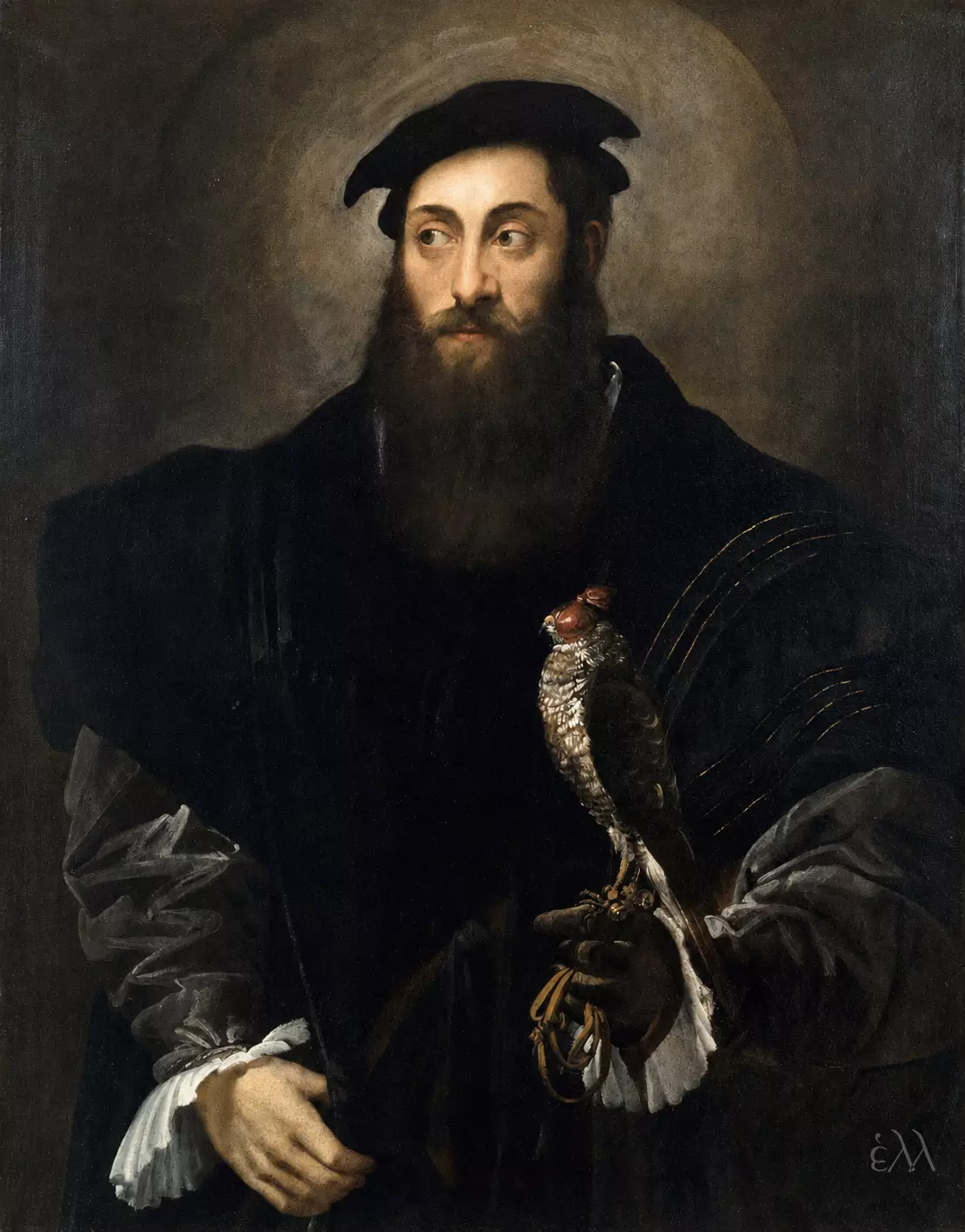
Niccolò dell’Abbate’s Portrait of a Gentleman with a Falcon, painted around 1548–50, presents an unidentified northern Italian aristocrat with the controlled formality expected of sixteenth-century portraiture, yet his expression resists an easy reading. The large oil on canvas, measuring approximately 140 × 117 cm as framed, is now held by the Art Gallery of New South Wales in Sydney. Neither signed nor dated, it has been assigned to the final years of dell’Abbate’s Italian career on stylistic grounds. The museum identifies the sitter as a nobleman, an interpretation supported by his costly clothing and the hooded falcon resting upon his gloved hand. The collection record dates the work to approximately 1548–50.
The figure occupies nearly the entire pictorial field. His shoulders establish a broad horizontal mass, amplified by the dark coat and the spreading grey sleeves, while the falcon introduces a narrow vertical accent near the centre. The sitter turns his head slightly to his right and looks beyond the edge of the composition. That sidelong gaze disrupts the authority of his stance. Around the black cap, a diffuse area of lighter grey sharply separates the forehead from the otherwise sombre background; lower down, garment, glove and shadow merge into a dense chromatic field from which the face, cuffs and bird gradually emerge.
Portrait of a Gentleman with a Falcon and the Language of Rank
Falconry carried an unmistakable social meaning in medieval and Renaissance Europe. Training and maintaining birds of prey required land, specialised knowledge, servants and leisure. The activity was therefore widely associated with nobility and aristocratic life, as the Metropolitan Museum of Art notes in its discussion of falconry as an emblem of rank. Within dell’Abbate’s portrait, the bird serves as visible evidence of cultivated privilege, although it never becomes a simple heraldic emblem. Its compact body, patterned plumage and long pale tail have been observed with considerable naturalistic precision.
The falcon stands on the sitter’s heavily gloved left hand. Thin jesses descend from its legs and gather in loops between the fingers, explaining both the position of the hand and the firm, practised grip. Over the bird’s head lies a reddish leather hood, keeping it quiet before release. The hidden eyes also create a subtle relationship with the human gaze: the falcon is deprived temporarily of sight, while the gentleman looks sharply towards something excluded from the painted space. Activity is anticipated and held in suspension, evident too in the sitter’s bare right hand, which rests near his waist as though caught between relaxation and readiness.
Dell’Abbate organised the composition through restrained asymmetry. The head occupies the upper central field, the falcon shifts the visual weight towards the sitter’s left side, and the uncovered hand draws the eye back across the lower portion of the canvas. No architecture, landscape or inscription identifies the man, so rank must be read instead through posture, clothing and possession. The falcon carries much of the portrait’s social specificity as a result, information that would otherwise depend on a setting the canvas simply does not provide.
Clothing, Light and Psychological Character
Black dominates the costume, yet the painting avoids chromatic monotony. Against the nearly opaque coat, the grey satin sleeves produce a changing sequence of highlights, creases and recessive shadows. Their ample construction broadens the body and lends material weight to the pose. Small white cuffs emerge at the wrists, sharply illuminated and irregularly folded. The left cuff falls beside the dark glove, while the opposite one frames the exposed hand and its warm flesh tones.
Above these calculated signs of prosperity, the face appears unexpectedly vulnerable. Dell’Abbate gives close attention to the long beard, high forehead, arched brows and slightly tightened mouth, but psychological character is concentrated in the eyes. They do not address the observer, nor do they settle comfortably upon a visible object. The commanding breadth of the body and the uncertainty of the glance coexist without being reconciled, leaving the sitter’s state of mind open, and this unresolved quality is part of what keeps the image from becoming a conventional display of aristocratic confidence.
The tonal modeling is soft around the temples and cheeks, becoming firmer along the nose and eyelids. Light touches the forehead most strongly, then diminishes through the beard and black clothing. Around the falcon, minute strokes distinguish feathers, straps and hood from the surrounding darkness. Such changes in handling establish a hierarchy of attention: face first, bird second, costume and hands following in slower succession.
Niccolò dell’Abbate before Fontainebleau
Born in Modena around 1509–12, dell’Abbate worked in Modena and Bologna before leaving for France in 1552. His early painting absorbed influences from Parmigianino and the broader artistic culture of Emilia, combining refined figure types with a growing interest in landscape and pictorial atmosphere. In France, he joined Francesco Primaticcio at Fontainebleau and became one of the artists responsible for spreading courtly Mannerism across northern Europe. The National Gallery, London records his work on the château’s fresco decoration and his subsequent importance to the School of Fontainebleau.
The Sydney portrait belongs to the moment immediately preceding that French phase. Its Mannerism is measured: elongated proportions are subdued, the palette remains austere, and elegance emerges through pose, surface and an elusive psychological tension. Dell’Abbate’s later reputation rests heavily upon decorative schemes and classically inspired landscapes, but this painting demonstrates an equally searching response to individual physiognomy.
Its modern provenance can be followed through the collection of Alessandro Contini-Bonacossi in Florence, the London dealer Agnew’s and the Australian collector William Bowmore. The Art Gallery of New South Wales acquired it in 1991. Across those changes of ownership, the identity of the gentleman was lost, though the falcon still points to a social world, a cultivated pursuit, and a status once asserted through possession rather than name.
(The translation was edited by F. Kalimeris.)