
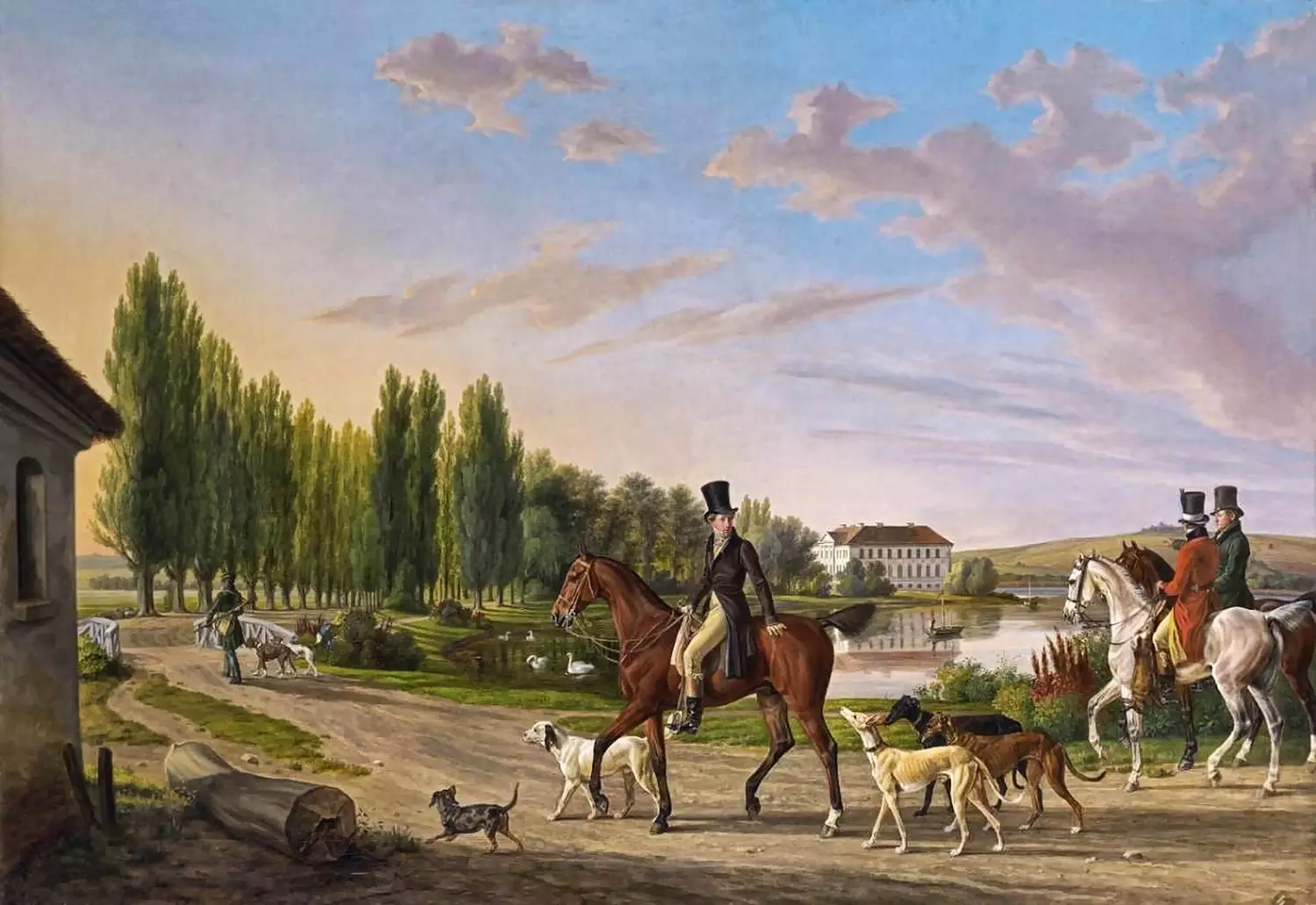
Albrecht Adam’s The Return from the Hunt, painted in 1828 in oil on canvas, measures 69 × 101 cm and is now in a private collection. At first sight the subject belongs to the familiar world of nineteenth-century sporting painting: mounted hunters, a restless gathering of hounds, horses moving at an easy pace after the exertion of the chase. Yet Adam places this activity within a landscape whose specificity changes the character of the picture. The country house across the water is Schloss Schorssow, and the work was commissioned around 1828 by Felix Georg von Voss, then associated with the estate, as one of a pair of hunting pictures. The architecture therefore does not serve as an invented backdrop. It establishes the social and geographical setting of the scene, binding the hunt to a particular landholding and its cultivated environment.
Much of the canvas is given over to air and open country. A pale blue sky, crossed by broad clouds touched with muted pink and grey, rises above the low horizon; below it, the lake, the distant slopes and the white façade of the house introduce successively narrower horizontal bands. Against this spacious arrangement Adam sets the hunters comparatively low in the pictorial field. The result is curious and effective. Although the principal rider occupies the centre of attention, the painting never contracts into an equestrian portrait. Rider, animal, dogs, road, trees and grounds remain parts of the same inhabited scenery.
The Return from the Hunt and the Schorssow Estate
The central horse, a richly coloured bay, advances almost laterally across the foreground while turning its head slightly into the direction of travel. Its rider sits upright in dark coat, pale breeches and high black hat, his figure sharply legible against the softer vegetation beyond. Adam controls this emphasis with very simple means. The horse’s warm brown body forms a substantial mass at the centre of the composition, while its pale lower legs and the rider’s light trousers break the darker silhouette into smaller accents. Immediately below and around them the hounds run in irregular succession, some crossing one another, some turning their heads, their lean bodies introducing a quicker visual rhythm than the measured gait of the horses.
To the right, two further mounted men approach on a white and a darker horse. One rider’s reddish coat provides the strongest warm chromatic accent in this part of the composition. The white horse beside it is more consequential compositionally: its light body marks the right edge of the principal group and answers, across a considerable distance, the pale walls of Schloss Schorssow in the middle ground. Between these two concentrations of white lie water, vegetation and open space. Adam thus allows colour to participate in the spatial organization without making the arrangement conspicuously geometric.
The road performs another task. Beginning broadly in the foreground, it bends towards the avenue of tall trees at the left and narrows into the distance. The recession is not forced. Trees diminish gradually, figures farther along the road become smaller, and the lake opens beyond them, creating an accessible pictorial space through overlapping forms and atmospheric perspective. The row of slender trees is especially important because its vertical rhythm counters the strong horizontal extension of the canvas. Their repeated trunks lead the eye inward, yet their irregular foliage keeps the sequence from becoming mechanically decorative. A partially visible building at the extreme left acts almost as a repoussoir, pressing the open landscape away from the picture plane.
Schloss Schorssow itself has been identified as the large nine-bay country house shown across Lake Haussee. The view presents the estate from across the water, and the commission belonged to a period when Adam was working for aristocratic patrons in northern Germany. A surviving account of his activity at Schorssow connects the hunting pictures with Felix Georg von Voss and indicates that Adam worked there during his visits of 1827 and 1828; the pendant hunting composition preceded The Return from the Hunt. The scene consequently has something of the character of an estate portrait, though people and animals remain too active for it to become an architectural record.
That distinction matters. The picture communicates possession and social rank indirectly. There are no heraldic devices prominently displayed, no ceremonial presentation of the house, and no rigid parade of riders. Instead, status appears through activity: trained horses, numerous hunting dogs, elegant dress, the maintained avenue, water, parkland and substantial residence. The hunt has ended, and Adam chooses the return rather than its pursuit or climax. The horses are controlled, the riders converse or look towards one another, and the hounds have dispersed into a loose, animated band. A small dog crossing near the lower edge, almost detached from the grander equestrian group, contributes a genuinely unforced note of observation.
Such attentiveness belonged naturally to Adam’s broader artistic formation. Born in Nördlingen in 1786 and later established in Munich, he became especially known for battle subjects, soldiers and horses. His career brought him unusually close to military life: as court painter to Eugène de Beauharnais, he accompanied the 1812 campaign in Russia, and material originating in those experiences later formed an extensive series of campaign images and lithographs. Royal commissions for battle paintings followed. Yet contemporary biographical scholarship also stresses his increasingly factual observation of nature, his careful drawing, his command of spatial distribution and a painterly handling that retained freshness despite considerable descriptive detail. In The Return from the Hunt, these abilities are transferred from military spectacle to an almost deliberately uneventful subject.
The horses demonstrate the change particularly well. They are neither heroic emblems nor generic accessories. Differences of colour, stance and gait individualize them, while the central bay is sufficiently substantial in modelling to dominate the foreground without disturbing the broader setting. Adam gives comparable attention to the dogs, but on another scale and with another rhythm: thin legs, extended bodies, lowered heads, tails and overlapping profiles make their movement more scattered. Human figures occupy the space between these two animal registers. The painter knew how much description the composition could carry.
Colour is restrained over most of the picture. Greens deepen beneath the avenue and around the lake; ochre and brown organize the road and horses; blue expands across the sky and returns, softened, in the water. Warmer light gathers towards the left horizon, but no theatrical illumination interrupts the scene. Even the clouds are broadly disposed, their soft edges very different from the more crisply delineated riders and animals below. This variation of handling helps establish depth while preserving clarity across a surface crowded with small incidents.
What Adam records, finally, is the estate after activity has begun to subside. The hunt survives in the horses, clothing and pack of hounds, but the action has loosened into return: along the road, past the water, towards the tree-lined grounds and the white house visible beyond. The large sky remains almost indifferent to the social precision below it, while Schloss Schorssow, reduced by distance, occupies only a modest portion of the canvas. The Return from the Hunt remains in a private collection.
(The translation was edited by T. Davies.)