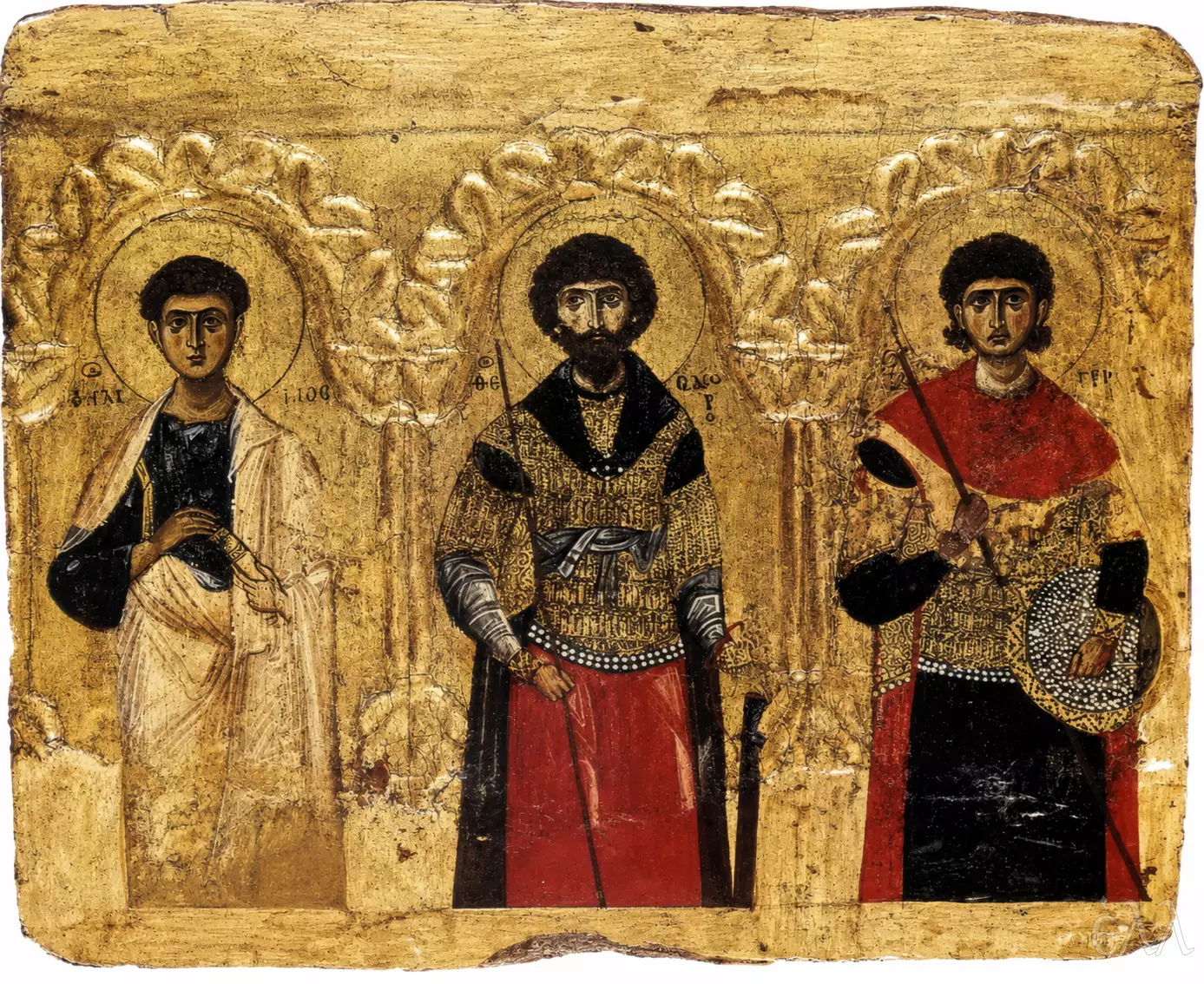
The surviving section of a twelfth-century Byzantine templon epistyle, now in the State Hermitage Museum in St Petersburg, preserves three standing saints beneath a continuous sequence of gilded arches. Dated to the first half of the century and probably associated with a Constantinopolitan workshop, the fragment belonged to a longer painted ensemble connected with the Great Deesis. Its painter is unknown. Within the surviving section, the figures are identified as the Apostle Philip, Saint Theodore and Saint Demetrius, a sequence that brings an apostle into immediate visual relation with two of the most familiar military saints of Byzantine art.
Gold dominates the object, but not uniformly. The background, haloes and architectural ornament form a luminous field whose present appearance is interrupted by abrasion, paint loss and areas in which the surface has thinned. Against it, the three saints remain remarkably distinct. Philip, youthful and beardless, wears a pale mantle over a dark garment; Theodore, at the centre, is bearded and dressed in richly patterned military attire; Demetrius appears in armour beneath a brilliant red cloak, holding a spear in his right hand and carrying a round shield on his left arm. Their differences of age, costume and attribute are pronounced, yet the repeated arches and nearly equal scale bind them into one ordered liturgical sequence.
Byzantine Templon Epistyle and the Great Deesis
The architectural frame is fundamental to the way the fragment is read. Each saint occupies an individual arched compartment, separated by narrow vertical supports, while raised vegetal forms spread above and around the arches. The ornament evokes carved architectural decoration without creating deep spatial recession. Figures, frame, gold ground: these elements are layered across the surface, but they remain visually close to one another. The result is a shallow, highly controlled pictorial space in which the saints seem to belong simultaneously to distinct compartments and to a single continuous sacred register.
At the left, Philip provides the quietest figure. His smooth, youthful face, compact dark hair and light mantle distinguish him immediately from the armoured saints beside him, and this calm apostolic presence already reads as a visual counterweight to the dense military textures that follow. The painter has not relied upon dramatic movement: his hands are brought forward in a restrained gesture, while the long pale folds of the mantle fall in broad, linear passages. The figure remains narrow and upright, its frontality softened only by the slight disposition of the arms.
Central to the arcade, Theodore carries the strongest visual emphasis, occupying the fragment’s middle arch. His dark beard and hair surround a face articulated by large eyes, a narrow nose and sharply controlled contours. Across his torso, the military costume is built from repeated ornamental patterns: bands, small geometric units, rows of light accents, darker sections at the shoulders and sleeves. The richness of this surface treatment does not dissolve the body beneath it. Instead, the patterning gives the saint a compact, almost ceremonial monumentality, reinforced by his frontal stance and by his position on the central axis of the surviving fragment. A dark vertical element beside his left side may belong to his military equipment, although the surviving surface does not justify a more exact identification.
Demetrius introduces a different colour balance. The red cloak, spreading broadly across his shoulders and descending behind the armour, sets off the black, gold and pale dotted ornament defining the cuirass and shield. His right hand supports the spear; the round shield rests at his left side and carries a dense decorative border. These attributes identify him visually as a military saint even before the damaged inscription beside the halo is taken into account. The slender spear also breaks the predominance of vertical and curved forms, drawing a firm diagonal through the right-hand compartment.
Byzantine Military Saints on the Templon Screen
The pairing of Theodore and Demetrius belongs to a wider Byzantine iconographic culture in which military saints developed a recognisable corporate identity, and their appearance on a templon beam carried a meaning wider than military costume alone. Christopher Walter’s study of warrior saints traces the importance of Demetrius and the two Theodores within this repertory, noting the frequency with which such saints were grouped or paired in Byzantine religious art. Such groupings placed the two soldier-saints within an ordered community of holy intercessors presented before the sanctuary.
Yet the surviving three figures should not be mistaken for an independent Deesis composition. A Great Deesis extended the central intercessory group of Christ, the Theotokos and Saint John the Baptist into a larger sequence of apostles and saints, often distributed along a templon epistyle. Philip, Theodore and Demetrius would consequently have occupied one section of a much broader programme whose lost centre established the theological and visual hierarchy. What survives is fragmentary in material terms, though repetition, direction and scale still allow its original logic to be traced.
This function helps explain the restraint of the composition. None of the three figures acts within a narrative episode; no landscape or architectural setting surrounds them beyond the ornamental arcade. They stand. Their identities are carried by physiognomy, costume, inscription and attribute, and their placement turns individual sanctity into collective order. In a sanctuary screen, such a row created a threshold between the congregation and the bema, a painted hierarchy positioned immediately above the physical division of ecclesiastical space.
The surviving condition makes certain aspects of the original surface difficult to reconstruct. Losses are particularly visible in the lower portions and along areas of the gilded field, while the upper margin has suffered abrasion and irregular wear. Even so, the chromatic organisation remains forceful, with colour differentiating each figure — pale cream and white around Philip, dense brown and black around Theodore, saturated red around Demetrius — even as the repeated arcade, and the expansive gold behind it, holds all three within a single continuous field.
What gives the fragment its particular character is this balance between individual identity and serial structure. The saints are carefully distinguished, yet none is isolated from the rhythm of the whole. The apostle, the bearded warrior, the youthful armed martyr; three different visual types, brought into alignment by the same scale, the same haloed frontality, the same gilded architectural cadence. In the setting of a twelfth-century templon, that cadence was part of the work’s function: an image of intercession organised as a visible order before the sanctuary.
(The translation was edited by M. Taylor.)