
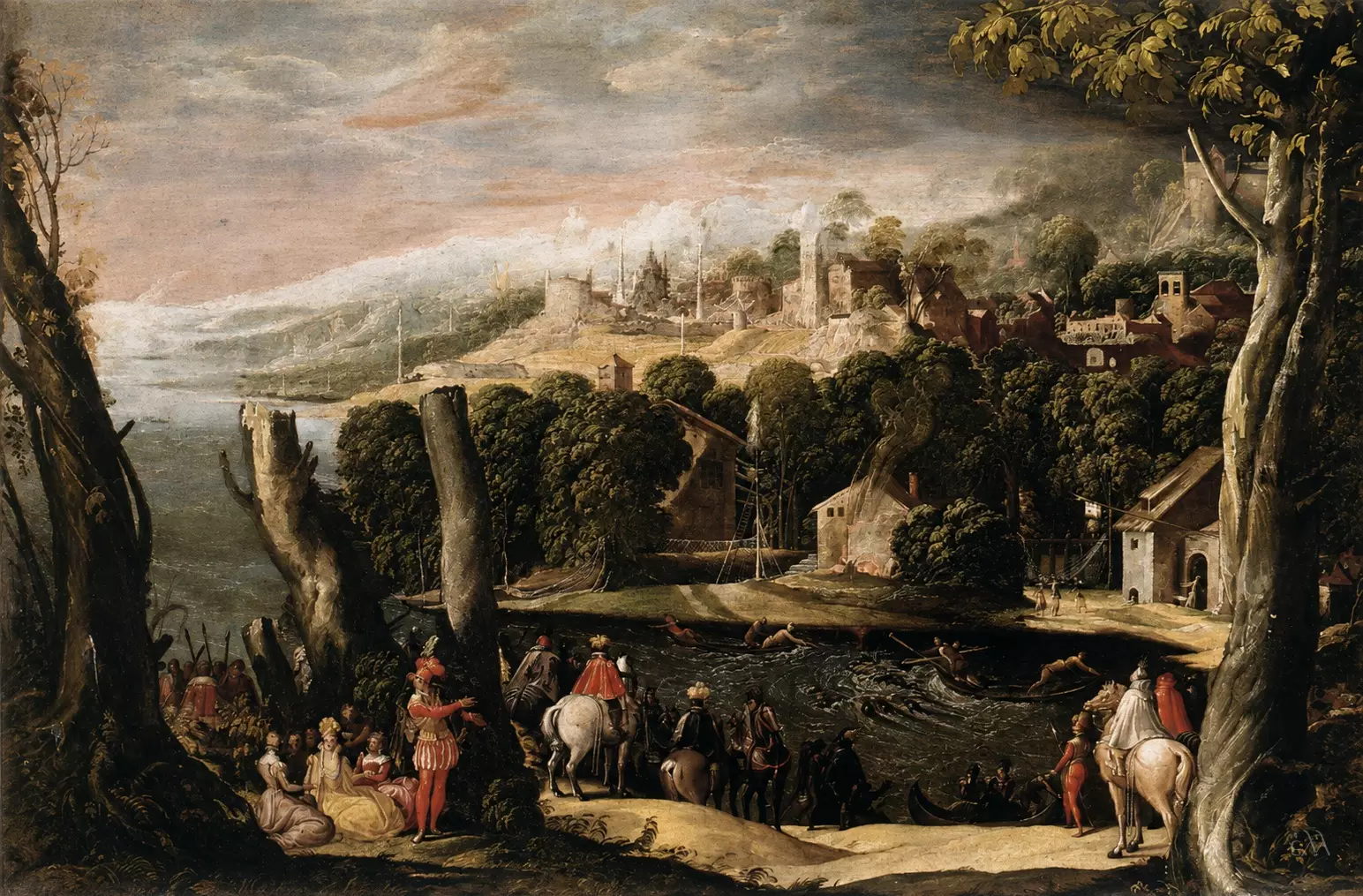
Niccolò dell’Abate’s Stag Hunt, painted around 1550–52, turns an aristocratic pursuit into a broad landscape narrative in which human action occupies only one part of a much larger pictorial world. Executed in oil on canvas and measuring 116 × 159 cm, the painting is preserved in the Galleria Borghese in Rome. The museum currently dates it to around 1550 and catalogues it under the fuller title Landscape with Ladies and Knights (The Deer Hunt).
Across the wide horizontal canvas, dell’Abate distributes hunters, mounted figures, soldiers and elegantly dressed spectators through a landscape of riverbanks, trees, distant buildings and rocky terrain. The decisive moment of the hunt occurs in the water, amid horses, men and the violently disturbed surface of the river. Yet the painter deliberately refuses to concentrate every visual force upon that episode. Noblewomen seated in small groups, standing knights and other figures occupy the foreground; beyond them, everyday activity continues around the houses of a distant settlement. The hunt becomes part of an inhabited landscape, active on several levels and unfolding at different speeds.
This unusual balance between courtly narrative and landscape places the work among the most distinctive paintings of dell’Abate’s Italian career, completed shortly before his departure for France. The controlled art-historical terminology used here follows established professional usage for Renaissance painting and visual analysis.
The Niccolò dell’Abate Stag Hunt and Its Landscape
Across the middle ground, between the foreground company and the distant settlement, a broad river determines the painting’s structure and establishes a strong horizontal interval. Around it rise irregular banks, vegetation and a steep rocky formation, while distant architecture recedes beneath a cool atmosphere. Blue and blue-green tonalities soften the more remote forms, giving the scene an expansive depth that contrasts with the sharper silhouettes and brighter accents of the foreground figures.
Within this setting, the final phase of the stag hunt generates the most concentrated movement. Horses enter or struggle through the river, riders bend, turn, water breaks around them. Dell’Abate organizes this agitation without allowing it to dominate the entire canvas. On the bank, groups of spectators remain comparatively still. Their measured poses create pauses around the central action, and these pauses matter: they transform the image from a straightforward hunting illustration into a courtly landscape in which looking itself forms part of the subject.
Especially characteristic is the relationship between scale and distance. The figures, slender, frequently elongated, retaining even at reduced scale an almost sculptural clarity, possess the cultivated elegance associated with mid-sixteenth-century Mannerist painting. Dell’Abate had grown up within the artistic environment of Modena and had connections with sculptural practice through his father Giovanni and the sculptor Antonio Begarelli; the Galleria Borghese catalogue notes this background when discussing the precision with which he constructed the human figure.
The landscape also reflects artistic currents extending beyond central Italian classicism. The Borghese catalogue emphasizes dell’Abate’s engagement with the landscape painting of Dosso and Battista Dossi, whose example he reworked through a cooler, more acidic palette. Flemish elements have likewise been identified in the detailed rendering of landscape and secondary incident. Such northern painting enjoyed considerable appreciation at the Este court in Ferrara, a milieu closely connected with the possible early history of the canvas.
That combination explains some of the painting’s peculiar fascination. Minute episodes invite close inspection, while the larger composition remains spacious and remarkably coherent. Figures appear near houses, others gather at the water, mounted hunters cross the landscape, spectators converse. No single incident exhausts the image. Through these dispersed centres of attention, dell’Abate encourages the eye to move laterally and gradually into depth.
Courtly Life, Movement and Observation
Hunting in Renaissance court culture carried associations of aristocratic leisure, physical skill and social rank, and dell’Abate presents the event through precisely such a refined social environment. The elegant company occupying the riverbank appears almost as significant as the hunters themselves. Dresses, mounted figures, soldiers, gestures: together they establish a world of cultivated display in which the pursuit of the animal forms one element of a broader courtly spectacle.
Among the foreground incidents, the Borghese catalogue draws attention to a man dressed in red standing beside seated ladies and apparently marking or writing upon the trunk of a tree. It is a small, curious action. Dell’Abate gives such secondary moments enough clarity to interrupt the main narrative, allowing the scene to retain something of a poetic tale whose connections remain deliberately loose.
Colour assists this fragmentation and reunion. Small passages of red, pale garments and brighter tones punctuate the cooler surroundings, directing attention from one group to another. Atmospheric blues bind the distant village, cliff and river into a softer field, while darker trees provide vertical accents against the dominant horizontal movement. From figure to figure, outward toward architecture and water, back eventually to the confused energy of the hunt, the eye moves through the composition.
Attribution and the Painting’s Place in Dell’Abate’s Career
The attribution has a complicated history. Early records associated the painting with other artists, including the Ferrarese Dossi and, in one documentary interpretation, Paul Bril. Carlo Gamba attributed it to Niccolò dell’Abate in 1924; Roberto Longhi and Aldo De Rinaldis subsequently supported that attribution, partly through comparison with dell’Abate’s Landscape with Boar Hunt in the Galleria Spada.
Its probable date places the canvas during the painter’s Bolognese years, immediately before Francesco Primaticcio helped secure his invitation to the French court of Henry II. Dell’Abate left Italy in 1552 and became an important participant in the decorative projects at Fontainebleau, including later work in the Salle de Bal and Galerie d’Ulysse. Already visible in Stag Hunt are several qualities associated with that later courtly art: elongated figures, graceful poses, narrative richness, an imaginative landscape capable of carrying human action without becoming subordinate to it.
The painting probably entered the Borghese collection in the early seventeenth century, perhaps in connection with works sent from Ferrara to Cardinal Scipione Borghese in 1608, although the museum stresses that this early provenance cannot be established with certainty. It is documented in a Borghese inventory of 1693 and was purchased with the collection by the Italian state in 1902. Within the river, wooded banks and scattered groups survives an unusually complete expression of dell’Abate’s Italian landscape imagination in the years immediately preceding his move to Fontainebleau.