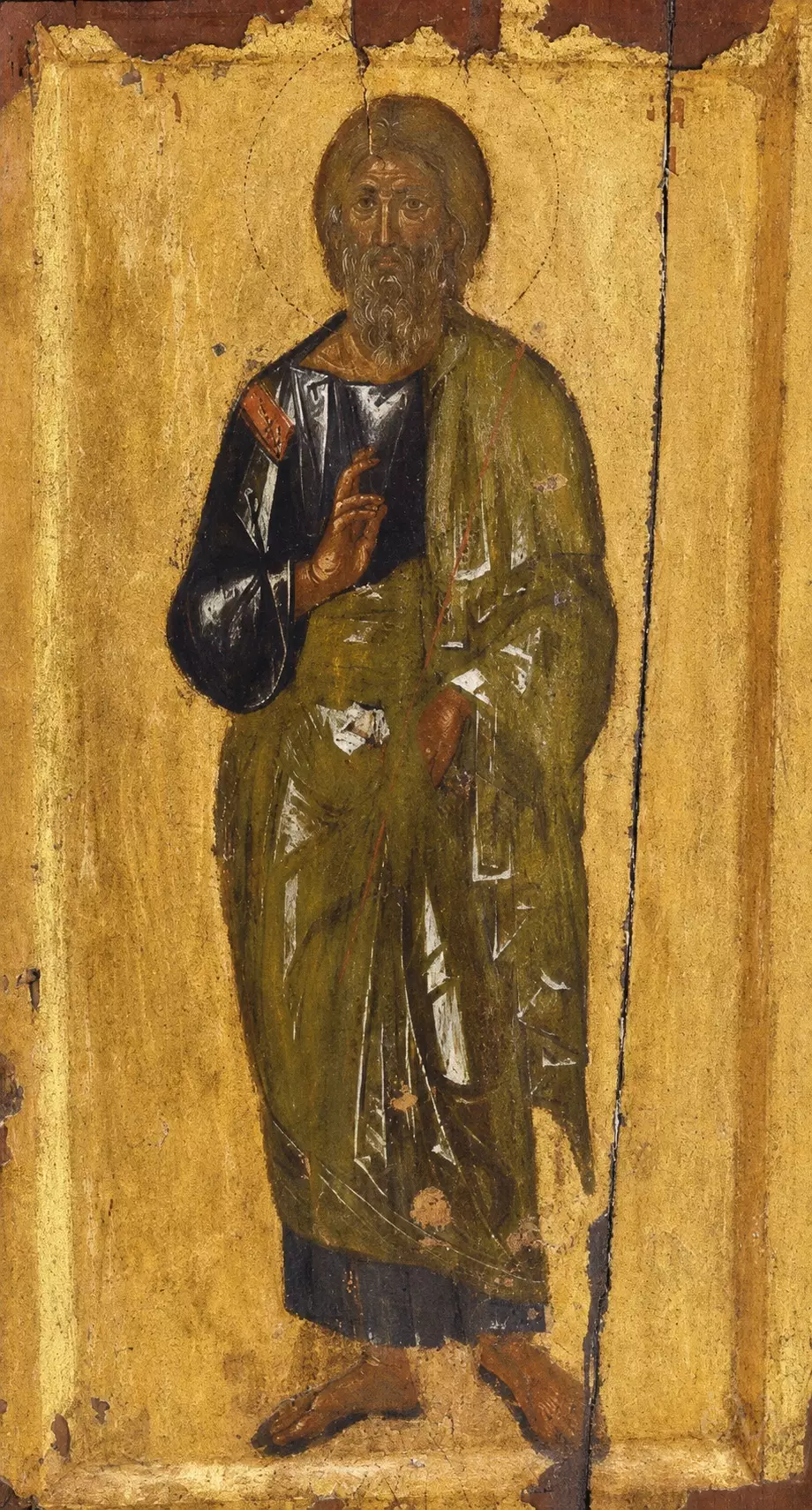
The Apostle Andrew Byzantine icon preserved at the Holy Great Monastery of Vatopedi on Mount Athos presents the saint as a tall, full-length figure isolated against a gold ground. Painted in egg tempera on a wooden support, the panel retains a striking clarity despite extensive surface wear. Andrew stands nearly frontal, his narrow body enclosed within the long vertical format, while the gilded field and restrained framing concentrate attention almost entirely upon the figure.
Apostle Andrew Byzantine Icon: Figure and Gesture
Across his body falls an olive-green mantle, its broad folds articulated with pale, sharply drawn highlights. Beneath it appears a much darker tunic, enlivened at the shoulder by a reddish ornamental band. Green, black, ochre, muted red: the chromatic restraint allows the gold ground to dominate the surrounding field.
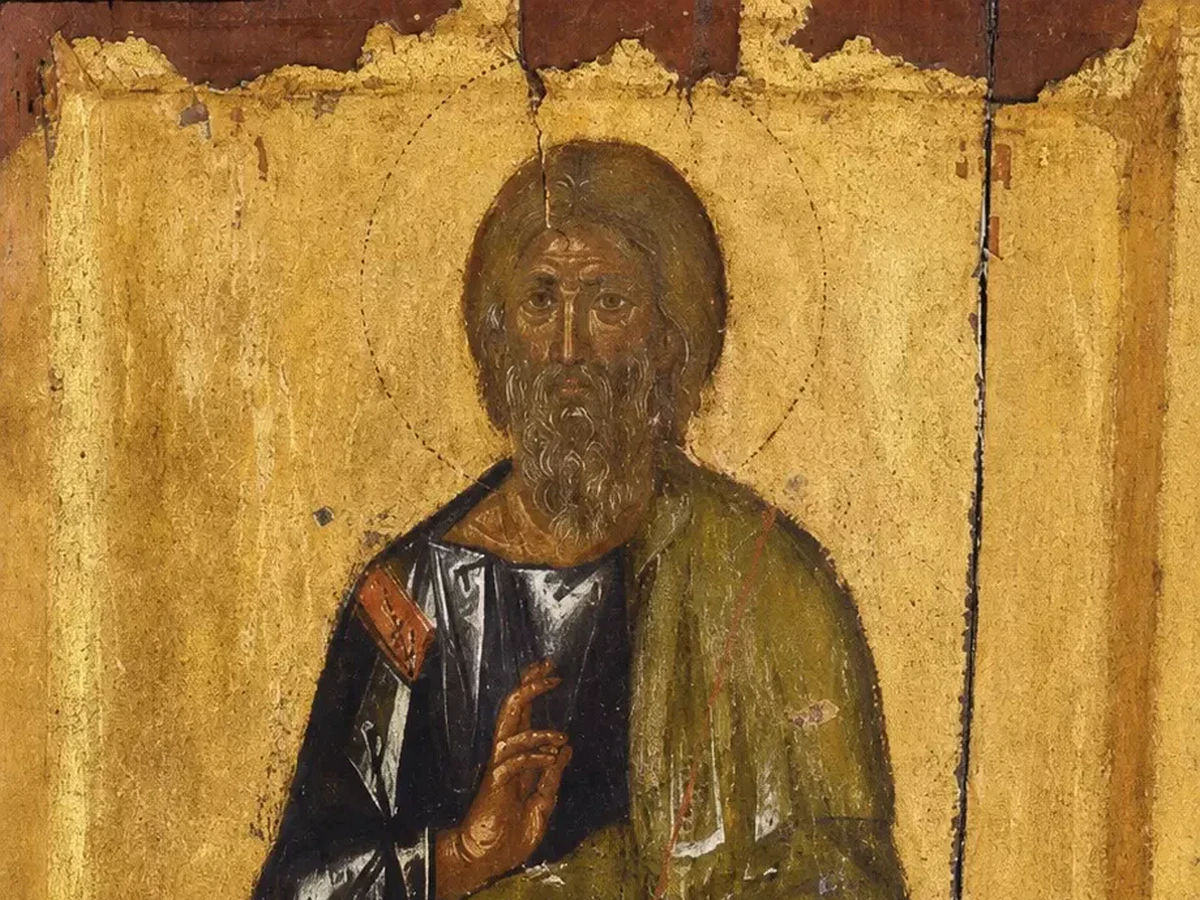
At chest height, Andrew raises his right hand in a gesture of benediction. His left remains lower, partly absorbed into the heavy folds of the mantle. Most distinctive is the physiognomy: long grey beard, thick curling hair, narrow face and deeply marked features. These belong to the established Byzantine iconographic type of Andrew, traditionally known as the First-Called and identified as the brother of the Apostle Peter (John 1:40–42).
Around the head, a finely incised double line defines the halo with remarkable economy. Pronounced cracking, abrasion and losses mark the surrounding gilding; a vertical split also runs through the wooden panel. Such damage leaves portions of the preparation layer exposed, particularly near the upper edge, while the face and blessing hand remain comparatively legible.
(The translation was edited by A. Orfanos.)