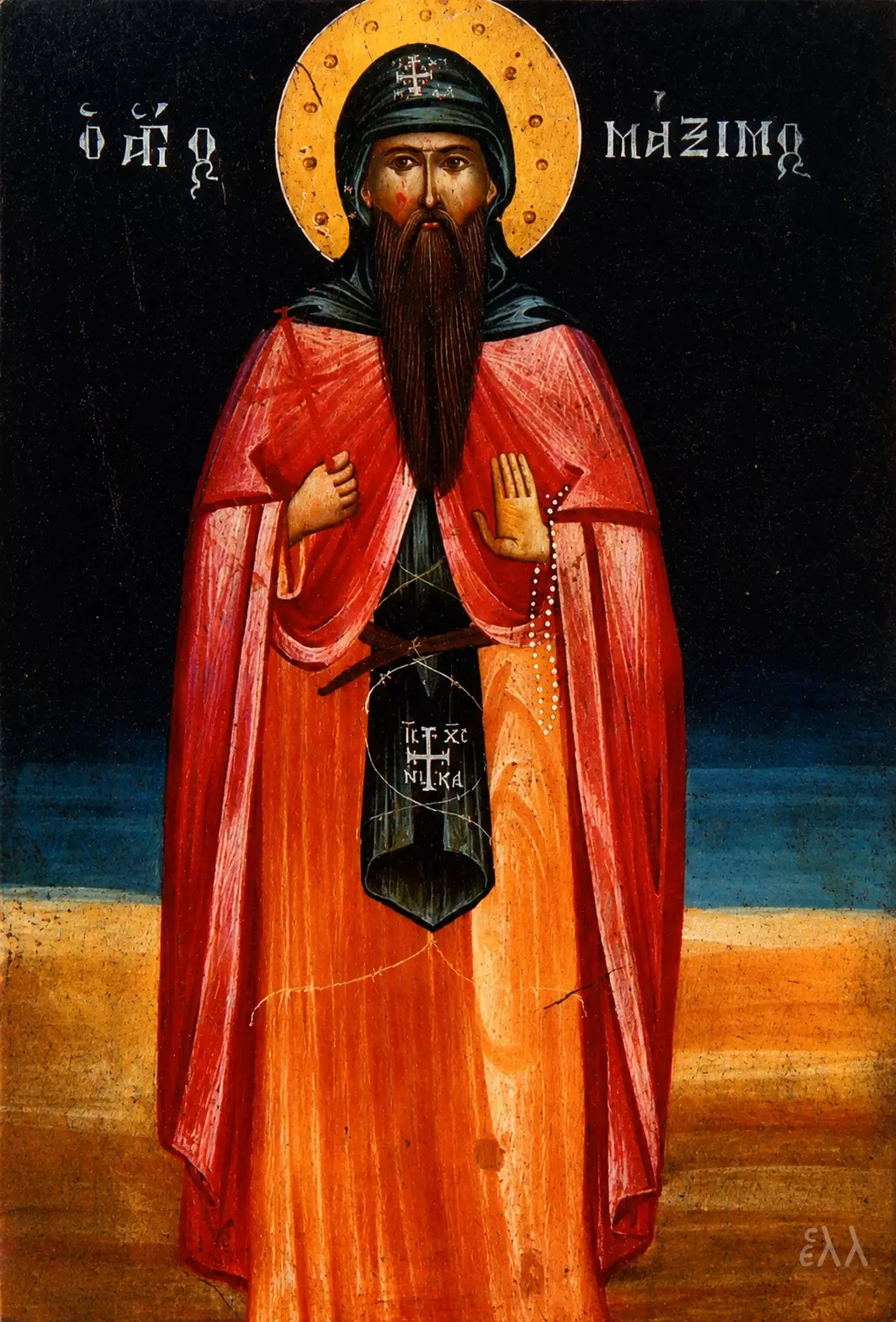
Fire runs through the biography of this Athonite hermit almost as insistently as it runs through his name, and it is worth beginning with the epithet before turning to the panel itself: Kausokalybites, “the Hut-Burner,” a title earned by the habit of setting alight each rough shelter he built before moving on to construct another. Painted by an anonymous hand and preserved today in the Kyriakon of the Holy Skete of Kausokalyvia on Mount Athos, the icon of Saint Maximos Kausokalybites has been dated to the eighteenth century, a period in which the community bearing his name continued to commission portraits of its founding hermit for veneration within its own church.
Against a ground of unbroken black, the saint stands frontally, an elderly monk whose long, reddish-brown beard descends nearly to the waist in loosely rendered, wiry strands, the individual locks separated by fine, dark linear strokes. A dark monastic hood frames the face closely, bearing near the brow a small cross device consistent with the koukoulion of the Great Schema; over it falls a red mantle, its folds built up through repeated, almost scratched parallel brushstrokes that catch the light unevenly across the shoulders and sleeves. The gilded halo behind his head is worked with a border of punched, dot-like ornament, and to either side of it a titulus in an archaizing, angular script identifies him: Ο ΑΓΙΟΣ ΜΑΞΙΜΟΣ. The face itself is modelled sparingly, with a high forehead, deep-set eyes, and a directness of gaze that leaves little room for the softer, more contemplative expressions found in some contemporary Cretan work.
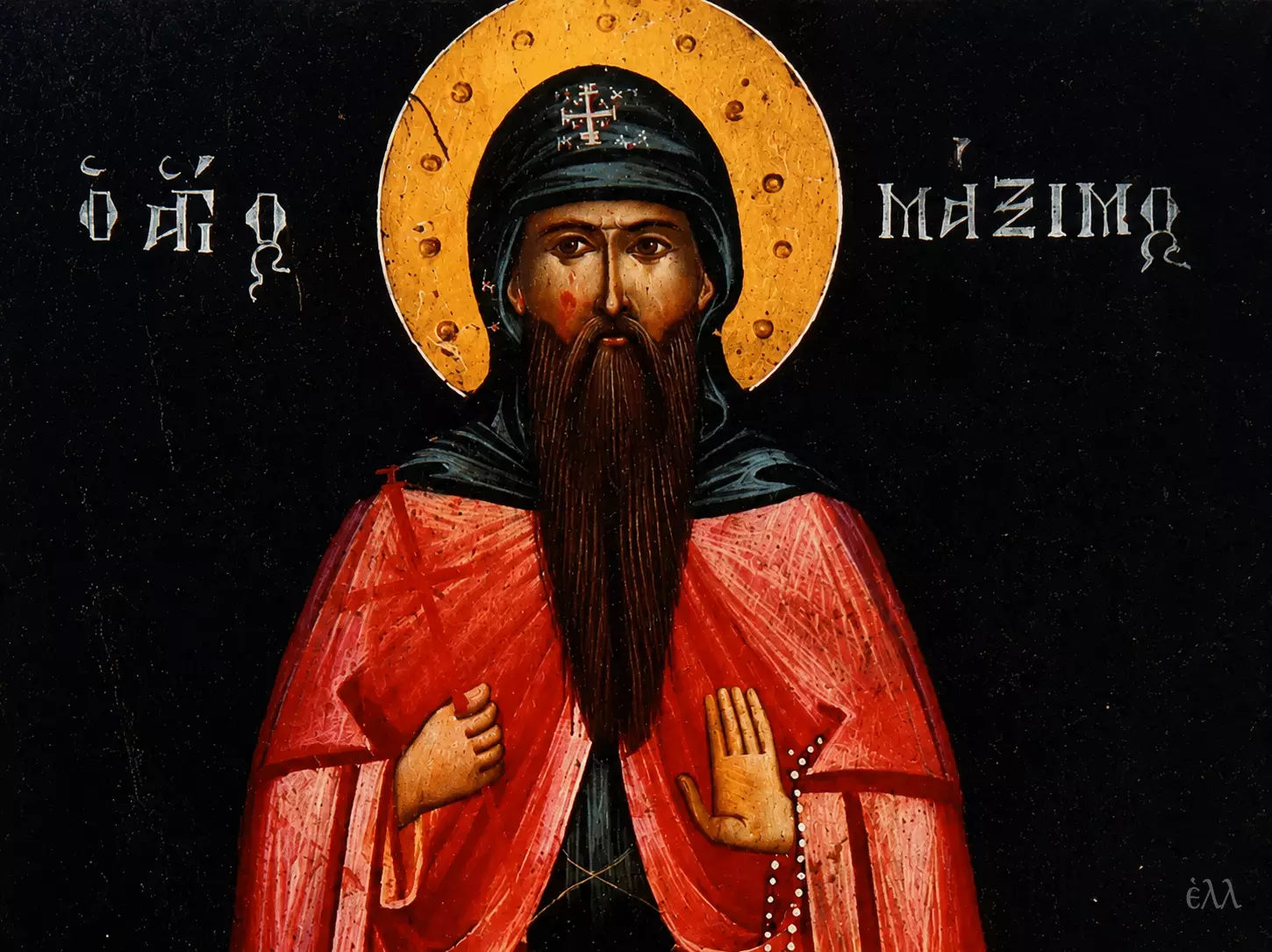
The Gesture of the Icon of Saint Maximos Kausokalybites
His right hand is drawn in against the chest, fingers gathered into a loose fist beneath the red drapery, while his left hand is raised at chest height with the palm turned fully outward toward the viewer, a strand of a prayer rope looped over its fingers and falling in small white beads. Within the established vocabulary of Orthodox icon painting, the open palm carries a settled meaning of its own, signifying virginity and the ascetic life, and here it is paired quietly with the komposchoinion rather than with any more emphatic gesture of blessing.
Lower on the panel, where the composition widens to include the waist, a dark scapular hangs from a crossed strap at the centre of the body, its worn surface inscribed with the christogram IC XC NIKA set within a roundel. Beneath this the mantle opens onto an orange-ochre undergarment, and the ground itself resolves into two horizontal bands, a strip of blue above a field of ochre, a spare suggestion of sea and barren rock appropriate to a saint who spent his days among the ravines of Athos rather than within its coenobitic walls.
Tradition places Maximos in the fourteenth century, born in Lampsakos on the Hellespont and drawn early to monastic life; before reaching Athos he is said to have passed through Thrace and Constantinople, testing successive forms of ascetic discipline until he settled on the peninsula’s most inaccessible slopes. The recurrent burning of his shelters, from which the skete of Kausokalyvia eventually took its name, was read by later hagiographers less as instability than as a deliberate refusal to let any dwelling become a possession. Painters approaching such a figure were rarely concerned with portraiture in a documentary sense; what mattered was the condensation of an entire spiritual biography into a handful of legible signs — beard, mantle, halo, gesture — repeatable across generations of copies produced for the skete’s own devotional use.
Stylistically, the panel belongs to the broad current of Athonite icon painting produced in the region during the post-Byzantine centuries, its drapery built through summary, somewhat dry parallel strokes, its flesh tones modelled with restraint, and its frontal, immobile stance keeping the figure emphatically hieratic. Losses and abrasion are visible across the dark background and along the edges of the cloak, wear consistent with long use in liturgical veneration within the skete’s own church rather than with storage or display elsewhere.
(The translation was edited by F. Kalimeris.)