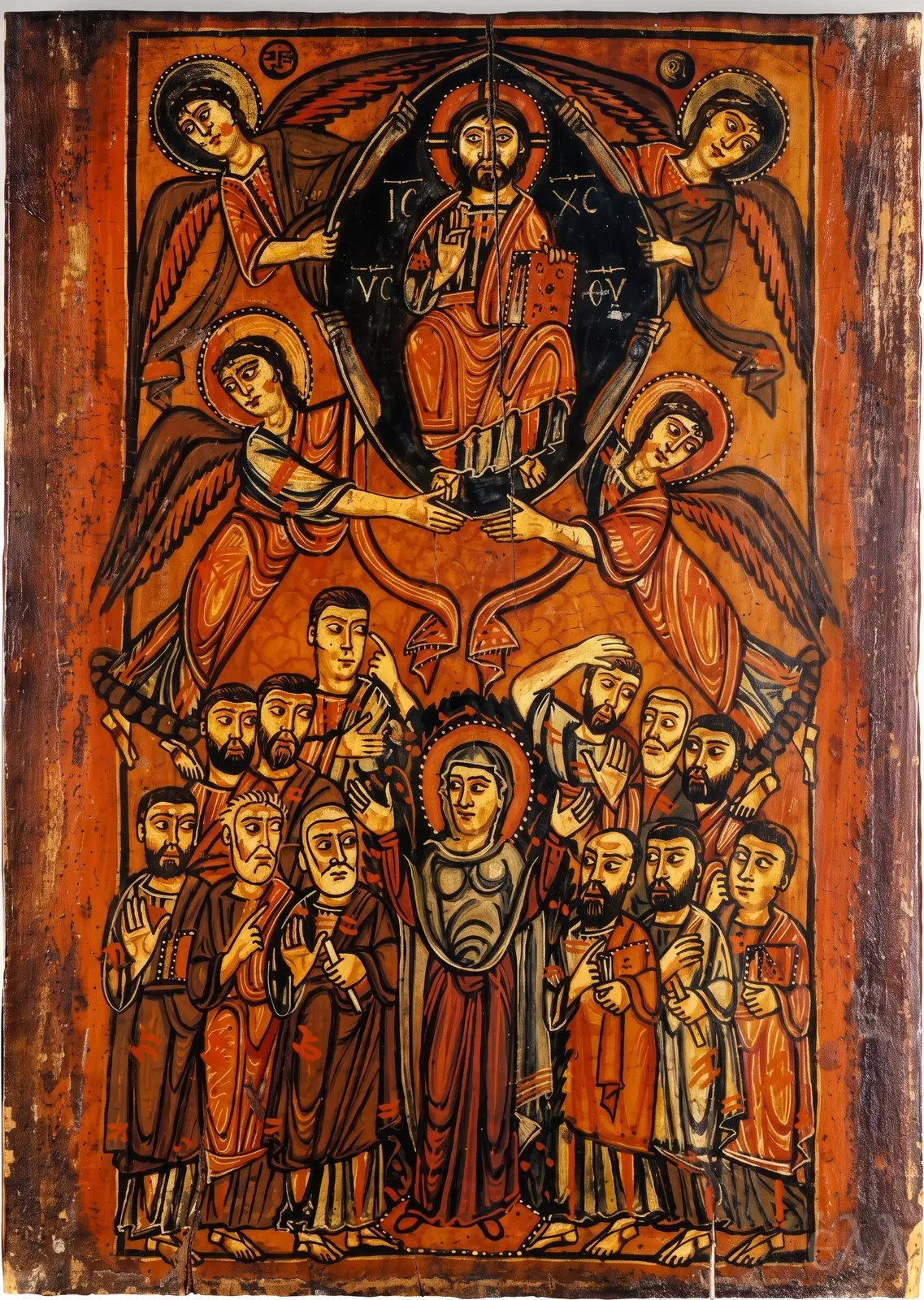
The Sinai Ascension icon, preserved at Saint Catherine’s Monastery on Mount Sinai, gives the Ascension of Christ (Acts 1:9–11) an unusual visual intensity within a panel of remarkably modest dimensions. Traditionally dated to the ninth or tenth century, the work measures approximately 41.8 × 27 cm and is painted in tempera on wood. It survives as the central panel of a former triptych, its authorship unknown. The conventional dating and the association with artistic production in the Holy Land remain the ones generally used in catalogue descriptions, although both chronology and place of production have been discussed more widely in scholarship.
Its small scale is deceptive. The painter has compressed into the vertical panel two clearly differentiated zones, celestial above and terrestrial below, without allowing either to become subsidiary. Christ occupies the upper centre, enclosed within a dark oval mandorla and carried by four angels. Beneath him, the Theotokos stands among the twelve Apostles, whose gestures and intersecting bodies transform the lower half into a dense field of human response. Nothing is dispersed into landscape or architectural setting. Bodies, wings, haloes, inscriptions, books, hands: almost every part of the available surface participates in the narrative.
The survival of an icon of this period at Sinai is itself significant. Saint Catherine’s, while vast numbers of sacred images elsewhere disappeared over the centuries, preserved an exceptional corpus of early panel painting, owing in part to the monastery’s geographical and political circumstances. Its collection consequently offers evidence for artistic traditions that cannot be reconstructed from Constantinople alone.
The Sinai Ascension Icon and Its Unusual Composition
At the summit of the image Christ appears frontally, seated in mid-air within a black-blue mandorla edged by narrow bands. His cruciform halo isolates the head against the dark field, while the abbreviated Greek IC XC identifies him immediately. His right hand is raised in blessing; his left supports a closed, ornamented codex. The distinction matters. Gesture and book establish an image of sovereign authority, yet the figure does not possess the immobility of a conventional enthroned Pantokrator. The entire enclosing form is being lifted.
Four angels make that upward movement visible. The upper pair incline towards the mandorla from either side, their enormous wings meeting above Christ in a sharply converging rhythm. Two more angels occupy the lower part of the celestial zone and support the ascending form from beneath. Their arms extend laterally, their garments curve downwards in long stream-like folds, their bodies create a visual bridge towards the figures standing below. Christ remains fixed upon the principal vertical axis; around him, wings, bodies, gestures in motion.
One peculiarity is immediately apparent. The rainbow upon which Christ frequently sits in Byzantine representations of the Ascension is absent. He remains unmistakably seated, but his seat seems suspended within the mandorla itself. This departure from a familiar iconographic formula has long attracted attention, as have several details connecting the image with the particular environment of Sinai. Catalogue scholarship has interpreted elements associated with the Virgin, the small reddish floral forms and the configuration beneath the heavenly vision as references to the Burning Bush. Such a reading is especially suggestive at Saint Catherine’s, although it is best retained as an iconographic interpretation rather than treated as something self-evident from appearance alone.
Below, the pictorial language changes abruptly. The expansiveness of wings and mandorla gives way to compression. The Theotokos stands on the centre line, haloed and frontal, surrounded so closely by the Apostles that their bodies overlap one another in successive, shallow layers. Her stillness supplies a second axis beneath Christ. Around her the disciples turn, point, raise their hands, clutch books or scrolls; some look upwards, others across the group. Their differences of reaction are carefully preserved even though their bodies have been packed into a space scarcely wide enough to contain them.
Two figures high in the apostolic group are particularly striking. On the left side of the composition, one Apostle raises a finger towards his eye. Opposite him, another lifts his arm across his brow as he turns towards the event above. The gestures introduce an unusual meditation upon sight itself: witnessing, looking, the difficulty of looking. The Ascension (Acts 1:9–11) becomes, in visual terms, an event perceived by human witnesses but simultaneously withdrawing beyond ordinary human vision. This tension between sight and transcendence gives the seemingly naïve gestures an unexpected intellectual weight.
The Virgin occupies a different role. The Acts narrative (Acts 1:9–11) does not identify her as a participant in the Ascension scene, yet by Late Antique and Byzantine tradition she had become the stable centre of the apostolic assembly. Her frontality contrasts with the movement around her. Apostles turn; angels incline; Christ rises. The Theotokos remains. In compositional terms, Byzantine artists repeatedly developed this vertical correspondence between the incarnate Christ ascending above and his Mother standing within the Church below, without requiring literal narrative simultaneity.
Colour strengthens that organisation. The warm reddish-orange ground dominates the panel, while black, muted green, reddish brown, cream and narrow passages of yellow construct the figures. Dark contour lines are emphatic. Faces are modelled economically, eyes enlarged, noses long and sharply delineated. Drapery does not attempt sustained volumetric illusion; folds proceed in rhythmic bands and angular linear accents. Even the wings are treated as patterned surfaces, their feathers reduced to strongly repeated shapes. The painter relies on line with unusual confidence.
Such treatment has sometimes been described as provincial, although that term needs care. The icon does not imitate the highly classicising naturalism associated with certain Constantinopolitan works. Its pictorial space is shallow, its bodily proportions variable, its figures tightly stylised. Yet the painting is neither careless nor visually unsophisticated. The controlled alignment of haloes, the counter-movement between the four angels, the balancing of the apostolic masses and the almost exact supremacy of the central axis show deliberate compositional calculation. Abstraction here becomes an organising principle, measured, compact, highly controlled.
The image also belongs to a much older eastern Mediterranean history of the Ascension. Its grouping of the Virgin among the Apostles beneath the ascending Christ has precedents in sixth-century objects associated with the Holy Land and in early Christian manuscript imagery. This continuity may help explain why scholars have connected the panel with Palestinian or more broadly eastern Christian production. The visual language carries older formulas forward while reshaping them through a markedly linear, compact manner.
Its original setting adds another layer. The Ascension was the central panel of a triptych whose detached wings represented mounted military saints, usually identified as Saint Theodore and Saint George. The combination is striking: the universal Christological event in the centre, warrior saints on the movable wings. Research into this ensemble, extending beyond conventional Byzantine attribution, has examined links with Christian art in Egypt, Syria and the Levant.
The date itself is not entirely free from debate. Kurt Weitzmann related the panel stylistically to ninth- and tenth-century material, including Coptic manuscript painting, and placed it within the earlier medieval history of the Sinai icons. This dating was subsequently accepted by other scholars. Lucy-Anne Hunt, however, proposed a substantially later, thirteenth-century Coptic attribution for the triptych. Later discussions continue to acknowledge the disagreement, while the ninth–tenth-century date remains standard in the monastery’s current catalogue presentation. The uncertainty is worth preserving: stylistic categories in the medieval eastern Mediterranean rarely observe the political boundaries that modern art history once imposed upon them.
Seen in that wider setting, the Sinai panel gains much of its historical importance from its resistance to easy classification. Byzantine in subject and fundamental iconographic structure, eastern Mediterranean in several of its formal affinities, specifically Sinaitic in the interpretations attached to the Virgin and the Burning Bush, it brings several artistic traditions into contact within a surface only a few centimetres across. Monumentality here is not a question of size. It emerges from the concentration of the image: the ascending mandorla, four great wings, a motionless Mother, twelve crowded witnesses, the dark eyes raised towards a figure already passing beyond them.
(The translation was edited by E. Wilson.)