The Drosiani Deesis, painted in the northern conch of the Panagia Drosiani on Naxos and generally assigned to the seventh century, preserves one of the most unusual pre-Iconoclastic formulations of the intercessory image. At the centre of the five-figure composition stands Christ, accompanied by the Virgin Mary, John the Baptist and two figures in sumptuous court dress, one of whom has traditionally been identified as King Solomon. The painter is unknown. The conception, however, belongs to an artistic culture of considerable sophistication, and its survival inside a comparatively modest island church has made Drosiani essential to the study of Early Byzantine wall painting.
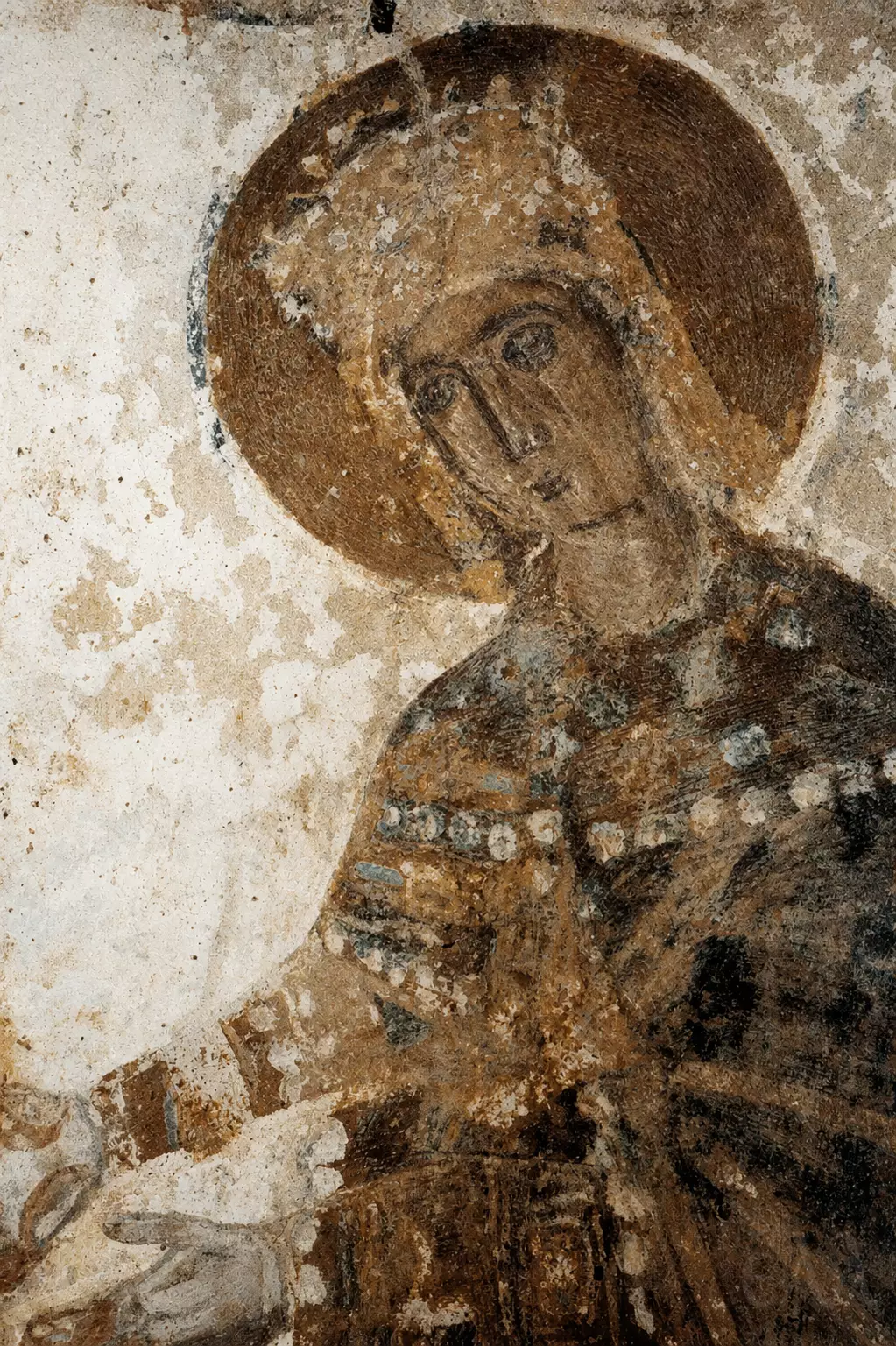
The royal figure seen here has suffered extensive abrasion and paint loss, though the essential structure remains surprisingly legible. A broad halo encloses an elongated head with large dark eyes, a long narrow nose and a small mouth. Below, the garment is densely articulated by pearled bands and blue-green ornamental forms, traces of an original richness now interrupted by exposed plaster. The costume provided earlier scholarship with an important element in identifying the figure as Solomon and in reading his presence beside Christ through Old Testament kingship, wisdom and the Temple.
Dating and interpretation have never been entirely settled. Nikolaos Ghioles, in his 1999 study, argued for the second half of the seventh century and related the painted programme to contemporary Christological disputes, including the controversies surrounding Monoenergism and Monothelitism. He also proposed a possible connection with Pope Martin I, who was exiled on Naxos in 653. These interpretations remain influential, though documentary certainty is lacking.
The Drosiani Deesis and the Royal Figure of Solomon
Detached from the complete composition, the figure traditionally called Solomon already conveys much of the unusual character of the Drosiani Deesis. Slightly inclined, the head disturbs the rigid frontality that might be expected from the imperial appearance of the costume. Dark, almond-shaped eyes dominate the face. Their asymmetry has been accentuated by losses in the paint surface, yet the original painter seems to have worked with considerable freedom, modelling the cheeks and forehead through broad tonal transitions within a predominantly ochre-brown range. The nose is defined by a firm linear contour; the mouth, small and restrained, carries little overt expression.
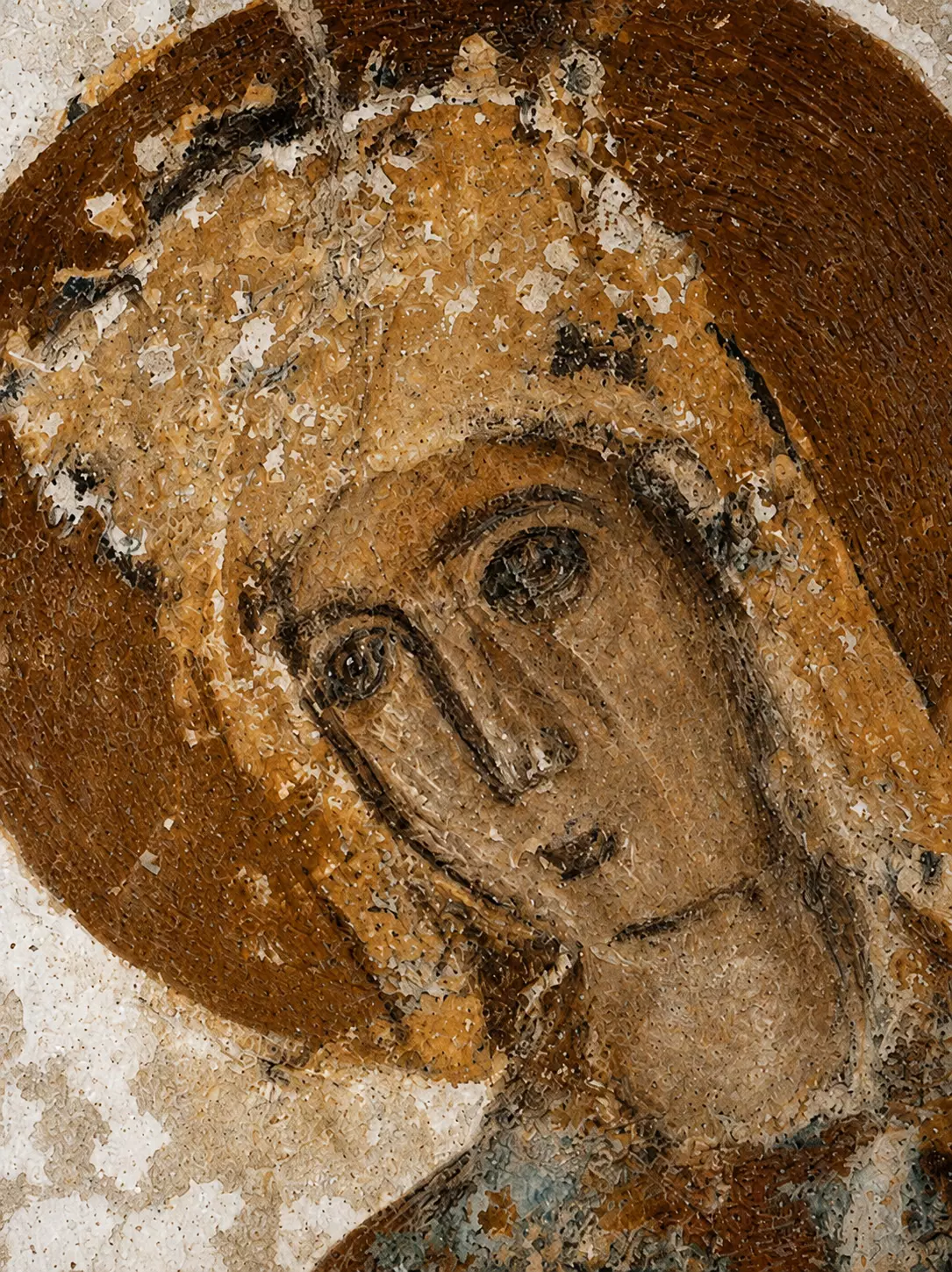
The larger detail makes the condition of the wall painting impossible to separate from its present visual effect. Numerous lacunae pass through the forehead, cheeks and halo, while smaller losses create a granular veil across the surviving flesh tones. Abrasion has weakened several contours. Brown, ochre and black nevertheless remain substantial enough to reveal the underlying modelling, particularly around the eyes and bridge of the nose. The halo appears today as a broad brownish-ochre field, its damaged state advising caution when reconstructing the original chromatic relationship between figure and background.
Below the neck the handling changes. More densely patterned, the garment organizes its surface through bands of pale bead-like motifs, dark outlines and intermittent blue-green elements. Much has disappeared, though enough survives to preserve an impression of ceremonial richness. The effect would once have distinguished this figure sharply from more simply clothed participants in the composition. Royal dress, in the traditional interpretation, supplied Solomon with a visual identity appropriate to the biblical king without depending exclusively upon an inscription. Such costume also carried a language familiar to Late Antique and Early Byzantine representations of sovereignty: pattern, precious ornament, ordered surfaces, an almost architectural construction of the body beneath the textile.
Seventh-century wall painting could move between classicizing modelling and more abstract linear modes, sometimes within monuments belonging to the same broad cultural horizon. Drosiani participates in that unsettled visual world. The face retains volume and a residual naturalism, while individual features are drawn with an economy that already gives the physiognomy an iconic concentration. Neither tendency entirely dominates. Even the eyes possess this double character, firmly outlined and enlarged yet set into a face still conceived through tonal substance rather than a purely graphic system.
Within the complete northern conch, the established reconstruction places Christ at the centre, with the Virgin Mary and the figure identified as Solomon on Christ’s right, and John the Baptist together with an imperially dressed female figure, traditionally interpreted as the personification of the Church, on Christ’s left. Above this group is the Virgin Nikopoios. Elsewhere in Drosiani, the programme includes the Ascension (Acts 1:9–11) in the sanctuary apse and the remarkable double representation of Christ in the dome. Taken together, these images led Ghioles to interpret the decoration within the theological debates over Christ’s human and divine natures that marked the seventh century.
Solomon acquired a particular significance within that interpretation. As biblical king and figure of wisdom, he could evoke the Old Testament Temple while participating in a visual argument centred upon Christ, the Incarnation (John 1:14) and salvation. His elaborate dress establishes a royal register immediately; the wider theological meaning depends upon the identification of the figure and upon its relationship to the remaining members of the group. Exceptional within a Deesis, the presence of Solomon demands explanation, since the later and vastly more familiar Byzantine formula concentrates upon Christ flanked by the Theotokos and John the Baptist.
Recent scholarship has complicated the matter considerably. A 2026 reassessment by Vasiliki Limberis argues that only three of the five figures can be identified securely and questions the authenticity of the nominal inscriptions attached to the two figures wearing imperial costume. According to that reading, their inscriptions may have been added later, so the traditional identification of the male royal figure as Solomon can no longer be treated as entirely secure. The argument leaves the older historiography in place while changing the degree of certainty with which its conclusions should be repeated.
The image itself consequently deserves a certain independence from the name placed upon it. What survives with confidence is a haloed male figure represented in extraordinarily rich ceremonial dress, integrated into one of the earliest surviving and most elaborate formulations associated with the Deesis. His narrow face, penetrating gaze and ornamented costume retain a striking authority despite the damaged surface. If the traditional identification as Solomon remains persuasive, his presence opens the composition toward Old Testament kingship and wisdom; if that identification is revised, the costume, position and relationship to Christ will require another historical explanation. The worn wall still preserves the question in the painted surface itself.
(The translation was edited by E. Wilson.)