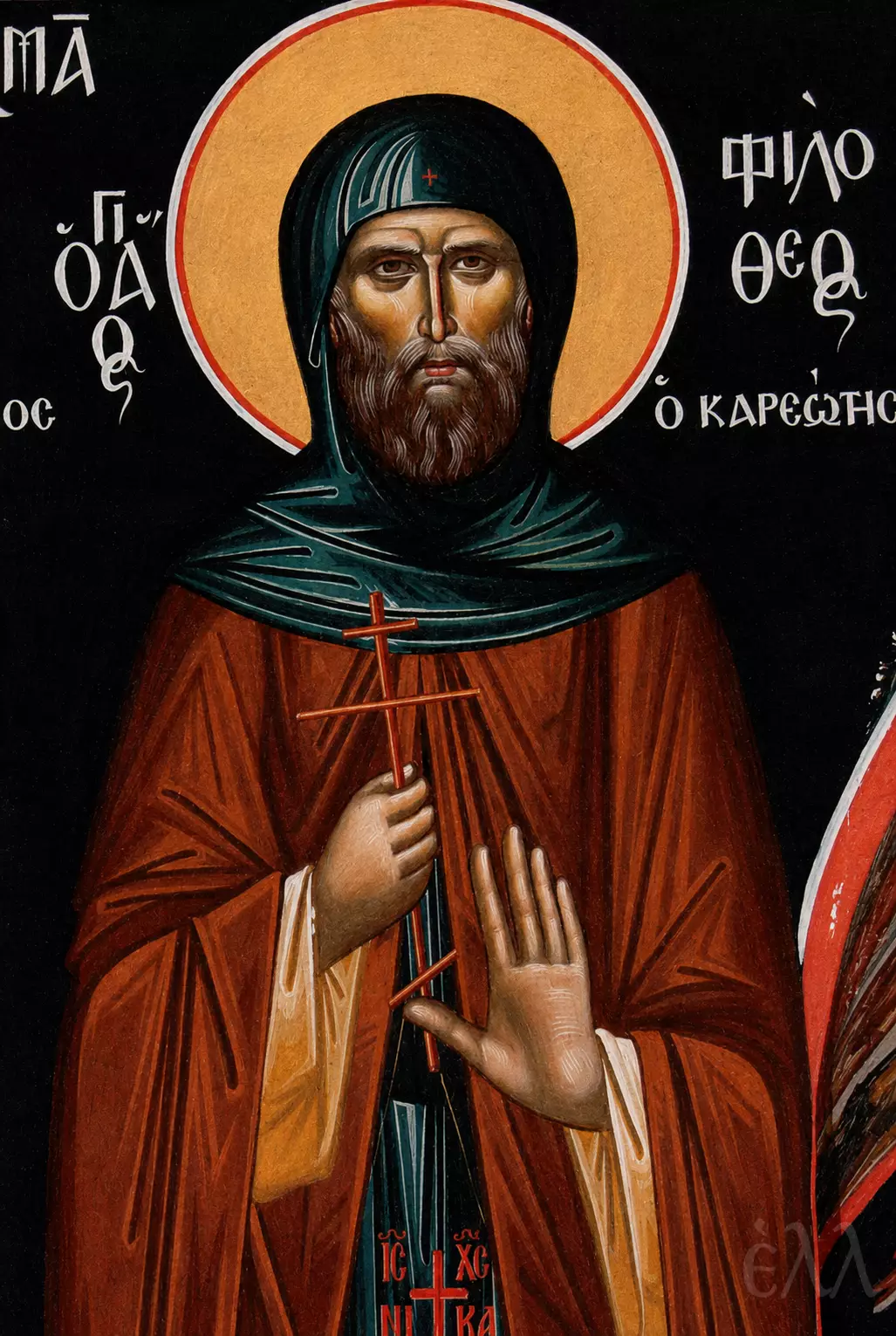
Within the trapeza of Koutloumousiou Monastery on Mount Athos, Saint Philotheos of Karyes is represented in a contemporary wall painting belonging to a modern Athonite decorative programme that preserves the formal discipline of the Byzantine and Post-Byzantine tradition. The saint occupies the pictorial field frontally, his upper body set against an uninterrupted black ground and enclosed above by a broad gold nimbus edged with narrow white and red bands. A dark monastic head covering descends around the face and over the shoulders, its blue-green highlights separating the folds from the background, while the large red-brown garment below provides the principal area of warm colour.
The gestures are carefully differentiated. Close to the centre of his body, the saint holds a slender red cross in his right hand; his left hand is raised with the palm exposed. Lower down, on the dark central section of the habit, another red cross appears together with the abbreviated IC XC NIKA, the familiar Christogram meaning “Jesus Christ conquers.” A smaller cross is painted on the head covering above the forehead. Around the nimbus, the identifying inscription gives the name Philotheos and the designation Kareotis, “of Karyes.” At the far edge of the composition survives a fragment of a neighbouring haloed figure, indicating that Philotheos belongs to a wider succession of saints rather than an isolated portrait.
Saint Philotheos of Karyes: Face, Gesture and Monastic Identity
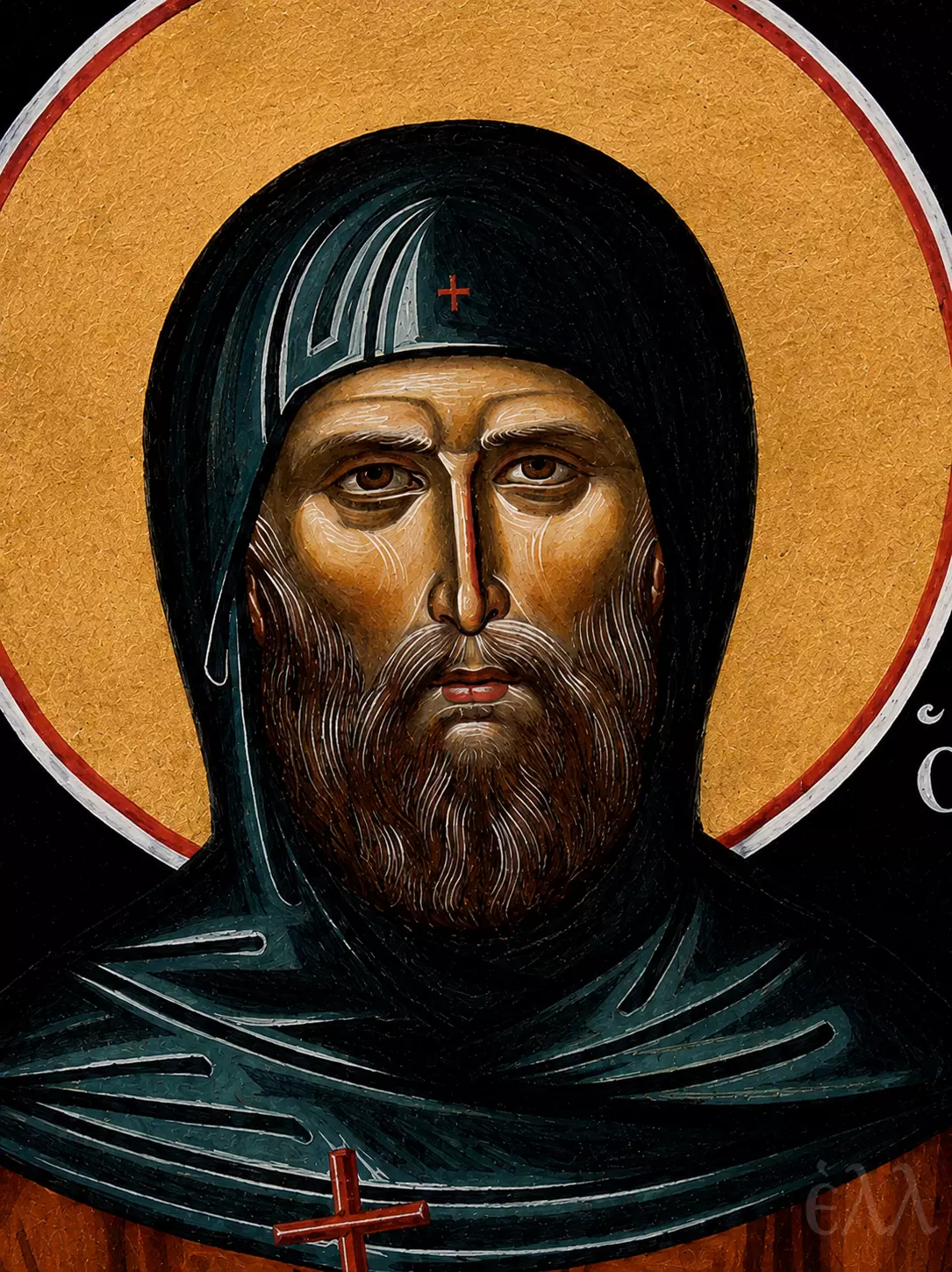
At closer range, the face becomes the most concentrated part of the painting. A long, narrow nose establishes the central vertical axis, extending almost directly from the brow towards the small closed mouth. The eyes, large and deep-set, are directed outward in a steady frontal gaze. Heavy curved eyebrows, darkened lower eyelids and the sharply marked bridge of the nose give the physiognomy its austere concentration. Strongly linear, the modelling combines warm ochre and brown flesh tones with narrow pale highlights along the forehead, nose, cheeks and the areas beside the eyes; shadow gathers beneath the brow and around the lower face. Volume is created without weakening the firmness of the contour.
The beard receives a different treatment from the skin. Long brown and grey strands descend in compact, slightly undulating lines, lighter strokes identifying individual locks around the cheeks, moustache and chin. Its lower edge merges gradually into the dark hood, so that the face seems almost suspended within the surrounding garment. Against the warm complexion, the near-black monastic covering and the luminous nimbus establish strong chromatic separations, with the countenance held at the centre of attention.
The head covering itself contributes substantially to the pictorial structure. Its dark surface is articulated by blue-green and pale linear accents, particularly on the saint’s right side, where a sequence of narrow folds descends from the crown. On the opposite side the fabric remains considerably darker. Within an otherwise strongly frontal composition, this uneven distribution of light introduces a slight internal variation. The tiny red cross above the brow stands between the face and the gold field of the nimbus.
Across the shoulders, broad angular folds spread laterally. Their pale edges and green-blue intervals create a compressed rhythmic movement before the eye reaches the red-brown outer garment. That garment is organised through dense linear passages, some sharply diagonal, others descending in long vertical folds. Restrained in chromatic range though the figure remains, the red-brown surface gives the body considerable visual weight against the black ground. The hands interrupt this larger field.
Around the vertical shaft of the cross closes the saint’s right hand, with the fingers carefully separated. The painter has placed the cross slightly off the central axis, although its upright shaft and short horizontal arm remain visually related to the small cross on the hood and to the larger cross lower on the garment. His left hand, seen fully open, is more expansive: the fingers rise vertically, the thumb extends outward, and the resulting pale shape stands sharply against the darker clothing. One hand therefore carries the principal attribute; the other broadens the otherwise compact silhouette of the figure.
Philotheos belonged to the Athonite world of the fifteenth century. The surviving tradition identifies him as the elder of the Cell of the Holy Archangels associated with Iagaris at Karyes, a kellion dependent upon the Great Lavra. He was also the elder of Saint Nectarios the Karyote. Athonite accounts remember Philotheos as a monk distinguished by rigorous ascetic formation and credit him with discernment and foreknowledge. He died at an advanced age and was buried at his cell; his commemoration is observed on 5 December. A liturgical service in his honour was subsequently composed by the monk and hymnographer Gerasimos Mikragiannanitis.
Those biographical elements acquire a particular visual relevance because the contemporary painter avoids narrative incident. Through physiognomy, clothing, inscription and gesture, Philotheos is presented according to an established vocabulary of monastic sanctity, while the epithet connecting him specifically with Karyes preserves his Athonite locality. In the refectory, where communal monastic life unfolds beneath painted sacred figures, the representation takes its place among images of ascetics and elders whose memory belongs to the Holy Mountain.
The painting’s linear highlights, strong frontal organisation and dark chromatic field draw upon a much older Athonite pictorial inheritance. Scholarship on Athonite painting has traced the importance of monastic workshops and monumental decoration on the peninsula, particularly during the flourishing of the sixteenth century, while the wider historical culture of Mount Athos has been examined through the unusually continuous institutional and artistic life of its monasteries. The present work belongs to a contemporary programme, yet its painter works within that inherited visual language, retaining the frontal pose, linear highlights, dark ground and broad gold nimbus.
(The translation was edited by N. Jones.)