
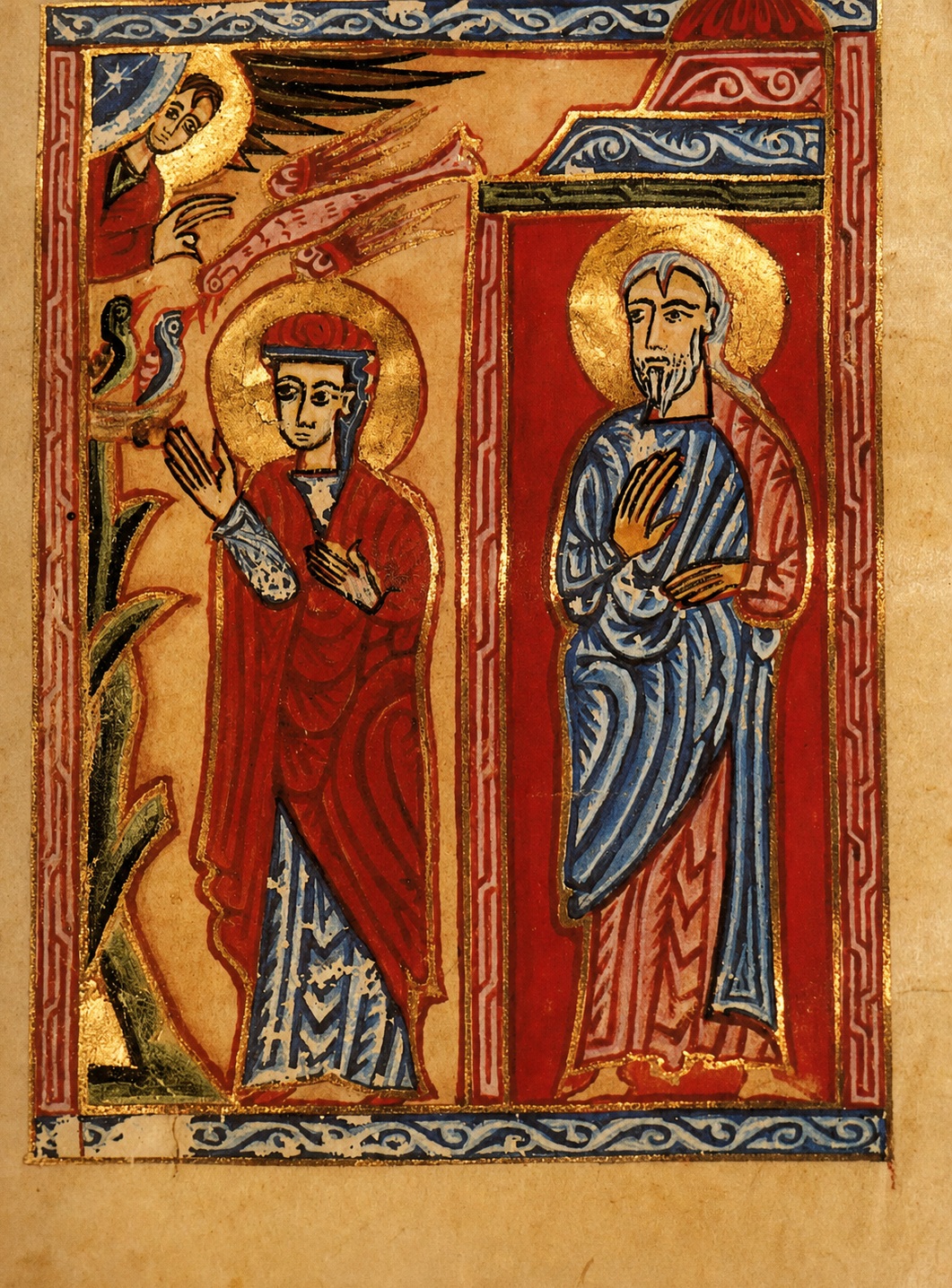
A single folio of dyed parchment, gilded with gold leaf and dated 1591, carries one of the more distinctive pairings found in Armenian manuscript illumination: the Annunciation to Anna, set beside the related apparition granted to her husband, Joachim. Housed today in the Armenian Museum of France, in Paris, the leaf belongs to that portable inheritance rescued by the Armenian diaspora across centuries of displacement. It once formed part of a hymnal, one of the liturgical books in which the Armenian Church recorded the hymns proper to each feast of its calendar.
Absent from the canonical gospels, the story nonetheless circulated widely through later apocryphal writings and became, across several Eastern Christian traditions, a favoured subject for illuminators. It recounts the prayers of an elderly, childless couple and the messenger who answered them — prayers eventually credited with the birth of the Theotokos. No signature identifies the painter, a silence typical of Armenian miniature work from this period; the drawing nonetheless betrays a familiarity with pictorial formulas established in manuscript workshops generations earlier, formulas passed down through long practice and repeated copying.
Composition and Iconography of the Annunciation to Anna
Two arched compartments divide the page, each framed by red colonnettes and closed above and below by lively interlace bands of blue, red and gold. Gold leaf fills the ground within both arches, a technique lending the folio a light that seems less painted than deposited onto the surface itself. In the upper left corner of the first compartment, enclosed within a small blue semicircle marked by a star, a winged figure in a red garment leans downward; the wings are drawn as sharp, flame-like strokes, closer in effect to bursts of radiance than to the plumage of any actual bird. Just below, a stylised plant with pointed leaves rises along the margin, and among its foliage sits a small bird with blue feathers — a quiet, garden-like note set against the drama unfolding beside it.
Anna occupies this first compartment, gold halo behind her head, standing frontally in the elongated, almost weightless proportion typical of medieval Eastern figural painting, where physical bulk gives way before spiritual significance. Beneath a red mantle patterned in fine striations, a blue-and-white striped undergarment shows at the hem; one hand is raised near the shoulder, palm turned outward toward the descending messenger, in the gesture of reception traditionally addressed to divine speech. In the second compartment, framed beneath a red canopy edged with pale, scalloped merlons, stands Joachim: an older man, his grey beard divided by a pale central streak, wrapped in a blue-grey striped robe over a rose-coloured tunic, right hand pressed flat against his chest in a gesture of humility. He stands on a small mound rendered in ochre, his gold halo answering hers across the painted interval separating the two arches.
Stylistically, the miniature belongs to the broader current of post-Cilician Armenian book painting that continued, through the Ottoman and Safavid centuries, in scattered monastic and urban scriptoria long after the collapse of the Armenian kingdom in Cilicia. The saturated red grounds, the angular drawing of drapery, and the preference for a flattened, iconic space over illusionistic depth are consistent with that later tradition, even where the exact centre of production for this particular hymnal remains undocumented. Nothing in the folio suggests restoration or later repainting; pigment and gilding appear consistent across the visible surface.
Anna and Joachim in Christian Apocryphal Tradition
The narrative behind the image derives from the Protoevangelium of James, a text composed well after the canonical gospels yet enormously influential on later Christian iconography, both Eastern and Western. According to that tradition, Anna and Joachim remained without children into old age, a condition regarded at the time as a form of social and religious reproach. Separated after Joachim withdrew in shame to the wilderness, each is said to have received, independently, the promise of a child through an angelic visitation — Anna in her garden, Joachim among his flocks. Their daughter, in the tradition that grew from this story, was the Virgin Mary. Armenian hymnals frequently paired the two annunciations on a single opening, much as this folio does, underscoring their shared answer to a single prayer.