
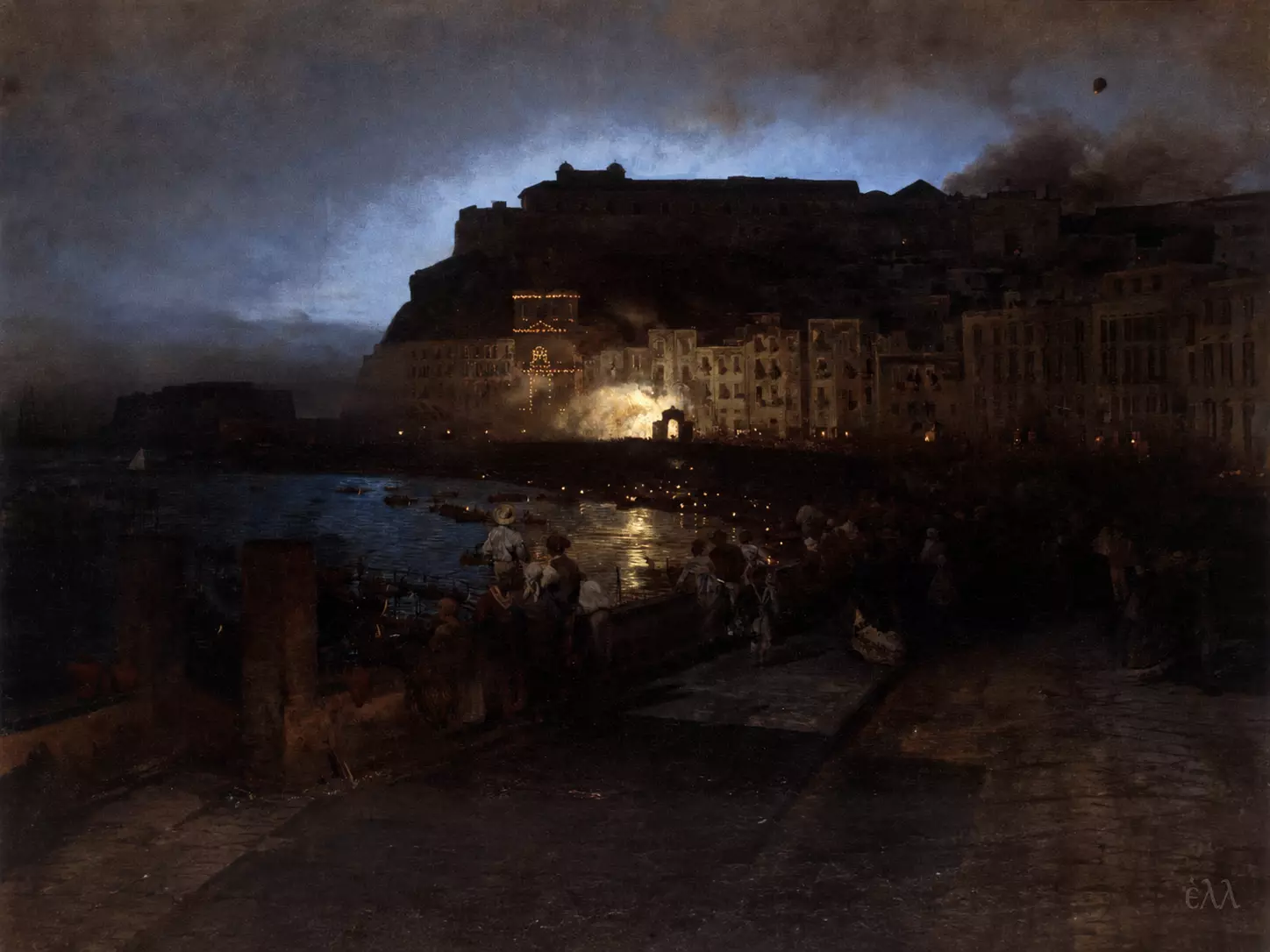
In 1875, the German painter Oswald Achenbach captured a nocturnal celebration in the Bay of Naples, where hundreds of spectators gather along a waterfront to watch fireworks illuminate the dark sky above the water. The painting, known as Fireworks in Naples, was executed in oil on canvas measuring approximately sixty-six by one hundred and two centimeters, and is housed today in the Hermitage Museum in Saint Petersburg. Set in the historic Santa Lucia district, the view looks westward shortly after sunset—a perspective almost entirely transformed by modern urban development. Rising above the rooftops, the dark, massive crag of Pizzofalcone dominates the background, while lower down, a row of decorated buildings glows with garlands of small festive lights. At the center of the composition, a brilliant burst of light marks the moment of launch, sending smoke drifting diagonally toward the upper right. Achenbach, a student and later professor of landscape painting at the Düsseldorf Academy, had traveled extensively throughout the Italian peninsula before creating this piece, seeking the atmospheric conditions that would define much of his career. The result transcends mere topographical recording: architecture, crowd, and light converge into a theatrical image of celebration.
Scenography of the Neapolitan Fireworks
An elongated fortification crowning the Pizzofalcone rock shows windows dotted with scattered points of light within the darkness. Below, along the shore, multi-story structures of old Santa Lucia feature facade decorations formed by small lamps—a floral-like motif signaling the night’s festivities. At this exact spot, an explosive flash illuminates the facade of a church identified as Santa Maria delle Catene, alongside an decorated archway erected for the occasion. Thick, greyish smoke rises diagonally toward the right, nearly touching a small dark hot-air balloon floating high in the sky—a nod to the balloon ascents popular during nineteenth-century Neapolitan festivals.
At the far left of the composition, a low, dark silhouette emerges above calm waters, with the mast of an anchored ship outlined before it, likely representing Castel dell’Ovo half-hidden in the twilight. Between this landmark and the foreground quay lies the bay, its slightly rippled surface shimmering with scattered reflections of golden and white light. Small boats carrying passengers glide slowly among lanterns floating on the water.
The Crowd on the Santa Lucia Waterfront
In the foreground, weathered stone steps form an irregular quay where spectators gather. Women in long dresses and bonnets, men in top hats, and children holding their parents’ hands stand or sit facing the bay, their features soft and shadowed. A small boat is moored to stone steps near the center. The crowd continues toward the right, gradually dissolving into shadow without individual portraiture, directing the viewer’s focus away from the onlookers and toward the spectacle itself.
Light and Atmospheric Technique
Associated with the Düsseldorf School, Achenbach focused on dramatic lighting effects, contrasting natural moonlight with artificial illuminations such as fires and pyrotechnics. In this work, broad, atmospheric brushstrokes render large, dark masses set against vivid points of light, combining Romantic influence with precise architectural observation. The Bay of Naples and the Roman countryside remained his primary subjects for decades, tying his reputation closely to Italian light despite his German training.
Born in Düsseldorf in 1827, Oswald Achenbach initially studied under his elder brother, the landscape artist Andreas Achenbach. Teaching landscape painting at the Düsseldorf Academy from 1863 to 1872, he influenced a generation of younger artists before his death in 1905. The painting passed through the Tretyakov Collection in Moscow and the Pushkin Museum of Fine Arts before entering the Hermitage Museum in 1933. In nineteenth-century Naples, such illuminated celebrations were typically associated with religious festivals like those of Saint Januarius or Our Lady of Piedigrotta, drawing the entire city toward the bay.