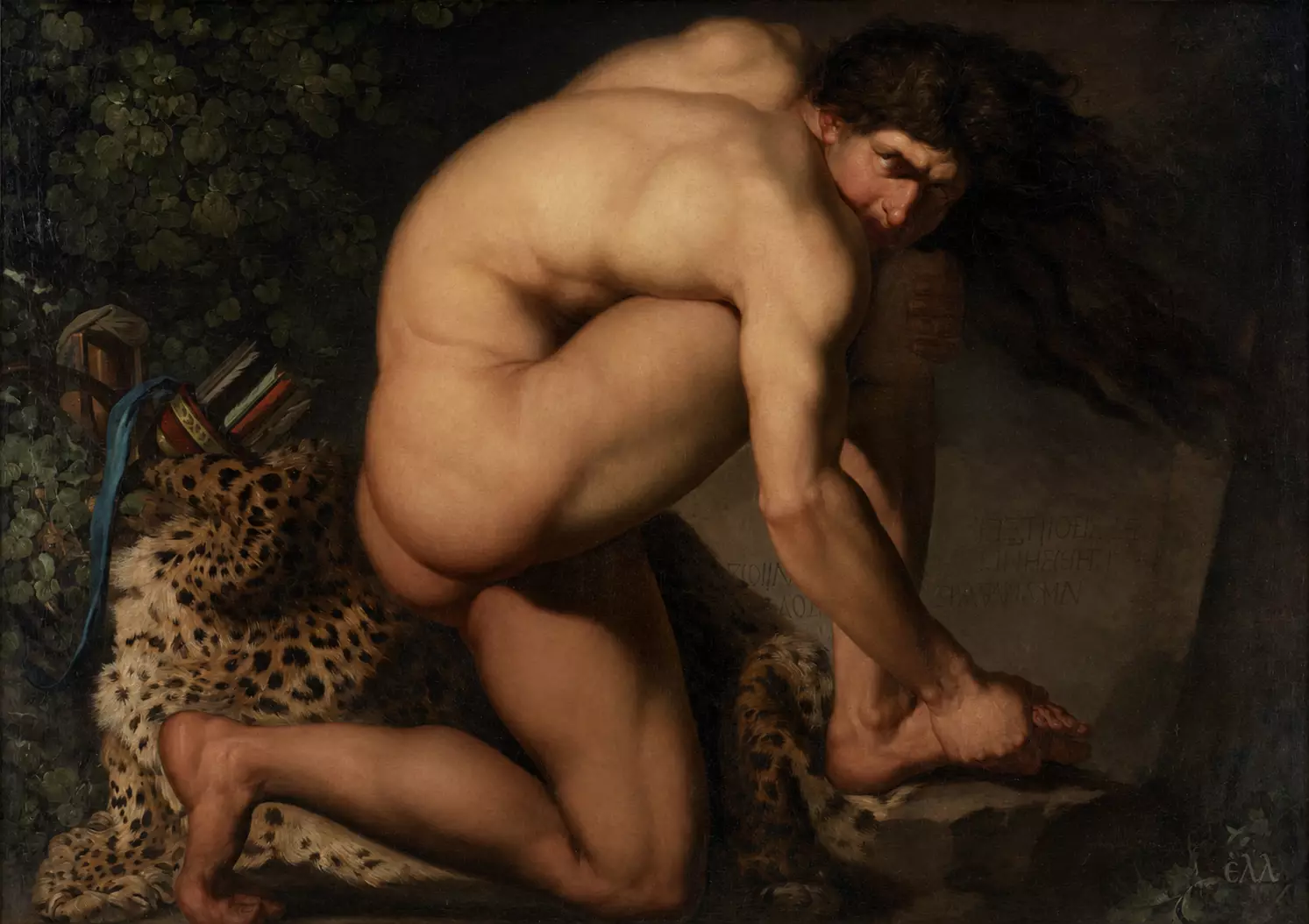
A nude male body, folded almost in two upon a leopard skin, dominates the canvas in The Wounded Philoctetes, completed by Danish painter Nicolai Abildgaard in 1775 in Rome. The oil on canvas, measuring 123 by 178 centimeters, is currently housed at the Statens Museum for Kunst in Copenhagen. Abandoned by his comrades on Lemnos due to an unhealing foot wound, the mythical hero of the Trojan cycle twists his body in a nearly spasmodic motion. His face turns backward, his gaze fixed directly on his own limb. Beside him, a quiver of arrows rests against the rock; a blue cord escapes the animal hide, while behind him emerges a stone slab carved with faux-ancient inscriptions.
Painted during the artist’s five-year stay in Rome on a Royal Danish Academy of Fine Arts scholarship, the piece belongs to his early mature works and testifies to a generation of painters seeking an exit from the serene rigidity of academic neoclassicism. Functioning not as a flawless heroic ideal, the body here bears the full weight of suffering, drawing heavily upon the plasticity of the Belvedere Torso, which Abildgaard had studied extensively at the Vatican.
Composition and Symbolic Elements
Positioned along a diagonal axis traversing the visual field, Philoctetes kneels. One knee rests on the hide, the other leg pulled tightly toward the hand gripping it. This posture twists the spine so severely that the back is presented almost entirely to the viewer, even as the face looks the opposite way. Flung backward, the long hair stands as the sole element of motion amid extreme stillness. A contrast between the calm of the primary body mass and the almost violent turn of the head encapsulates the work’s core logic: a physique trained in the rules of classical proportion, forced to express an agony those rules never accommodated. Light falls almost exclusively on the bare skin, leaving the background submerged in greens and browns so dark they appear black.
Surrounding objects serve as the scene’s prehistory. The leopard skin alludes to the hunter’s life in the wild, where Philoctetes endured years of isolation. Half-hidden behind the knee, the quiver recalls the bow of Hercules—inherited by the hero and destined, according to myth, to bring about the fall of Troy. In the background, a smooth stone surface features capital letters mimicking ancient Greek epigraphy, a common practice among painters of the era who integrated their signatures into the scene as forgotten tombstones on the rock.
Defying Neoclassical Serenity
In 1770s Rome, Abildgaard formed close friendships with the Swiss Johann Heinrich Füssli and the Swedish sculptor Johan Tobias Sergel. These artists resented the standard of serenity established by Winckelmann as the ultimate ideal of ancient Greek art. Published just nine years prior, Lessing’s Laocoön had already opened the debate on how far art could go in depicting pain without sacrificing beauty. Abildgaard’s Philoctetes delivers a bold response: the hero’s face does not suppress its torment, even while the anatomy remains faithful to classical sculptural norms. This was no isolated gesture, as Füssli’s circle actively sought subjects from Homer and Shakespeare that emphasized extreme emotion.
Born in Copenhagen in 1743, Nicolai Abildgaard died in Frederiksdal in 1809. Following studies at his hometown academy, he departed in 1772 for Rome, spending five years studying ancient sculpture and Renaissance painting. Returning to Denmark in 1777, he assumed the directorship of the Royal Academy of Fine Arts, where he mentored the sculptor Bertel Thorvaldsen and the painter Christoffer Wilhelm Eckersberg. His body of work serves as a vital link between late neoclassicism and the dawn of Danish romanticism.
Today, hanging among other works by his generation in the Copenhagen museum, the painting stands out through the sheer intensity of a body turned in upon itself—a posture no academic manual of the time would have recommended. Philoctetes’ gaze, pinned to the wound, remains the only focal point where the narrative halts, leaving nothing but pain.