
The Compositional Dynamics of Abildgaard Culmin’s Ghost
The intersection of Nordic mythological revival and rigorous anatomical study finds profound expression in this late eighteenth-century canvas. Executed circa 1794 by the Danish painter Nicolai Abraham Abildgaard, the painting—an oil on canvas measuring 62 by 78 centimeters and currently housed in the Nationalmuseum, Stockholm—marks a critical transition between the austere strictures of Neoclassicism and the burgeoning emotional turbulence of early Romanticism. Drawing its narrative foundation from the immensely popular Ossianic poems compiled by James Macpherson, the composition distills the tragedy of martial loss into a concentrated, claustrophobic psychological encounter. The visual field eschews the grand, populated battlefields of traditional history painting, isolating instead the grief of a single maternal figure confronted by the spectral return of her fallen son. This supernatural visitation, Abildgaard constructs it not through ethereal transparency, but via a stark, sculptural solidity that underscores the visceral reality of death. The tension between the classical corporeality of the deceased warrior and the unearthly context of his suspension upon a cloud generates a profound visual dissonance. Through meticulous manipulation of chiaroscuro, a highly restricted palette, and the deliberate obfuscation of the living subject’s face, the artist articulates an atmosphere dense with silence and sorrow. This visual economy amplifies the psychological weight of the scene, forcing the viewer to engage directly with the mechanics of mourning and the eerie intrusion of the supernatural into the earthly realm.
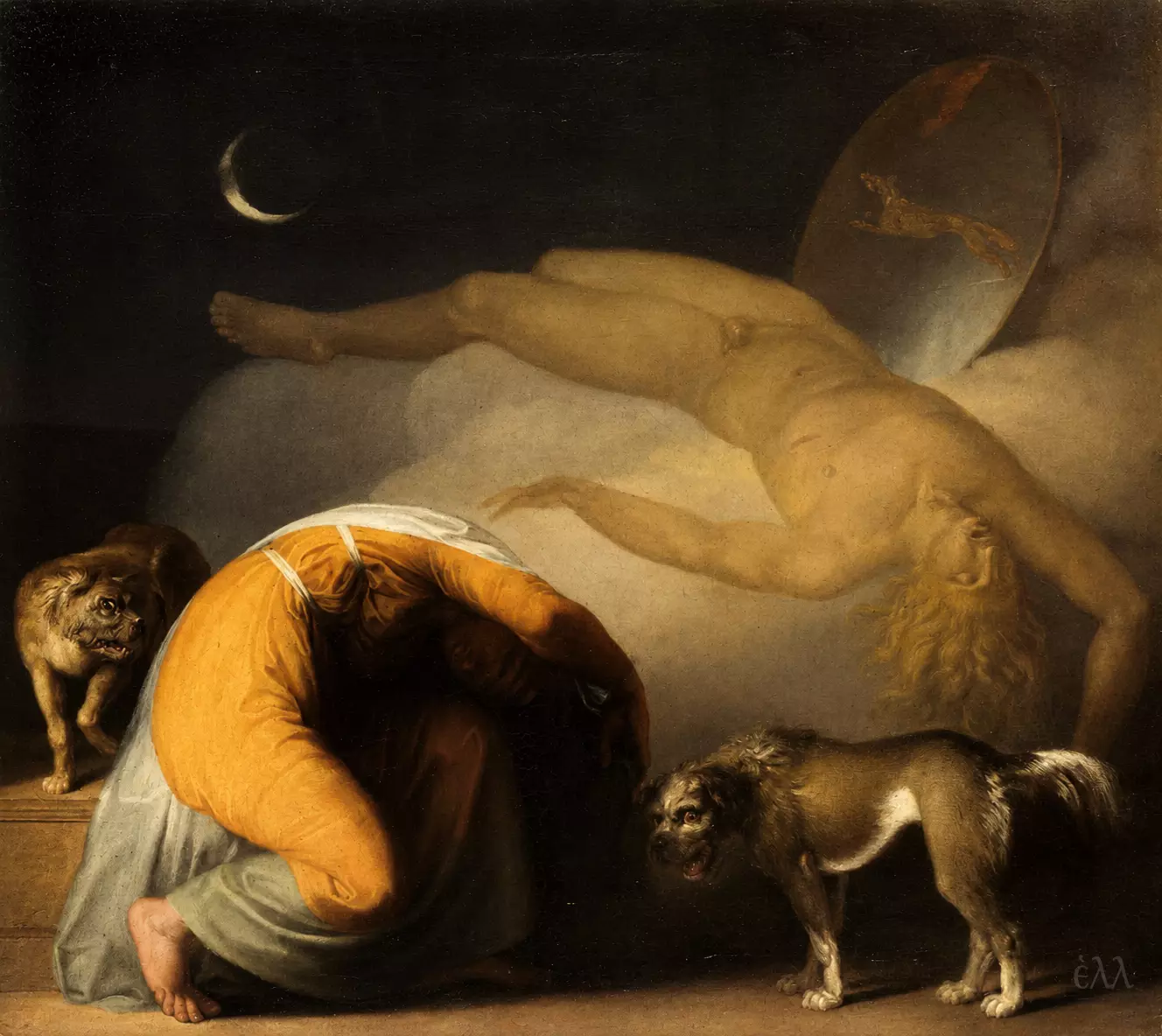
Suspended within an impenetrable void, the spectral figure of the fallen warrior establishes the primary compositional axis of the painting. Abildgaard Culmin’s Ghost captures the precise moment of supernatural intersection, a moment wherein the boundaries separating the terrestrial sphere from the afterlife dissolve. The visual narrative—an arrangement the artist executes with rigorous geometric precision—places the luminous, levitating body of the son in the upper register, while displacing the agonizing, collapsed mass of the mother to the lower left. The structural flow of the image is interrupted by the severe horizontality of the ghost, inserted abruptly into the space directly above the grieving woman.
Nude, pallid, structurally idealized, the apparition rests upon a dense, billowing cloud formation. The dead warrior exhibits a classical corporeality; a corporeality that belies his ethereal state. His arms extend downward and backward, the head falling into deep shadow with golden hair cascading limply, indicating the absolute cessation of life. Emphasizing the sculptural plasticity of the torso, the artist relies upon a meticulous tonal modeling of the flesh, illuminated by an unseen, sickly light source that seems to emanate from the phantom himself. Behind his supine form, a large circular shield—faintly decorated with the golden, bounding silhouette of a canine or wolf—and the shaft of a spear rest upon the vaporous bed. A slender crescent moon pierces the absolute darkness in the distant upper left, providing a solitary spatial marker in an otherwise compressed, suffocating environment.
The Terrestrial Weight of Grief
The mother’s figure, anchoring the lower left quadrant, provides a stark, material counterpoint to the suspended apparition. Her body collapses inward, draped heavily in a luminous ochre mantle over a slate-blue gown. The face remains entirely concealed. Her physiognomy, shielded by her own arms and enveloped by the shadows of her garments, is hidden from the viewer; we deduce the magnitude of her despair solely from the physical contraction of her frame. This deliberate obfuscation functions as a potent emotional device, transferring the burden of emotional articulation from facial expression to the rhythmic, cascading folds of the drapery. The living succumb to gravity; the dead, to the ether.
Symmetrical stability is deliberately avoided. The composition relies upon an asymmetrical balance, weighing the expansive, illuminated horizontal of the ghost against the concentrated chromatic intensity of the mother’s crouching form. Placed directly upon the hard geometry of a stone step or plinth, her bare foot underscores her vulnerability and her indissoluble connection to the mortal realm. Through the careful topological shifting of these visual weights, the spatial ambiguity of the dark background forces the viewer to focus exclusively on the interaction between the solid, grief-stricken mass and the luminous, weightless specter. Step by step, the logic of the spatial arrangement reveals a highly controlled orchestration of light and shadow. The deep shadows enveloping the mother’s arms and the lower folds of her blue garment merge seamlessly with the blackened background, making her form appear as though it is being consumed by the surrounding darkness.
Canine Sentinels and Supernatural Perception
Flanking the human drama, two dogs serve as intermediaries between the physical and spiritual worlds. In the right foreground, a sturdy canine—rendered with striking naturalism, displaying patches of white on its muzzle, chest, paws, and tail—stands rigidly. Its gaze is fixed intently upward at the apparition. The animal’s mouth is slightly open, the teeth bared, its stance capturing the visceral, instinctual reaction to the unnatural presence. Conversely, a second, brown-coated hound emerges from the shadows on the left, positioned behind the mourning mother, its expression one of cautious observation. The presence of these animals introduces a sensory realism into the mythological narrative, validating the supernatural event through their instinctive alarm.
The brilliant ochre of the mother’s mantle, catching the same spectral light that illuminates her son, creates a visual tether between the two primary figures. This chromatic link—a link that physically bridges the gap between the terrestrial stone and the celestial cloud—serves as the emotional fulcrum of the piece. The air within the pictorial space is thick, heavy, still, absolute. Abildgaard portrays the mother and the son and the hounds in a rigid, inescapable emotional triangle.
The Aesthetic Vocabulary of Nordic Neoclassicism
The execution of these details reveals the painter’s sophisticated command of narrative economy. Stripping the Ossianic legend of any superfluous contextual markers, the painter isolates the emotional essence of the encounter. The seamless integration of classical form—evident in the heroic, albeit lifeless, anatomy of the son—with the brooding, atmospheric tension characteristic of early Nordic Romanticism results in a pictorial language of profound resonance. Every element, from the stark juxtaposition of the vivid yellow ochre against the monochromatic gloom to the taut musculature of the startled hound, reinforces the overarching theme of loss and eternal separation.
This exacting approach to the canvas demonstrates an acute awareness of the limitations and capabilities of the oil medium. The application of paint remains tightly controlled, favoring smooth, imperceptible brushwork that heightens the illusion of three-dimensional form. Such precision aligns the work with the academic traditions of history painting, yet the deeply internalized, subjective nature of the subject matter subverts those very traditions. The mythological past is invoked not to provide a moral exemplar of civic virtue, but to explore the private, devastating reality of bereavement. Through this synthesis, the painting transcends mere literary illustration, offering instead an enduring meditation on the finality of death and the unyielding architecture of human sorrow.