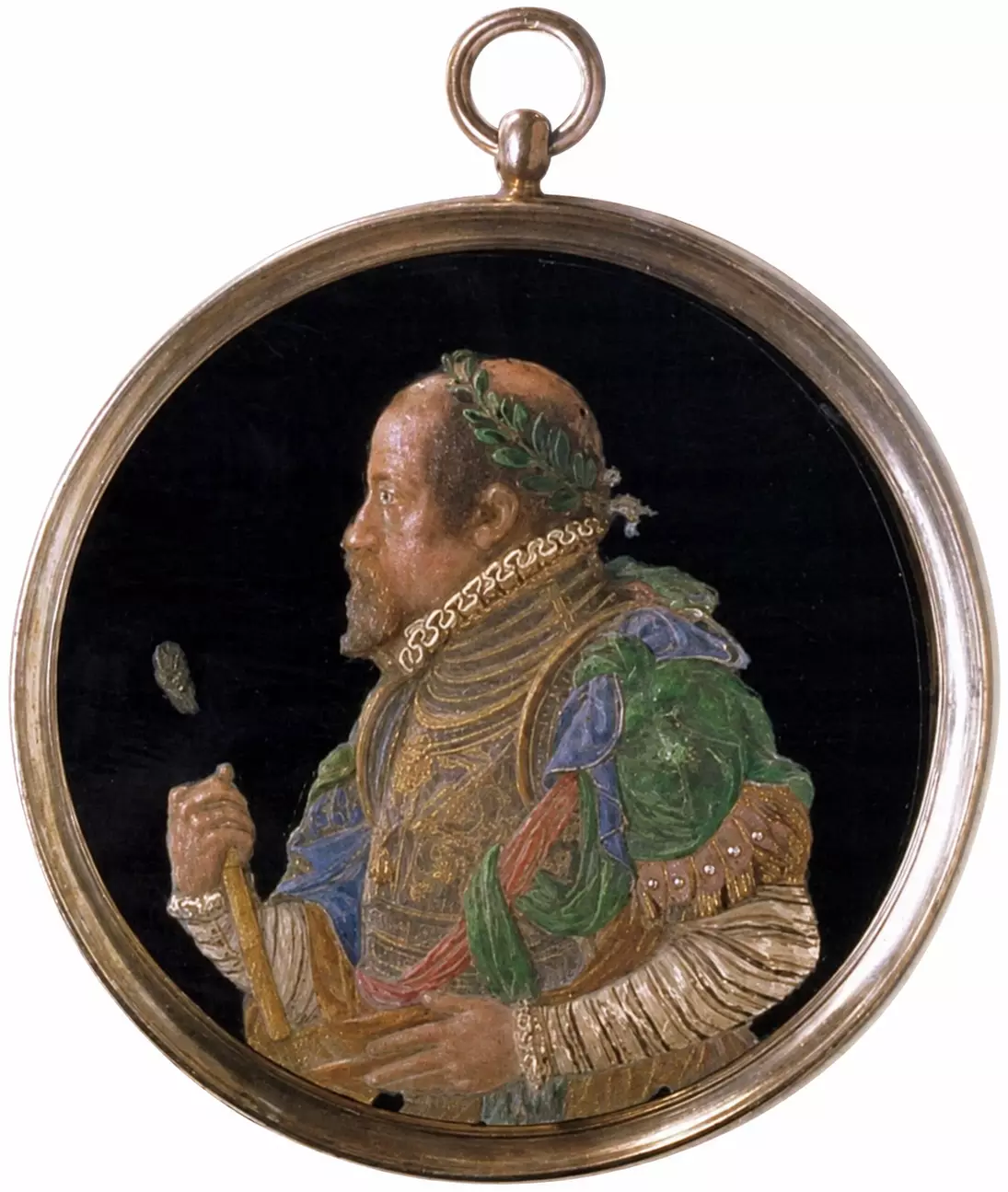
A colored wax relief portrait of Emperor Maximilian II Habsburg, crafted around 1575 by the Italian medallist Antonio Abondio, is preserved today at the Kunsthistorisches Museum in Vienna. Worked upon an obsidian disc and framed in silver and pearls, the piece reflects the mastery of an artist born in Riva del Garda in 1538 and deceased in Vienna in 1591. Abondio was a pioneer of polychrome wax portraiture at the Habsburg court, where he served Maximilian II and subsequently his successor, Rudolf II.
Likely created in Innsbruck, this small object encapsulates the ambition of courtly art: to immortalize a ruler’s likeness with the precision of a painter and the tactile substance of a sculptor. The emperor appears in a strict profile pose following ancient numismatic traditions, wearing a laurel wreath upon his head and holding a marshal’s baton in his right hand.
The Artistry Behind the Maximilian Medallion
Against the dark depth of obsidian, the wax acquires the dimensionality of oil paint, rendering with painterly subtlety every facial nuance, from the sparse beard to the fine lines around the eyes. The cuirass, decorated with gold arabesques, evokes the armor of Roman generals, while a high pleated ruff collar surrounds the neck alongside a golden chain of office.
Over the shoulder, a voluminous green sleeve with gold bands contrasts with draped blue fabric, while a red sash crosses the chest diagonally as an emblem of military honor. The left hand rests low against the chest. The reverse side of the medal bears the inscription VICTORIA DACICA, reflecting the court’s military aspirations against the Ottoman Empire.
A legacy of Roman numismatic portraiture, this technique evolved in Abondio’s hands into an exquisite micro-sculptural art—portable, precious, and designed to be worn or exchanged among sovereigns.