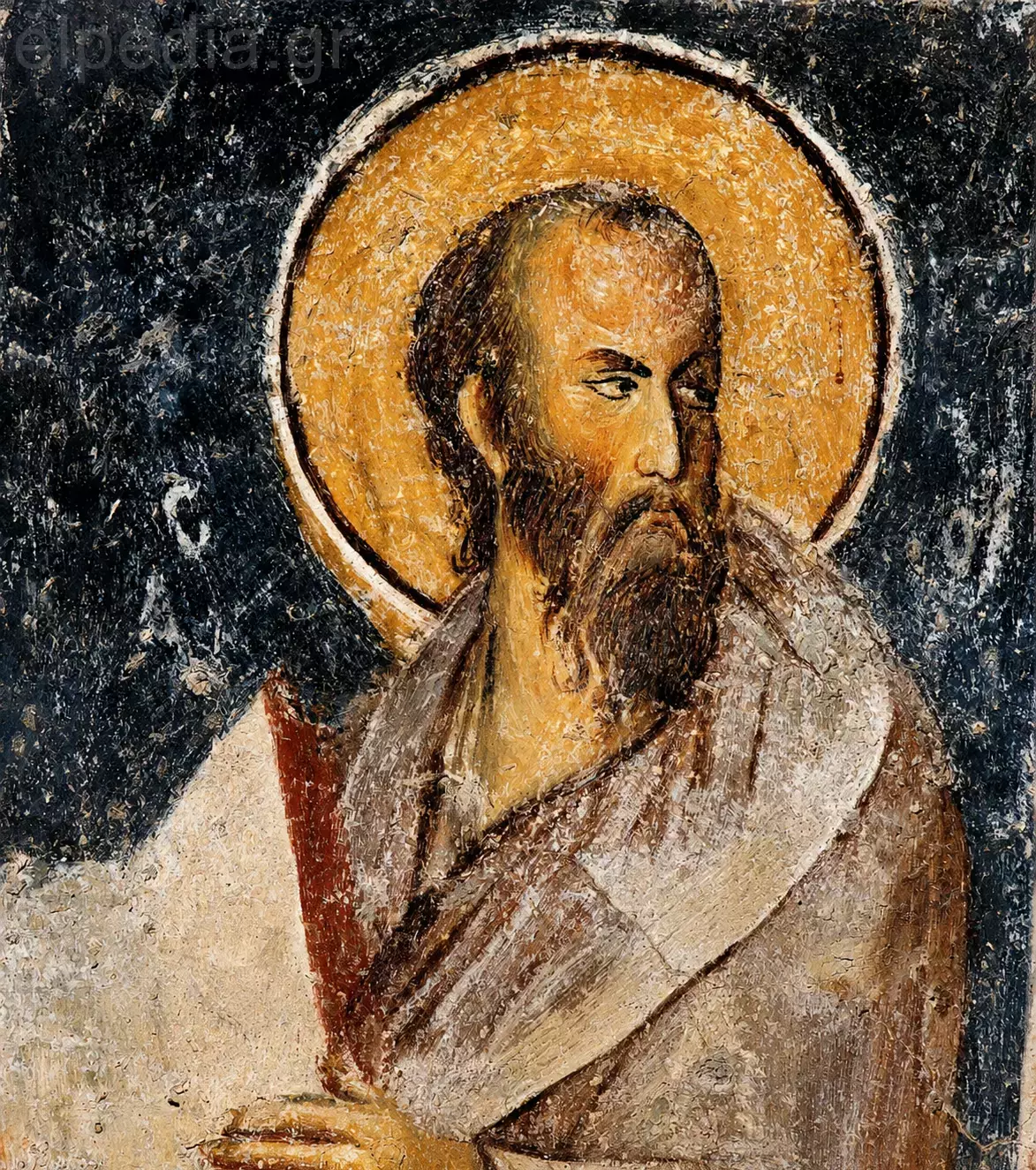
In the northwestern chapel of one of the katholika of the Vrontochion monastery at Mystras is preserved — in a fresco fragment which time has afflicted without however having extinguished it — the figure of the apostle Paul. Unknown remains the name of the painter, as happens, indeed, with the greater part of the monumental painting of the site. The composition dates to the early decades of the 14th century, to the years, that is, when the abbot Pachomios was rebuilding the new katholikon of the monastery and endowing it with an iconographic programme the quality of which testifies to a direct relationship with Constantinople. The history of the monument following the Ottoman conquest, its abandonment, and the gradual return of scholarly interest to its study and management, have occupied an extensive dissertation devoted to post-Byzantine Mystras.
The apostle is rendered in bust, wrapped in a white cloak that allows his reddish tunic to show through at the opening of the neck, with a golden halo that distinguishes him as a sanctified figure. The high, bare forehead and the long bifurcated beard follow faithfully the established iconographic type that separates Paul from Peter already since the first centuries of Christian iconography. Lowered the gaze, it gives to the composition an introspective tone, far from the frontal severity of other apostolic representations of the era.
The Apostle Paul at Mystras: The Chapel and its Position within the Katholikon
This northwestern chapel belongs to a complex and original edifice, known in the bibliography as the “Mystras type”, which combined the longitudinal basilica of the ground floor with a five-domed cross-in-square church on the upper storey. Two tower-chapels initially flanked the ends of the narthex, whilst in the second half of the 14th century other spaces of worship were added, enriching even further the already dense iconographic programme of the katholikon. The masonry — with the roughly hewn stones and the sparse horizontal courses of bricks — and the facade with the many domes and the porticoes refer directly to models of the Capital.
In the interior, the lower sections of the walls had once been revetted with polychrome marbles, a zone of luxury above which developed in arched frames figures of standing saints. Into this exact system is integrated, stylistically and spatially, the figure we are examining, although the decay of time has removed from around it every architectural element of framing. Two-storeyed was, besides, the narthex itself, with its own dome in the centre, while on the upper storey was formed a “promenade” that reached unto the eastern ends of the building, above the prothesis and the diakonikon — a solution that lent to the whole the sense of an ambitious monastery, with gaze directed constantly towards the Capital.
The Face, the Gaze and the Vestment of the Figure
Deep grey-blue, almost dark, is the background against which the apostle projects, with white spots that testify to the decay of the plaster and the unevenness of the surface after centuries of exposure. The halo, in a warm golden ochre, is surrounded by a deep red outline and gathers around it the light which the rest of the composition refuses. The face, modelled in warm ochres with shadowings in reddish hues, bears a high and bare forehead, a trait that Byzantine iconography attributed steadfastly to Paul to declare the wisdom and the maturity of his spirit. The beard — long and bifurcated, in chestnut-red tones with lighter gleams at its peak — frames a mouth closed and grave.
Lowered the eyelids, the gaze avoids the viewer and turns towards a thought which the painting does not name. White is the cloak that covers the shoulders, with folds rendered in dark linear borders, according to the schematised plasticity that distinguishes Palaeologan painting. From beneath projects, at the opening of the neck, a strip of vivid red colour, perhaps a remnant of the tunic, perhaps a section of an omophorion which modern research has not yet clarified fully.
The Byzantine Art of Mystras: Position of the Work in the Fresco Tradition
Not an isolated phenomenon is the quality of this figure. It belongs to a broader movement of artistic flourishing which Mystras knew in the early decades of the 14th century, when workshops with direct ties to Constantinople transferred to the Peloponnese the models of the new monumental style. Plastic clarity, calmness of volumes and a restrained, almost classicising simplicity in the proportions characterise this current, which would subsequently stamp also other great ensembles of the site, from the Peribleptos unto the Pantanassa. The figure of Paul, however much it has paid the heavy toll of the centuries, belongs indubitably to this tradition of Byzantine art that elevated Mystras into one of the most significant artistic centres of late Byzantium.
The study of such fragments — however fragmentarily they are preserved — composes gradually a more complete picture for the programme that once covered the entire space of the chapel, and reminds that every stone and every trace of colour at Mystras constitutes a testament of an art that withstood, albeit fragmentarily, time. The modern visitor, or even the researcher who approaches the subject through the bibliography, is called ultimately to read in this ruined face the testimony of a workshop which, working far from Constantinople, managed to transfer to the Peloponnese that same plastic sensitivity that characterised the metropolitan painting of its times.
(Translated from the Greek text by K. Pappas.)

