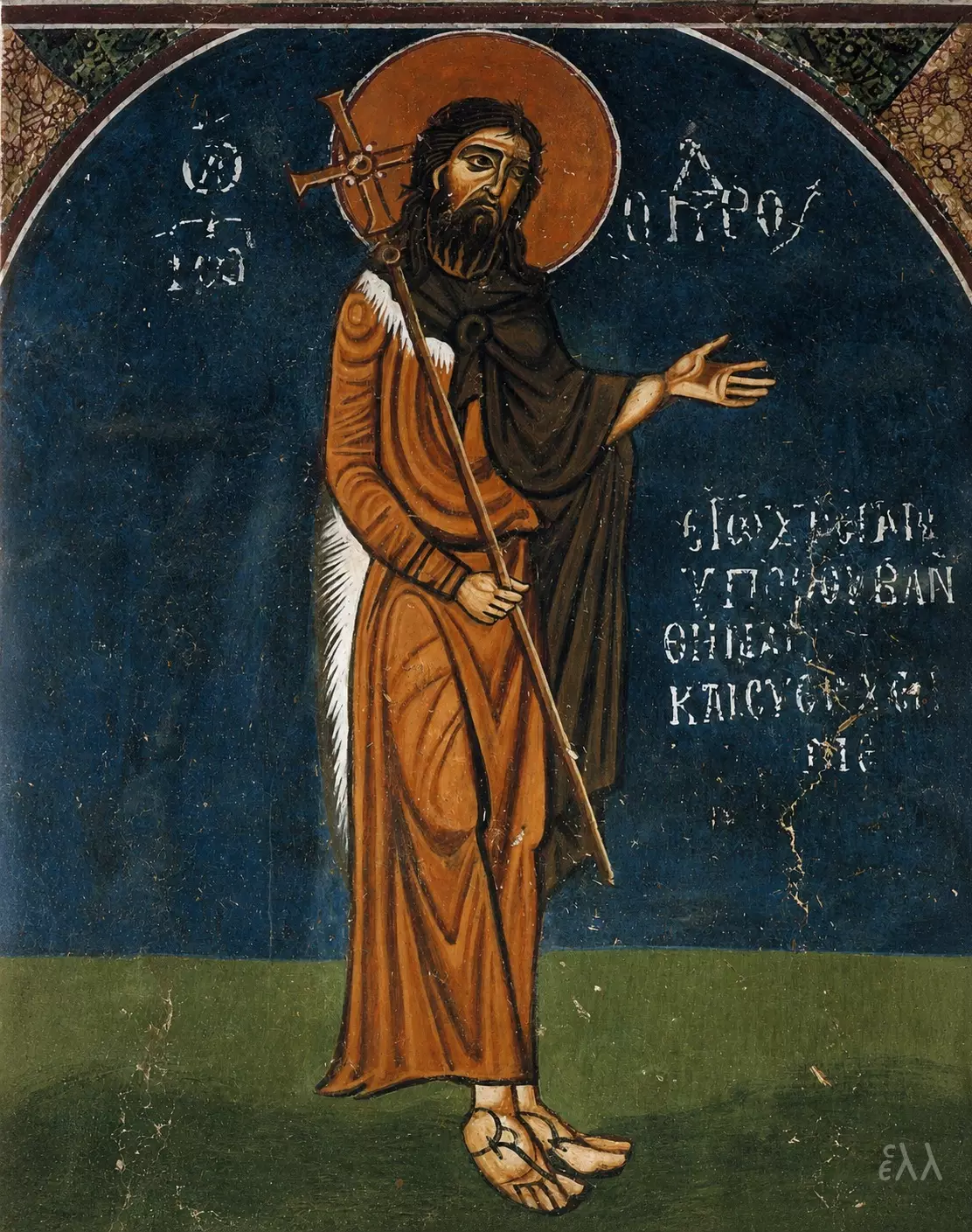
In the southwestern chapel of the catholicon of the monastery of Hosios Loukas, in Boeotia, is preserved a fresco of the third quarter of the 11th century which depicts the meeting of Christ with John the Forerunner, the moment before the baptism in the Jordan. The pair of the two figures is situated in the highest zone of the space, above the scene of the Baptism, the Forerunner on the north wall and Christ on the east, under arched openings that rest upon colonnettes.
The monument, known primarily for the gilded mosaics of the narthex and the main church, hosts in the lateral chapels a series of frescoes less brilliant in material, yet of equally high technical quality, the work probably of painters with a Constantinopolitan education. From the entirety of this composition, the present article examines exclusively the figure of the Forerunner, as it is rendered in two photographs, a general view of the whole figure and a close shot of his face.
Christ, who stands on the opposite side of the chapel, remains outside the field that we examine here. It concerns a Byzantine fresco of geometrized austerity, where the deep blue ground and the green earth organize the space with abstract clarity, without landscape or architectural depth distracting attention from the human shape.
John the Forerunner in the Art of the Byzantine Fresco
John stands upright, with the body turned towards the right, there where the coming Christ would be situated. With the left hand he holds, rested upon the shoulder, the cruciferous staff, while the right is extended forward, with the palm open, in a movement of acceptance and reverence together.
His garment, the melote of camel’s hair, is rendered in warm tones of ochre, with the folds incised linearly, without plasticity of volume; over the shoulder is discerned a strip of white fur, a realistic element that is rarely absent from the representations of the ascetic. The feet, bare inside sandals bound with straps, tread upon the green earth that functions as the conventional base of the scene. To the right of the figure are discerned traces of an inscription, a section of the name “FORERUNNER” and lines from the evangelical dialogue, an element customary in Byzantine art where the written word accompanies and explains the depicted event.
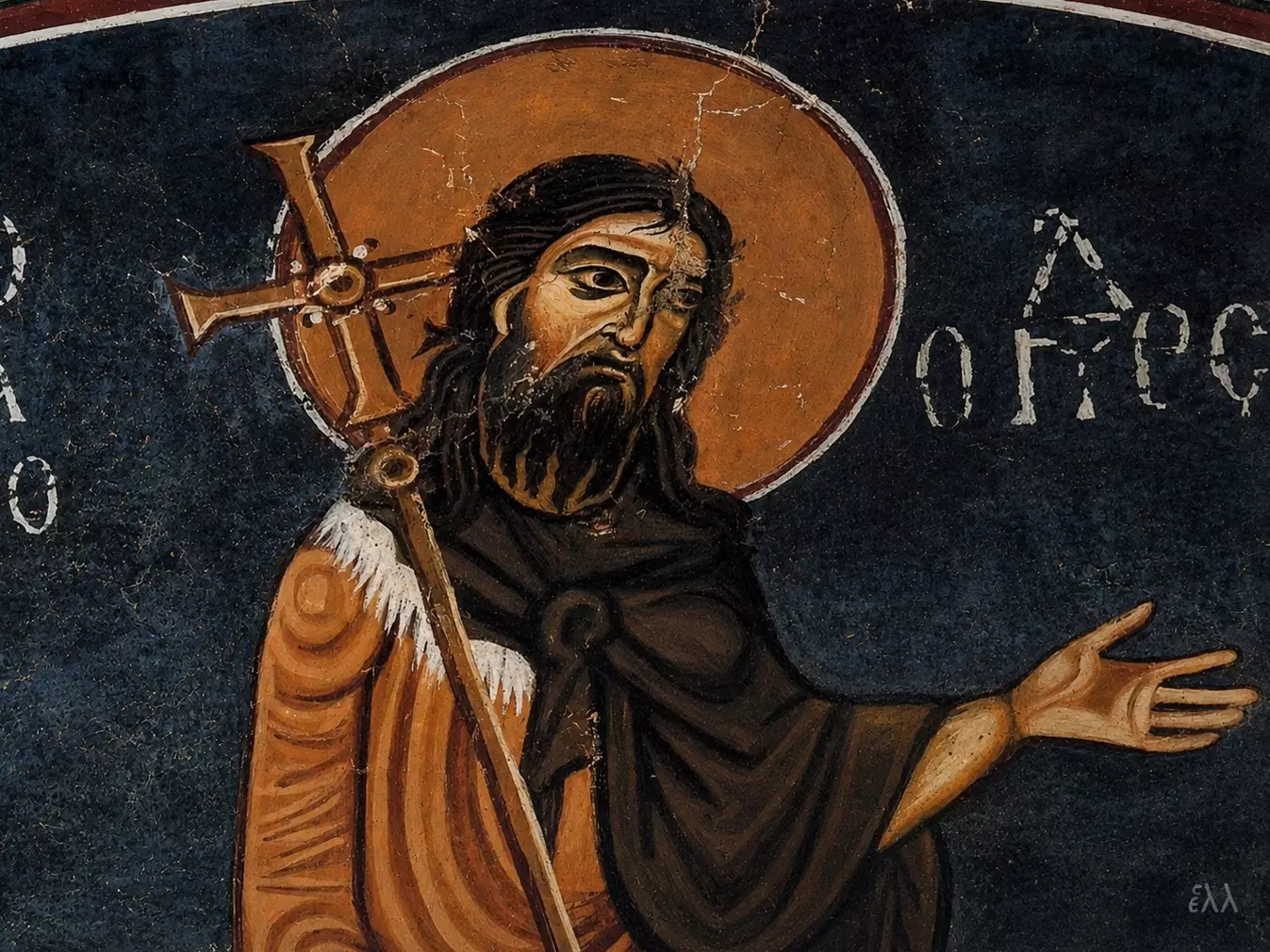
The Face of the Forerunner Close Up in this Byzantine Fresco
In close shot the same figure reveals other virtues. The halo, deep red and cracked by time, frames features severe, almost sullen, with the hair falling in dark tufts upon the shoulders. The gaze, turned slightly to the side, does not seek the spectator. Something in the tension of the eyebrows recalls less the serenity of later icons and more the roughness of the desert.
The cracks of the plaster, visible across the whole breadth of the face, subtract nothing from the expression; on the contrary, they add that patina which only time can imprint upon a work of art old nearly a thousand years. This painter, whoever he may have been, did not pursue beautification. He pursued something more difficult, the rendering of a person who stands on the threshold between the desert and the history of the Church.
(Translated from the Greek text by K. Pappas.)


