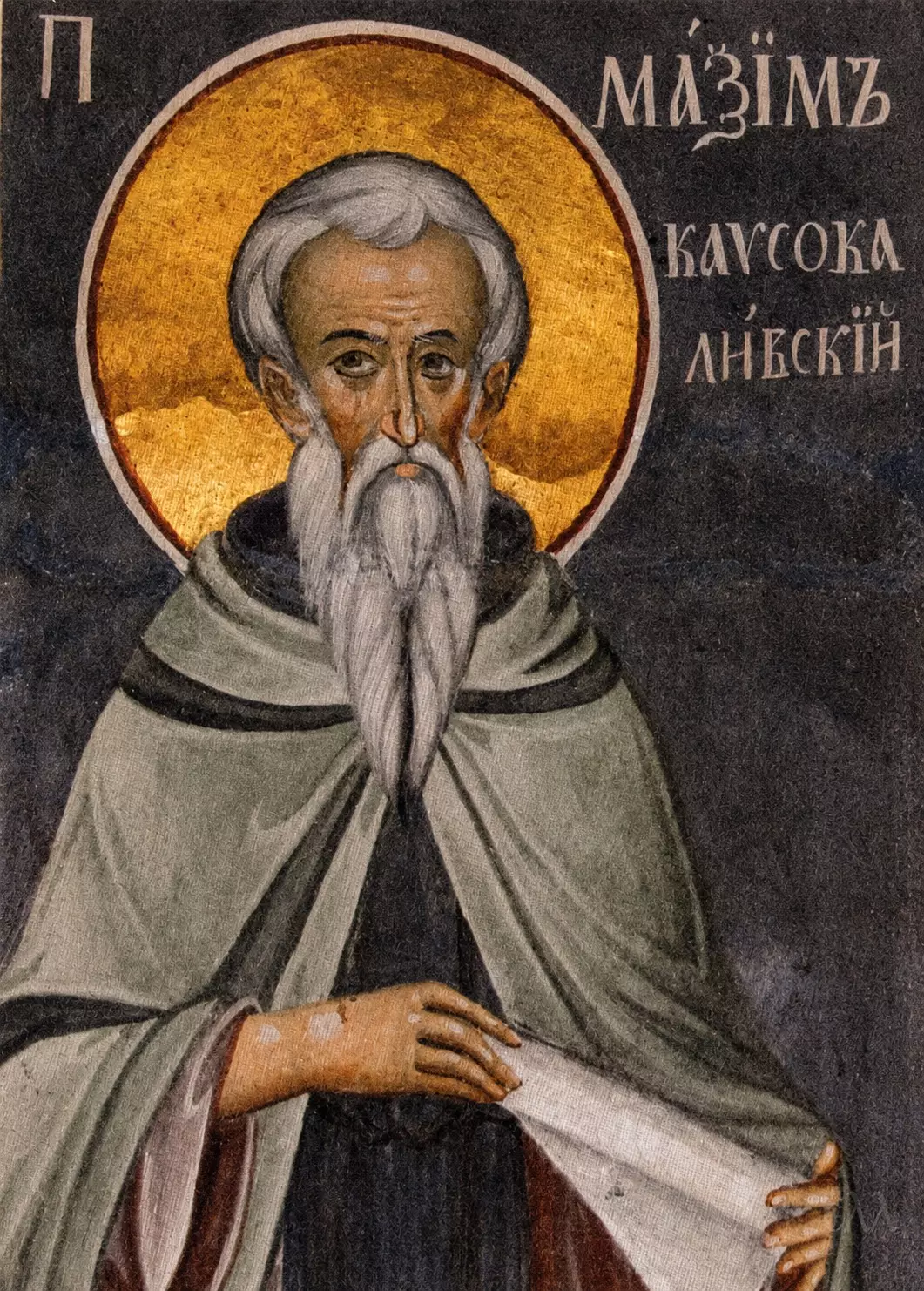
Against a dark, almost opaque background rises the figure of Saint Maximos Kausokalyvites, with the gravity of a man who has passed through every trial of the eremitic life. This is an eighteenth-century fresco, the work of a painter who remains anonymous, painted in the Holy Cell of the Typikario, in the area of Karyes on Mount Athos. The saint is depicted frontally, his gaze fixed upon the viewer, while his right hand holds a white cloth that falls in gentle folds before his body. Around his head extends a broad golden halo with a red outline, and in the upper-right part of the composition an inscription can be discerned, with characters resembling Slavonic rather than Greek script, a detail by no means unusual in Athonite workshops, where artists and influences of different origins often coexisted. Whitened hair, combed backwards, leaves exposed a forehead furrowed by deep wrinkles. The beard, long and thick, divided into two sections at its lower end, descends to the level of the chest. Over a dark, deep-brown tunic, the saint wears a light, greenish mantle with a dark lining, the typical garment of the monk who has renounced every material comfort, an element directly connected with the history of the saint himself.
The Iconographic Type of Saint Maximos Kausokalyvites in Post-Byzantine Art
Born Manuel in Lampsakos in Asia Minor, he left his paternal home while still young and was tonsured a monk on Mount Ganos in Eastern Thrace. He passed through Constantinople and Thessaloniki before arriving at the Monastery of the Great Lavra, where the pursuit of noetic prayer led him to a wandering life, without permanent shelter, among the rugged slopes of Athos. He built makeshift huts from branches and set fire to them a little later, so that he might possess nothing of his own, not even a place to which he could become emotionally attached. From this very practice arose the epithet that accompanied him until his death and which the fresco at Karyes confirms through its inscription. The white cloth that he holds in his hand refers to this same state of dispossession, to a life stripped of every unnecessary object, in which even the simplest piece of cloth acquires symbolic weight. The post-Byzantine art of Athos, particularly in the area of the Skete of Kausokalyvia and the surrounding cells, repeated this figure many times, often in association with other saints of the same ascetic tradition, such as Nephon and Akakios. In the fresco of the Typikario, however, the representation retains a more restrained character, without narrative details surrounding the figure, with the emphasis falling exclusively upon the face and the posture of the body.
The painterly treatment of the face, with the lightly illuminated cheeks and the shadowed hollows of the eyes, follows the conventions of the later Athonite tradition, in which plastic modelling recedes before the spiritual clarity of the gaze. It is not a portrait in the sense of individual likeness, but an artistic formulation of the wisdom of old age and unceasing ascetic discipline, qualities that the Byzantine and subsequently the post-Byzantine iconographic tradition consistently attributed to the great ascetics of the desert.
(Translated from the Greek text by K. Pappas.)


