
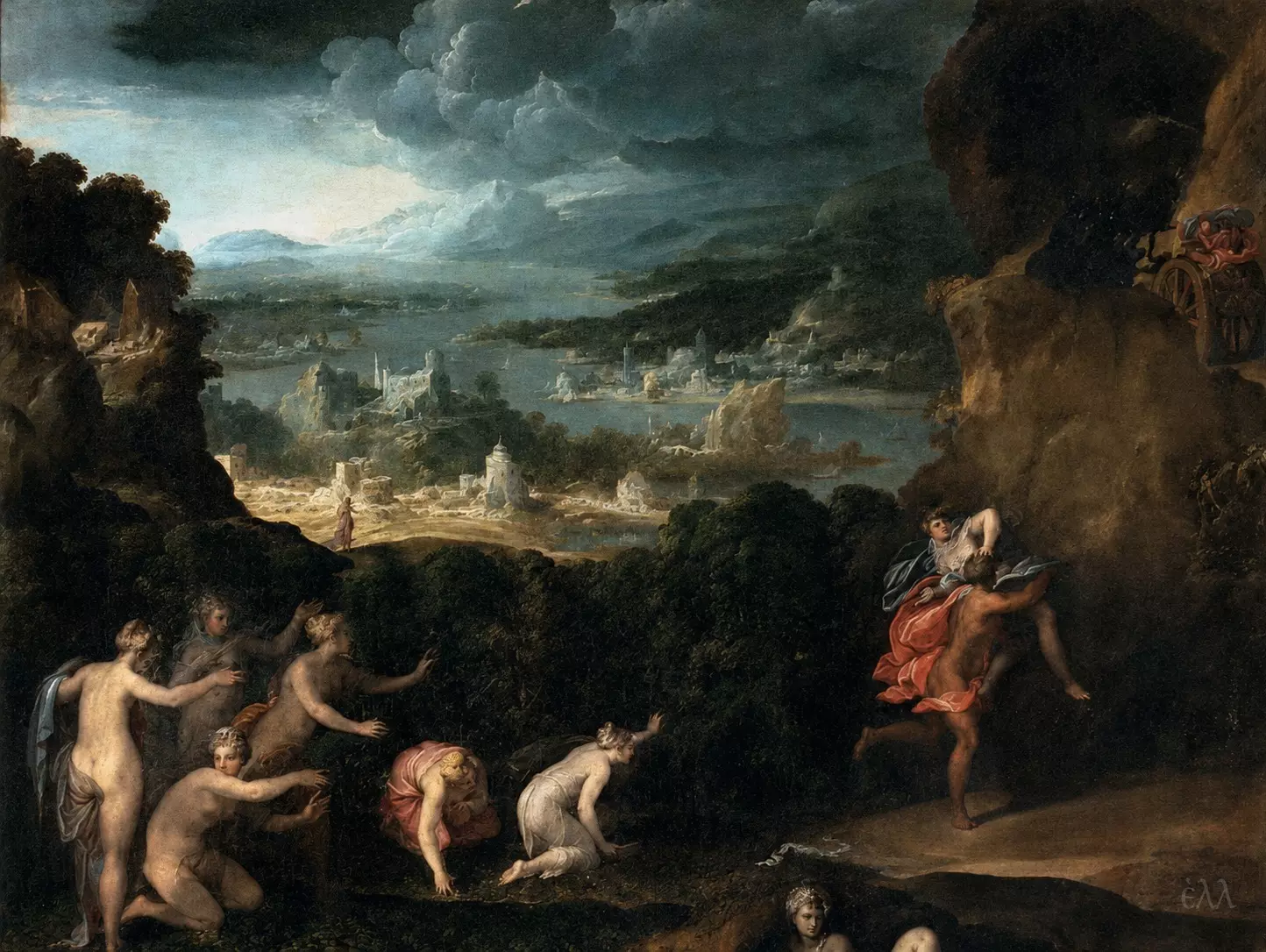
A landscape unfolds under two contrasting skies, at the moment when the painting captures the abduction. The work was painted around 1570 by Niccolò dell’Abbate, a painter born in Modena in 1509, who died at Fontainebleau in 1571, having linked the final part of his life and art with the decoration of the French royal palaces. The canvas, entitled The Rape of Proserpine, measures 196 by 220 centimetres and is now held in the Louvre Museum.
The subject is drawn from the ancient myth of Proserpine, daughter of Ceres, whom the god of the underworld abducts while she is gathering flowers in a meadow with her companions. At the centre of the composition, the painter places two worlds in collision: on the one side, the idyllic calm of a group of young women; on the other, its violent interruption, with the abductor running towards his chariot. Around them, an immense landscape with a lake, towns and mountains disappears into the horizon, while above all these a sky laden with black clouds foretells the transformation of the landscape into a scene of terror. The technique remains that of oil on canvas, with subtle gradations of colour that reveal the influence of the School of Fontainebleau and, indirectly, of Correggio, in the elegance of the bodies and the fluidity of the movement.
The Dramatic Composition of The Rape of Proserpine
On the right side of the painting, the god, with dark hair and a muscular body clothed only in a red cloth around his waist, runs up a rocky path while holding Proserpine in his arms. She wears a rose-coloured veil and stretches one hand behind her, towards the lost world she is leaving. Above the pair appears a smaller figure, perhaps an attendant or a divine presence directing their course towards the chariot, whose horses can be faintly distinguished at the top of the rock on the right. This movement, swift and unstable, stands in complete contrast to what is taking place on the opposite side.
There, five young women react, each in a different way, to the loss of their companion. Two nude figures extend their arms forwards in a gesture of despair; a third, dressed in pale rose, bends low, almost sinking to her knees, as though trying to gather what has been scattered from the woven basket of flowers; a fourth, in a white garment, kneels even closer to the ground, with one hand raised in the air. None of them looks in the same direction, and it is precisely this discordance of gazes that conveys the disturbance more powerfully than any individual facial expression.
At the lower right edge of the composition, half-submerged in water, a female figure observes the scene almost indifferently, her body reclining and one hand resting upon a rock. She is probably a personification of a spring or river, perhaps Cyane, the nymph who, according to tradition, opposed Pluto and was transformed into water because she failed to stop him. Her presence here functions as a silent witness, almost like a prophecy of the fate awaiting her.
Landscape and Mannerist Art in The Rape of Proserpine
The background of the painting is no mere supplement. A lake with small boats, buildings scattered along its shores, a solitary traveller upon a road disappearing into the distance: all these compose a landscape that inherits the imagination of the northern Italian and French painting traditions, where nature is not a background but an interlocutor of the myth. Above this world, the clouds gather, dark and heavy, with light breaking through only in a narrow opening towards the left, where the sea still shines, as though nature has not yet had time to understand what has happened.
In this work, the art of Niccolò dell’Abbate combines the classical balance of the Italian tradition with a nervousness of line that anticipates the style of the School of Fontainebleau, where the painter spent the final years of his life. The figures, elongated and slightly twisting in their poses, owe much to the Emilian painting of Correggio and Parmigianino, while the narrative density of the scene, with several episodes unfolding simultaneously, reveals an artist familiar with the rhetoric of Italian fresco painting.
What remains, finally, from this composition is not only the narration of the myth. It is the precise moment before the final rupture, when the meadow is still a meadow and the sky has not yet broken into rain.
(Translated from the Greek text by K. Pappas.)


