The Boris-Michael miniature on folio 1v of the Teaching Gospel of Constantine the Presbyter, GIM Syn. 262, belongs to a small and difficult group of early Slavonic ruler images whose identity, chronology, and relationship to lost South Slavonic prototypes remain debated. Preserved in the State Historical Museum in Moscow, the manuscript was dated in the older Russian catalogue information supplied with the folio to the late twelfth or early thirteenth century, with Vladimir or Rostov tentatively proposed as its place of production. Its large parchment leaves carry formal Cyrillic ustav, normally arranged in two columns, with cinnabar initials and headings. More recent cataloguing has altered that chronology considerably: the State Historical Museum’s museum catalogue assigns Syn. 262 to the first quarter of the twelfth century and gives its place of production more broadly as Ancient Rus.
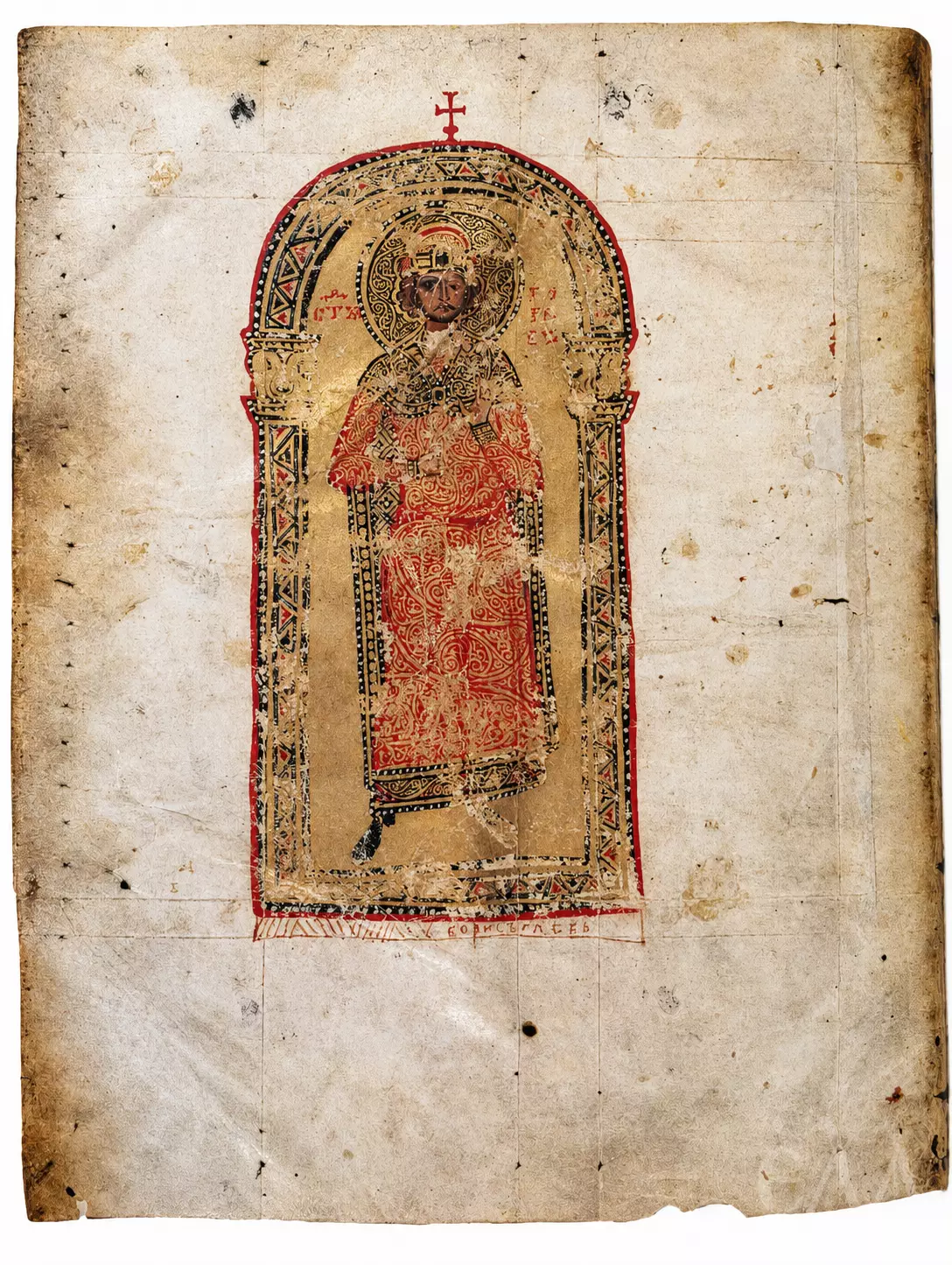
Folio 1v, within a codex otherwise dominated by text, presents a solitary full-length ruler beneath a semicircular architectural frame. Crowned and haloed, he stands frontally, holding a cross in his right hand—the hand seen on the left by the viewer—while his left hand is raised across the chest, the palm turned outward. The older catalogue identifies him as the Bulgarian prince Boris-Michael, ruler from 852 to 889 and the monarch associated with the Christianisation of Bulgaria. That identification has a substantial historiography. The miniature has also been interpreted as the Rus’ prince Boris, son of Vladimir, whose cult developed together with that of Gleb during the eleventh century.
Boris-Michael Miniature: Image, Script, and Attribution
Across the large parchment leaf, the painted miniature occupies only a relatively restricted central area. Considerable expanses remain bare around it, and faint ruling is still discernible, especially to the right and below the painted field. The page therefore differs markedly from a densely illuminated Byzantine manuscript folio. Within the material breadth of the parchment the ruler seems almost isolated, enclosed by his own ornamental architecture, while stains, abrasion, scattered small losses, and other traces of prolonged use remain visible outside the painted frame.
Inside the arch the visual language is ceremonial. Two narrow supports rise into a rounded frame articulated with geometric bands, repeated angled forms, and small ornamental motifs; above the arch, a red cross marks the central axis. A gold ground surrounds the ruler and continues through parts of the costume and insignia. Surface abrasion and paint loss have disrupted the original continuity, especially across the face and lower garments, where lighter underlying areas are exposed. Even in this damaged condition, the principal hierarchy remains legible: gold ground, architectural frame, halo and crown, densely patterned ceremonial dress, the cross held by the ruler.
The figure is governed by frontality. His feet introduce a slight displacement from the vertical axis, yet the upper body remains rigidly oriented towards the viewer. Behind the crown is a nimbus, and pendant ornaments descend on either side of the head. Deep red dominates the clothing, crossed by elaborate curling and linear patterns whose density gives the textile a highly wrought, almost metallic effect. Pearl-like borders, jewelled details, and repeated ornamental lines heighten the courtly character. Axinia Džurova’s iconographic study likewise describes the ruler against a gold ground beneath a decorated arch, with a cross in the right hand and the open left hand across the chest, and relates the crown and costume to Byzantine sovereign imagery.
The Byzantine connection lies primarily in the visual formula. Crown, halo, gold field, ceremonial dress, and hieratic frontality place rulership within a sacred register, while the cross gives the ruler an explicitly Christian attribute. Under the traditional Boris-Michael interpretation, that attribute acquires particular weight because of his role in the conversion of Bulgaria. The architectural frame has also been compared with ornamental forms associated with Preslav. Bulgarian scholarship has consequently treated such parallels as possible evidence that the East Slavonic copy retained features inherited from an earlier Bulgarian manuscript model, a reading Džurova supports when she associates the composition with the visual culture formed around Boris and Simeon.
Later research on the codex has made the identification more difficult. Elena Ukhanova’s palaeographical and codicological work proposed an earlier date and a Kievan context for Syn. 262, while reopening the possibility that the figure represents the Rus’ saint Boris. Subsequent scholarship has continued to register competing chronologies, with some studies retaining a later twelfth-century dating and the museum now assigning the codex to the first quarter of that century. Script, scribal organisation, codicology, textual transmission, the damaged painted inscription, and the iconography of Boris and Gleb all enter the discussion. A 2023 study available through Hrčak likewise reflects the continuing importance of the manuscript within debates over its textual and historical setting.
The textual history of Syn. 262 sharpens the problem. The codex preserves the Teaching Gospel associated with Constantine of Preslav, an important work of early Slavonic Christian literature, together with other material connected with the same literary environment. Its surviving East Slavonic copy carries linguistic and scribal evidence belonging to a cultural history wider than the locality in which this particular manuscript was produced. A South Slavonic textual inheritance could therefore coexist with an East Slavonic codex and with pictorial material transmitted, altered, or reinterpreted during copying. The miniature, moreover, need not belong to precisely the same historical layer as every annotation later written around it.
At the bottom of the painted frame this later reception becomes materially visible. The supplied catalogue records a fifteenth-century semi-ustav inscription reading “Борись Глебъ”, added several centuries after the original production of the manuscript. Its presence is important evidence for the later understanding of the image within an East Slavonic environment shaped by the cult of Boris and Gleb. Because the note is late, however, it cannot by itself determine the identity intended by the original illuminator. It belongs to the history of the page’s interpretation as much as to its palaeography.
Free Translation of the Inscriptions
The identifying painted lettering flanking the ruler’s head has been read in scholarship as:
“Saint Boris.”
Beneath the frame, the later fifteenth-century annotation recorded by the manuscript catalogue reads:
“Boris, Gleb.”
The second wording is best preserved closely in translation, since it consists essentially of the two names. It should be distinguished from the original painted identification beside the halo. Different moments of the manuscript’s history meet here: the painted inscription belongs to the conception of the miniature, whereas the lower note records the way a much later reader labelled or associated the image.
The Boris-Michael miniature thus occupies an unusual position between manuscript illumination, ruler portraiture, and the transmission of Slavonic Christian culture. Its abraded gold ground and elaborate red costume still preserve the ceremonial logic of the composition, while the surrounding parchment carries the physical evidence of long handling and later reinterpretation. Whether the ruler is ultimately identified as Boris-Michael of Bulgaria or Boris of Rus’, folio 1v remains central to the debate because several historical moments survive on the same leaf: the painted ruler and inscription, the scribal culture of the codex, the fifteenth-century name beneath the frame.
(The translation was edited by A. Orfanos.)