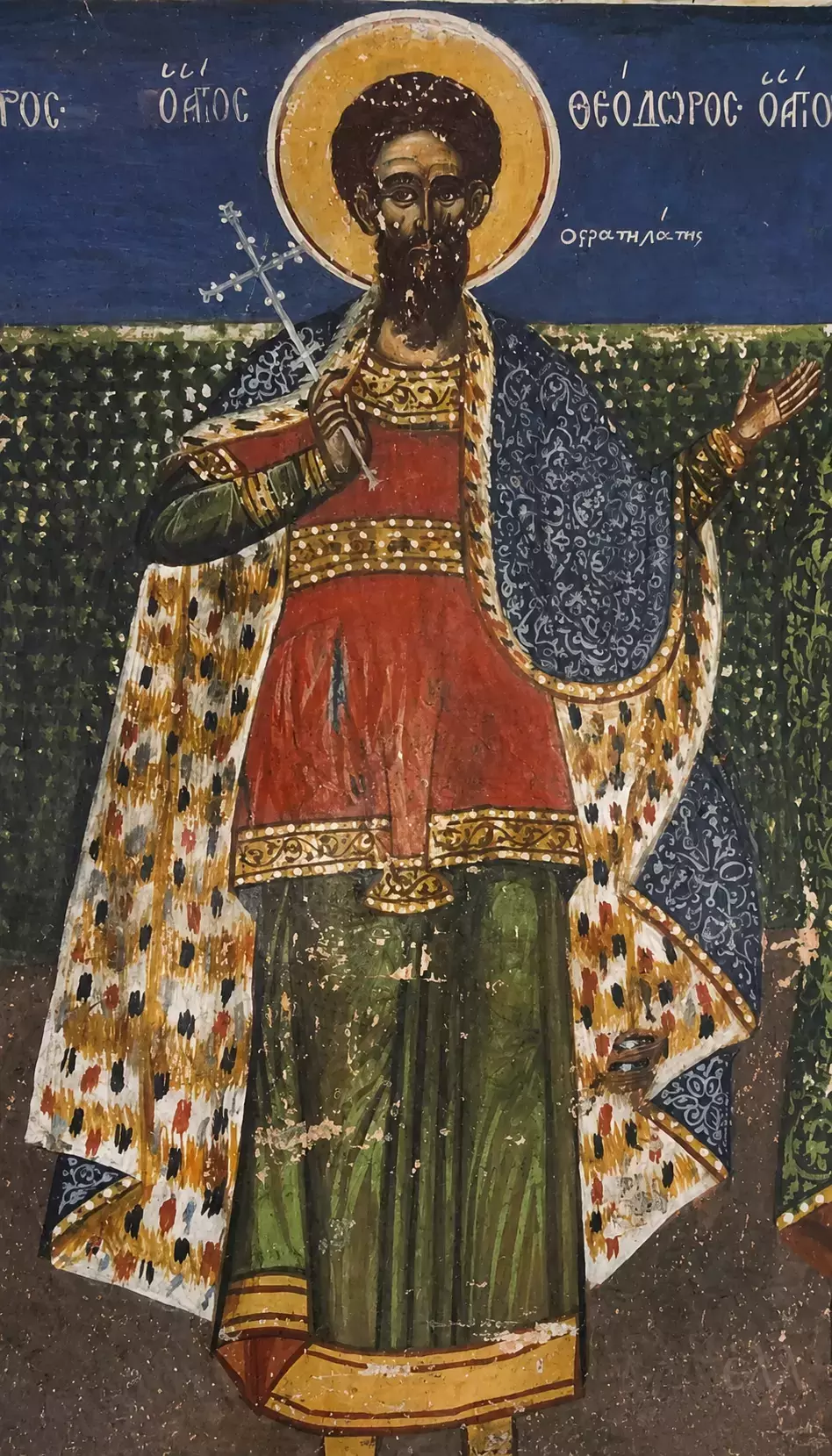
Preserved within the venerable ecclesiastical interior of the Holy Monastery of Panagia Pelekiti in Karditsa, the monumental wall painting of Saint Theodore Stratelates stands as a compelling reflection of the endurance of Byzantine visual culture. This true fresco, executed during the Post-Byzantine period, a time when monastic workshops in the mountainous Agrafa region safeguarded and propagated established Orthodox iconographic models, commands the pictorial field through its hieratic frontality and solemn restraint, its surface finished with precise, a secco details. The saint is projected against a deep azurite upper register, separated from the terrestrial domain by a bipartite background; the lower section, a stylized green field punctuated by rhythmic, white floral motifs. This abstract garden, devoid of atmospheric perspective, evokes the timeless paradise reserved for the martyrs. The saint’s identification is unequivocally established by the white majuscule inscription—O AΓΙΟC ΘΕΟΔΩΡΟC Ο CΤΡΑΤΗΛΑΤΗC—flanking his halo in the upper pictorial zone. Displaying a magnificent synthesis of linear precision and chromatically rich ornamentation, the unknown master has successfully articulated a figure that is simultaneously authoritative and deeply spiritualized, and that serves both a didactic narrative function and a profound liturgical purpose within the sacred space.
The Iconography of the Saint Theodore Stratelates fresco
Dominating the composition, the saint presents a commanding silhouette rooted in the traditions of ecclesiastical portraiture. The painter, eschewing the heavy, metallic cuirass of a warrior saint prepared for combat, has portrayed the martyr in the lavish, ceremonial attire of a high-ranking patrician. Holding a slender, white processional cross with trefoil terminals delicately in his right hand, the saint presents his left hand raised, the open palm facing outward. According to the established visual language of Christian iconography, this specific gesture of benediction and supplication signifies ascetic purity, spiritual readiness, and the intercessory role of the holy figure.
The garments clothing the martyr constitute a striking display of the post-Byzantine painter’s affinity for densely patterned, richly ornamented surfaces. A vivid red chlamys, acting as the primary tunic, forms the volumetric core of the figure. It is cinched securely at the waist by a wide, gem-encrusted belt that introduces a horizontal geometric structure to the otherwise vertical emphasis of the drapery. Beneath this striking crimson garment, a muted green tunic descends in sharp, tubular folds toward the lower border, culminating in an intricately embroidered golden hem. Draped with solemn majesty over his shoulders, a voluminous mantle engulfs the outer silhouette. Its surface is a meticulously executed array of abstract, stylized motifs—black, red, and ochre accents scattered across a pale ground—echoing the luxury textiles traded across the Eastern Mediterranean. Over his left arm, an additional layer of indigo fabric, heavily decorated with white scrolling tendrils, introduces a cool tonal contrast to the warm vermilion of the tunic.
Despite the evident ravages of time—visible in the significant paint loss, abrasions, and exposed plaster substrate particularly concentrated in the lower green garment—the spatial organization of the figure remains powerfully intact. The painterly handling relies heavily on contour and silhouette, suppressing naturalistic corporeality to achieve a flattened, dematerialized mass that aligns perfectly with the transcendental aims of devotional art. Toward the saint’s face—the devotional center of the image—the sharply defined folds of the drapery draw the viewer’s eye upward.
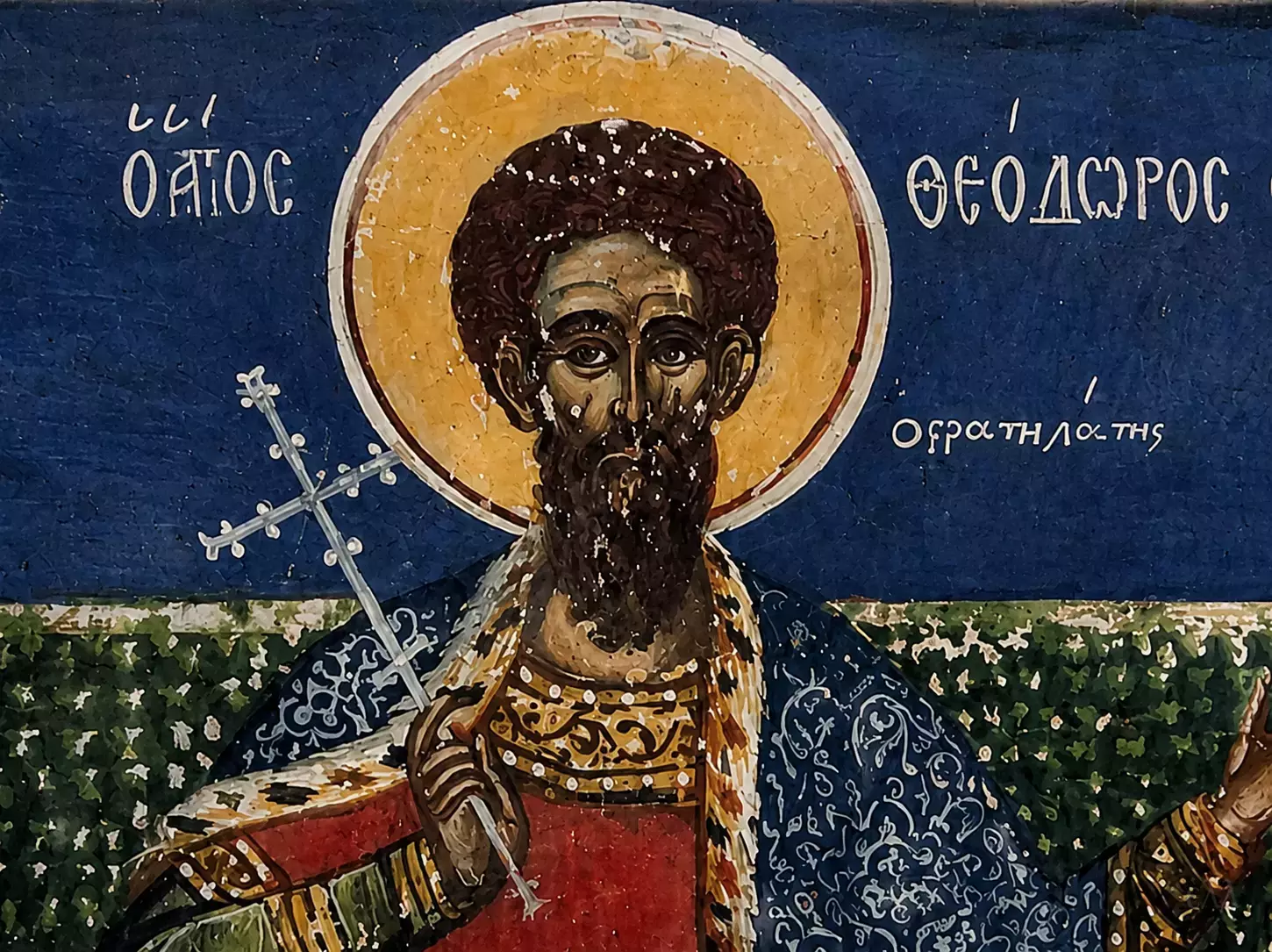
Physiognomic Likeness and Tonal Modeling
A close visual examination of the bust-length detail reveals the exceptional technical refinement invested in the saint’s physiognomy. Constructed upon a dark, earthy proplasmos, the foundational preparatory layer typical of the mainland workshops, the facial topography emerges gradually through the successive application of warmer flesh tones. Crisp, linear white highlights, applied via fine hatching and cross-hatching, aggressively articulate the prominent cheekbones, the bridge of the straight nose, and the arches of the eyebrows. Intensifying the psychological characterization of the portrait, this stark chiaroscuro imparts a volumetric plasticity to the head.
The saint’s deep-set, almond-shaped eyes gaze directly outward, conveying an expression of contemplative severity and introspective gravity. His hair, a dense and stylized mass of dark curls, closely frames a high forehead and smoothly transitions into a meticulously bifurcated beard. This distinctive physiognomic trait strictly conforms to the canonical type for Theodore Stratelates, ensuring his differentiation from other military martyrs within the Orthodox repertoire. Framing the head, the halo is rendered as a simple, unburnished yellow-ochre disk bordered by concentric red and white lines. Functioning as a radiant visual anchor, this luminous aureole sharply separates the hair from the azure ground.
Through its masterful command of limited chromatic ranges and unwavering adherence to traditional formal vocabularies, this fresco transcends mere architectural decoration. The deliberate juxtaposition of elaborately detailed courtly vestments against a flat, symbolic landscape encapsulates the dual nature of the Byzantine martyr, physically grounded in the history of the Church while eternally residing within the heavenly liturgy. Sustained by the artist’s controlled brushwork and profound theological understanding, the image of the Stratelates remains a potent conduit for veneration and a silent yet resonant participant in the continuous sacred life of the Panagia Pelekiti monastery.
(The translation was edited by A. Orfanos.)