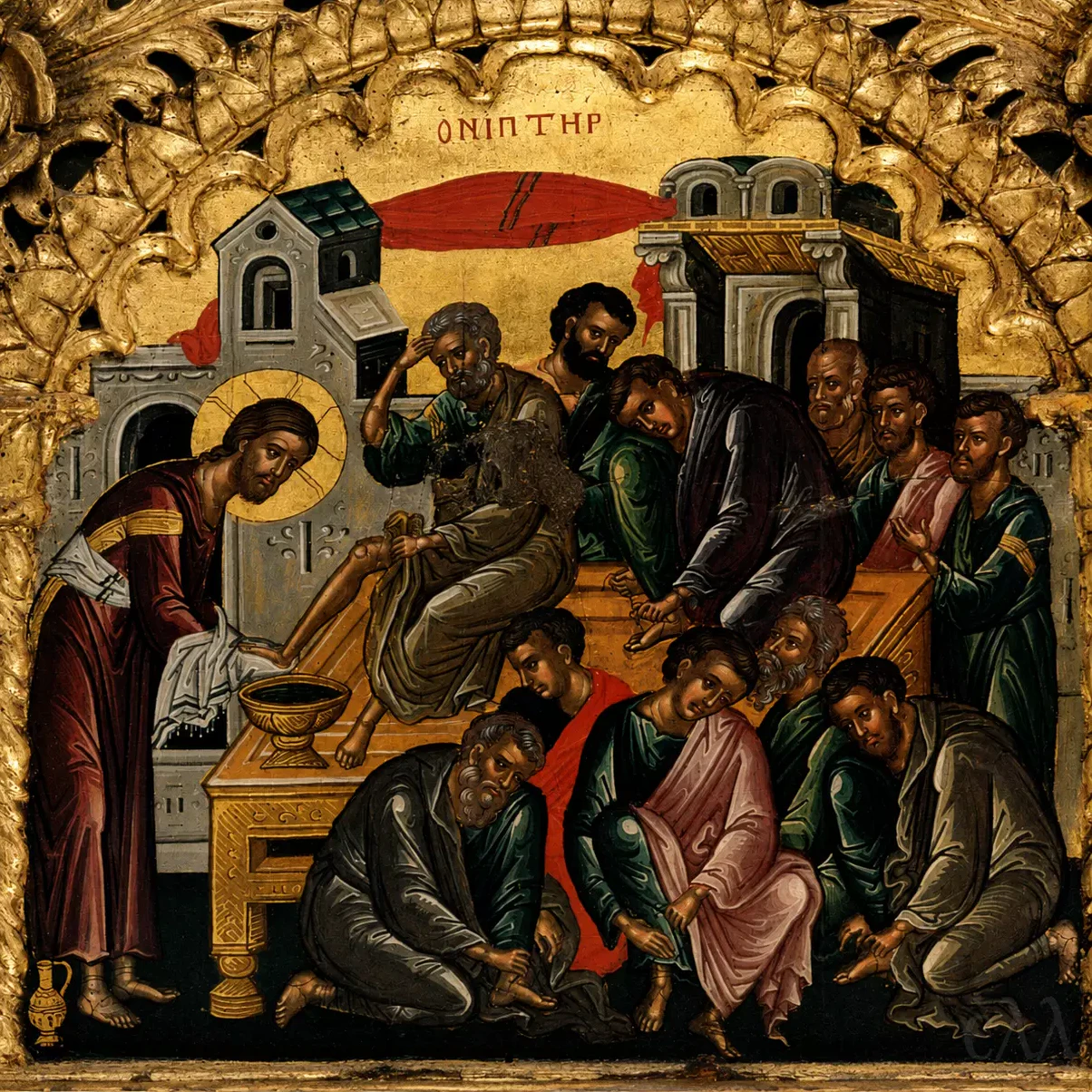
Attributed to Theophanes Strelitzas-Bathas, better known as Theophanes the Cretan, and dated to 1535–1545, The Washing of the Feet belongs to the painted epistyle formerly associated with the iconostasis of the katholikon of Iviron Monastery on Mount Athos. The image shown is the Washing of the Feet (John 13:1–17); the Last Supper (Matt. 26:17–30) occupies the neighbouring compartment within the same Passion sequence, followed by Christ’s Prayer on the Mount of Olives (Matt. 26:36–46). Four sections of this remarkable epistyle survive, preserving twelve scenes from the Christological cycle. Euthymios Tsigaridas’s fundamental Tsigaridas study established the close iconographic and stylistic relationship of the ensemble to the documented work of Theophanes and attributed it to the Cretan master.
Within its carved and gilded frame, the composition is immediately identified by the red inscription Ο ΝΙΠΤΗΡ written against the gold ground. Christ bends towards Peter at the left of the pictorial field, a white towel wrapped around his waist, while the apostle extends his bare foot towards him. The remaining disciples collect behind Peter and across the lower right of the composition, their seated and standing figures packed into a shallow architectural space. A golden basin, elaborate buildings, dark openings, red textile hangings and sharply articulated garments create a setting of considerable visual richness despite the restricted dimensions of the individual compartment.
Theophanes the Cretan: The Washing of the Feet — Composition and Iconography
The narrative derives from John 13:1–17, the Gospel passage in which Christ rises from supper, lays aside his outer garments, takes a towel and washes the feet of the disciples. Theophanes concentrates the extended episode upon its defining encounter. Christ has already assumed the role described by the text: his body bends deeply, his garments fall in long controlled folds, the white cloth crossing the darker red and grey tones of his clothing. Peter, seated considerably higher, responds through gesture. His extended leg creates the physical connection between the two figures, while one hand rises towards his head, recalling his request that Christ wash his hands and head as well after his initial resistance (John 13:8–9).
Pushed forward beside the encounter, the basin rests upon a small architectural support and lies close to the foreground edge. Its placement gives concrete form to the title Niptēr, a Greek word referring literally to a vessel or basin for washing, while in Byzantine and post-Byzantine visual usage the term became attached to the entire episode of the Washing of the Feet. The inscription therefore carries an unusual economy: through the name of a single object, an extensive Gospel narrative receives its conventional designation.
Behind Peter, the apostles form an increasingly dense human mass. Heads rise at different heights; one disciple inclines sharply forward, another touches his head, several lean towards the action, while figures seated in the foreground turn their bodies in different directions. Theophanes avoids presenting the group as a mechanically repeated row. Peter remains physically closest to Christ, yet the others participate through posture and gaze. Movement passes quietly from Christ’s low, bowed figure through Peter and into the compact assembly gathered beyond him.
This organization corresponds closely to qualities Tsigaridas identified throughout the Iviron epistyle: closed compositions, a strong geometric conception, carefully balanced masses and controlled relationships between individual gestures. His attribution also places the ensemble between major landmarks in Theophanes’s career, especially the paintings of Saint Nicholas Anapafsas at Meteora in 1527, the Great Lavra on Mount Athos in 1535 and the later work at Stavronikita in 1545–1546. Within this chronology, the surviving Iviron sections belong to the mature Athonite phase of the painter’s activity, when the inherited vocabulary of fifteenth-century Cretan painting had been absorbed into an increasingly assured compositional language.
At the left, a compact grey building rises behind Christ and Peter; opposite it stands a more elaborate structure with columns, arches and a dark entrance. Between the two architectural groups, a vivid red hanging extends across the upper part of the gold background. The architecture helps to contain the concentration of figures below, while the broad strip of red has an unusually important role within the composition. It binds the buildings across the upper zone and marks a visual boundary above the apostles, preventing the crowded human action from dissolving into the gold field. Little measurable depth is suggested by the buildings themselves. They overlap, turn at abrupt angles, and operate chiefly as constructed elements of the pictorial space, their façades and dark openings giving rhythm to the upper half.
Colour is handled with comparable discipline. Deep green, wine red, black, muted violet and warm brown move through the garments of the apostles, interrupted by narrow passages of lighter modelling. Christ’s dark red mantle carries particular weight at the left, whereas the white towel draws attention because very little comparable light colour occurs elsewhere in the scene. Peter’s subdued clothing and exposed leg create a quieter secondary focus. The extensive gold ground remains luminous behind these dense colours, though scarcely empty: inscription, architecture and the suspended red textile occupy much of its visible surface.
Faces receive close linear definition. Foreheads, noses, brows and cheekbones are built through concise transitions between darker underpainting and narrow highlights; grey hair breaks into small curling locks, while the younger faces have smoother contours and less pronounced modelling. Age and individual physiognomy can consequently register even within a scene containing many closely grouped figures. Several apostles are partly obscured by neighbouring bodies, yet their expressions, profiles or silhouettes retain sufficient differentiation to keep the assembly from becoming visually uniform.
Much of the composition’s force comes from its unequal vertical structure. Among the principal figures Christ occupies the lowest position. Peter sits above him, while the other apostles rise higher still behind. The physical hierarchy follows the action described in the Gospel, where the teacher deliberately lowers himself before his disciples (John 13:4–5). Theophanes renders the relationship without isolating Christ entirely from the group or enlarging him disproportionately. His halo, posture and pictorial separation at the left preserve his visual primacy, although the bowed body descends almost to the level of the basin.
Theophanes the Cretan: The Washing of the Feet — The Iviron Epistyle
The panel also needs to be read within the epistyle rather than as an isolated devotional icon. The surviving sections originally created an extended succession of Christological scenes above the sanctuary screen, and the Washing of the Feet stood within a sequence moving from the Last Supper (Matt. 26:17–30) towards the events of the Passion. Four sections containing twelve scenes survive from the broader ensemble, which scholarly reconstruction has associated with a considerably larger original programme.
The 1997 Treasures of Mount Athos catalogue likewise identifies the section containing the Last Supper, Washing of the Feet and Prayer on the Mount of Olives as part of Theophanes’s work for Iviron and stresses the stylistic links connecting it with his other Athonite paintings. Seen in that context, the individual compartment participates in a continuous narrative sequence whose meaning depended partly upon its proximity to the scenes before and after it.
At close range, the carved gilded surround matters almost as much visually as the painted compartment. Dense vegetal relief presses against the painted arch, its irregular glints and deeply cut recesses forming a materially sumptuous border around the more controlled narrative within. Painting, gilding, carving, inscription, architecture, clustered bodies: different visual registers compressed into a remarkably restricted space. The central action nevertheless remains unmistakable. Christ bends towards Peter; Peter extends his foot; beside them stands the basin from which the episode takes its traditional Greek title.
(The translation was edited by E. Alexandraki.)