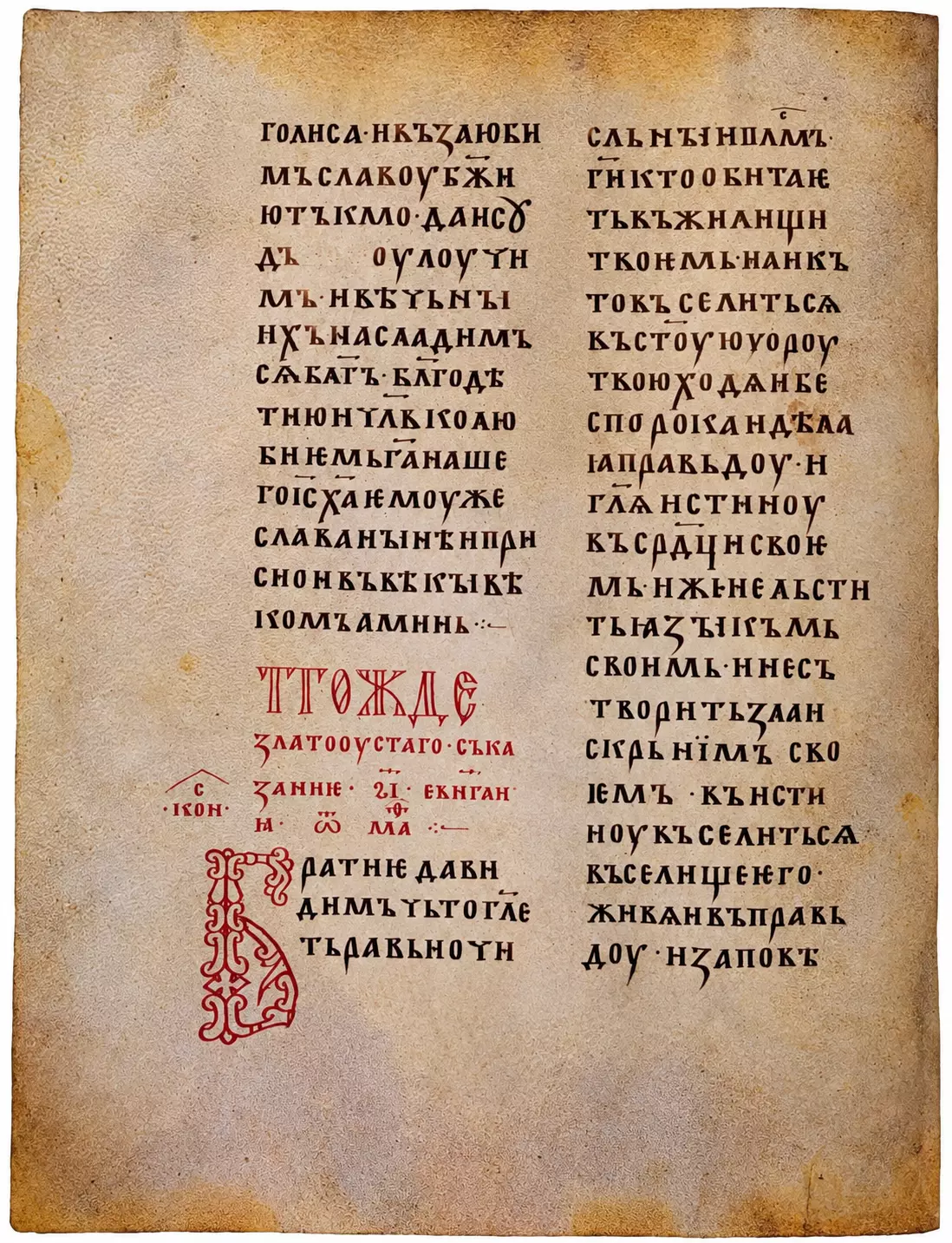
Teaching Gospel Folio 118v of GIM Syn. 262 preserves a transition between two homiletic units within the Teaching Gospel associated with Constantine of Preslav. The upper part of the left column closes the preceding discourse with a doxology. Below it, cinnabar suddenly changes the hierarchy of the page: a rubric attributes the following exposition to John Chrysostom, and an enlarged ornamental Б begins the address Братие—“Brothers.” Modest in material terms, the decoration nevertheless occupies enough of the written field to alter the movement of the text across the folio.
The manuscript belongs to the Synodal Collection of the State Historical Museum in Moscow. The older catalogue information accompanying the folio dates the codex to the late twelfth or early thirteenth century and tentatively associates it with Vladimir or Rostov. That chronology has been substantially reconsidered. The current museum catalogue assigns Syn. 262 to the first quarter of the twelfth century, with its place of production given more broadly as Ancient Rus. Roman Krivko’s palaeographic study discusses the still earlier dating proposed through palaeographic and linguistic analysis, around the end of the eleventh or beginning of the twelfth century. The discrepancy is worth preserving because it records a genuine shift in the scholarly assessment of this important early East Slavonic witness.
Compiled in Bulgaria at the end of the ninth century, Constantine’s Teaching Gospel comprises fifty-one homiletic texts arranged for the Sunday Gospel readings of the ecclesiastical year. Much of their exegetical material derives from Greek New Testament catenae and patristic commentary, while the resulting Slavonic collection developed its own homiletic structure through introductions, interpretation and concluding exhortation. Syn. 262, the earliest surviving complete witness of the work, consequently has unusual importance for Old Bulgarian textual history and the transmission of early Cyrillic writing.
Teaching Gospel Folio 118v and the Cinnabar Initial Б
The disposition of Teaching Gospel Folio 118v is governed by its two-column ustav script. Dark brown-black writing occupies comparatively narrow vertical fields on the parchment, the letters clearly separated from one another even where individual words are only lightly distinguished. Iron-gall ink and cinnabar are recorded among the materials employed in the codex by the current museum catalogue, and their visual contrast is particularly effective on this leaf. The principal text has aged towards a warm brown-black, whereas the rubrication retains a dense red tonality.
Formal Cyrillic ustav structures the page through upright, deliberately articulated letterforms. Most characters remain within a fairly regular vertical module, although their widths vary according to shape, giving the lines a rhythm that is disciplined without becoming mechanically even. Ascending and descending elements are restrained. Curved forms sit beside strongly rectilinear ones, while the broad pen produces firm terminals and small changes in stroke weight. Abbreviated sacred names appear beneath titla, a compact scribal convention that saves space while distinguishing frequently recurring theological vocabulary. Across the written surface, verbal text and small palaeographic signals remain visually intertwined.
Near the middle of the left column a more conspicuous hierarchy emerges. The preceding homily reaches its conclusion with the formula invoking “the grace and love for humankind of our Lord Jesus Christ,” followed by the familiar doxology and Amen. The red rubric then begins ТОГОЖДЕ, “of the same,” and identifies what follows as an exposition attributed to Chrysostom. The numeral in the heading designates the sixteenth Gospel reading, followed by an abbreviated reference to Matthew. Much of the editorial work that a modern book would assign to spacing, typography or a separate heading is carried here by the change from dark ink to cinnabar.
Beneath the rubric stands the initial Б. The older manuscript catalogue characterizes the codex’s initials as being in an “Old Byzantine” style, executed in cinnabar. On folio 118v the letter is an ornamental initial rather than a historiated one: no human or animal figure is embedded in it. A tall red outline establishes the basic Cyrillic form, its interior and projecting curves worked into looping, interlaced ornament. Some strokes turn back upon themselves; others form small knot-like compartments. Linear throughout, the decoration depends on the contrast between the red line and bare parchment rather than on polychrome filling.
Its scale matters. Occupying several lines, the initial takes possession of much of the remaining lower portion of the left column. Only the black letters completing Братие and the opening words of the new discourse can be placed beside it before the text continues at the upper part of the right column. The letter therefore participates directly in the architecture of the page, marking the beginning and interrupting the regular block of ustav while determining the distribution of the following words.
The surviving textual sequence makes that function especially clear. Before the rubric, the closing passage urges the audience to turn away from the “crafty fox” and seek divine glory. Its preceding context identifies the underlying subject as vainglory: the temptation to practise fasting, prayer, almsgiving or obedience for human recognition. The new section then changes direction. Its opening Братие да видимъ (“Brothers, let us consider”) introduces a scriptural citation and draws attention to the psalm that asks who may dwell in God’s habitation (Psalm 14:1–3 LXX; Psalm 15:1–3 in many modern English Bibles). The complete diplomatic transcription of Syn. 262 confirms the division visible on the folio and preserves the continuation across columns 118c and 118d.
The passage quoted is Psalm 14:1–3 according to Septuagint numbering, corresponding to Psalm 15:1–3 in the numbering familiar from many modern English Bibles. The righteous person walks blamelessly, acts justly, speaks truthfully and does no evil to a neighbour (Psalm 14:1–3 LXX). The manuscript does not visually isolate the biblical quotation with quotation marks. Its authority emerges from the introductory wording and the continuity of the ustav text, an arrangement natural to medieval homiletic books in which citation and commentary regularly occupy the same graphic field.
Free Translation of Folio 118v
“…this crafty fox. Let us love only the glory of God, so that we may obtain a favourable judgement and enjoy the eternal blessings, through the grace and love for humankind of our Lord Jesus Christ, to whom be glory now and always and unto ages of ages. Amen.
Of the same John Chrysostom. Exposition of the sixteenth Gospel reading from Matthew.
Brothers, let us consider what the corresponding Psalm says: ‘Lord, who shall dwell in your habitation? Or who shall settle upon your holy mountain? The one who walks blamelessly and practises righteousness, who speaks truth in his heart, who does not deceive with his tongue and does no evil to his neighbour’ (Psalm 14:1–3 LXX; Psalm 15:1–3).
Truly, the one who lives in righteousness, keeps His commandments and makes them fruitful shall dwell in His habitation; the one who conceals and hides them shall be cast out.”
The translation follows the complete text preserved on columns 118c–118d, including the conclusion carried over from the preceding discourse, the cinnabar rubric and the beginning of the newly introduced exposition. The University of Sofia historical-language corpus independently records the same column division and wording in its transcription of Syn. 262.
Folio 118v is valuable palaeographically even apart from the celebrated ruler miniature elsewhere in the codex. Ordinary scribal practice is exposed with unusual clarity in the measured ustav, sacred contractions beneath titla, cinnabar rubrication and an ornamental initial whose dimensions directly regulate the written space. Elsewhere in Syn. 262, later additions and ownership records trace a very different history, including Patriarch Nikon’s donation of the manuscript to the New Jerusalem Monastery in 1661 and its eventual preservation in the State Historical Museum from 1920.
(The translation was edited by E. Wilson.)