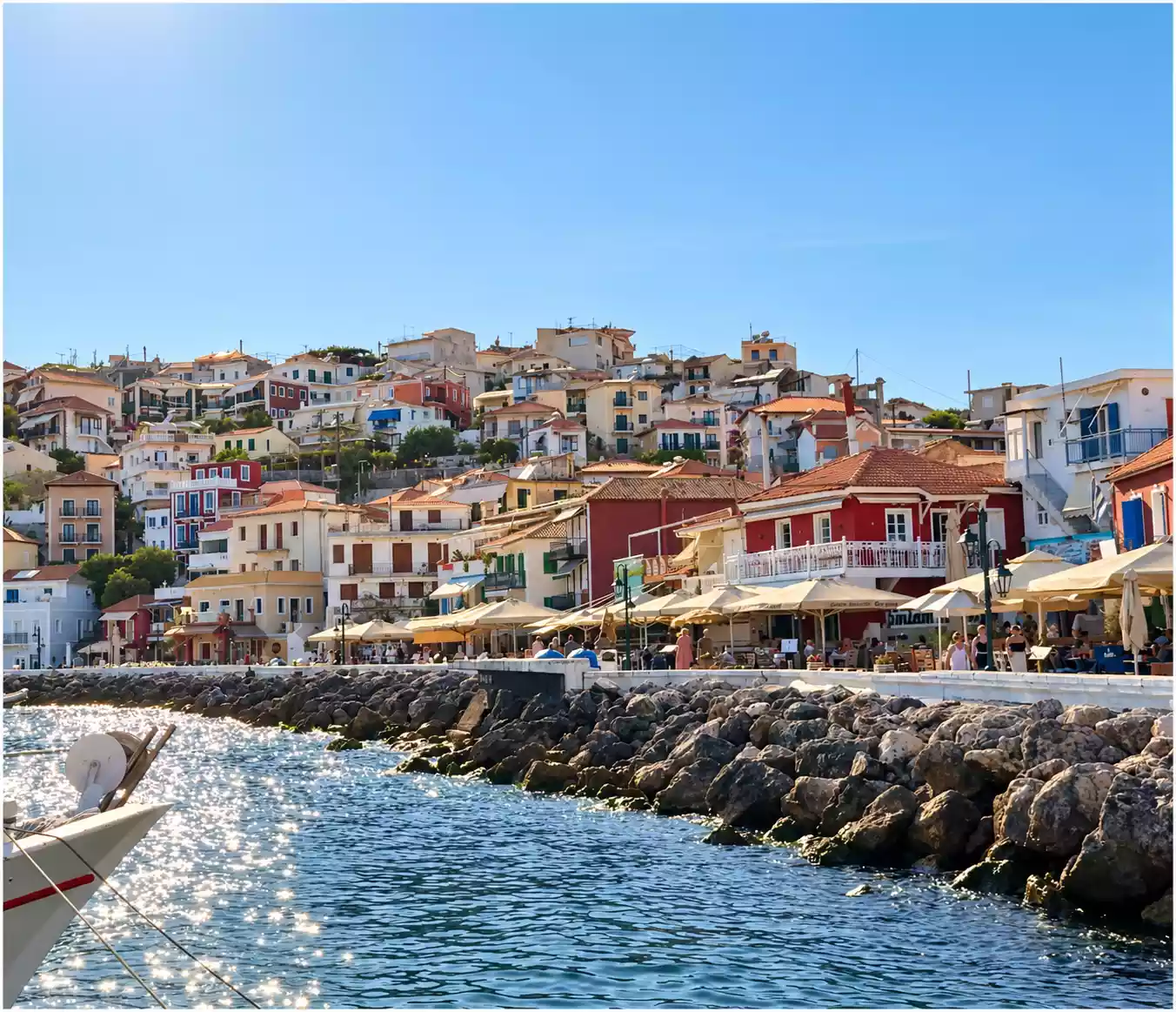
 The waterfront of Parga, with houses climbing the hillside behind the cafés along the quay.
Parga, a coastal town of Epirus facing the island of Paxos, spreads like an amphitheatre over the slopes above an Ionian bay. Houses with tiled roofs and painted façades climb in tiers from the waterfront, while the castle occupies the rocky headland between the harbour and the beach of Valtos. From the sea, the close bond between the settlement and the shore is easy to grasp. It was by sea that Parga kept up its links with Corfu, on which it depended administratively through the centuries of Venetian rule.
Its position on the mainland coast gave Parga particular strategic value. For Venice it was a trading station and an advanced foothold facing Epirus, with Ottoman territory stretching across the hinterland.
Ancient Toryne and the testimony of Plutarch
Ancient Toryne, a coastal site mentioned in the events leading up to the Battle of Actium in 31 BC, is usually placed in the wider area of Parga. This identification calls for caution, since the exact location of the ancient settlement remains uncertain. Associating it with the area of the present town does not prove that the two settlements occupied precisely the same spot.
According to Plutarch, in his Life of Antony, Octavian crossed the Ionian Sea and seized Toryne, causing alarm in the camp of Antony, whose land forces were still lagging behind. Cleopatra met the news with a pun. Because the word ‘toryne’ meant a ladle, she joked that there was no reason to be afraid just because Caesar was sitting on a ladle.
More than a century separates the author from the events he relates. The episode preserves the way Cleopatra was portrayed in the biographical tradition, but it does not resolve the topographical question. On the western side of the castle hill, remains of an ancient wall survive, a sign that the site was in use much earlier. Between these fragmentary traces and medieval Parga, however, the record has wide gaps.
Four centuries under Venetian protection
The name Parga appears in written sources at the beginning of the fourteenth century. The decisive year for its later course was 1401, when the inhabitants concluded a treaty with Venice and the settlement became a Venetian possession while keeping its privileges. Its administrative link with Corfu secured support from the sea and drew the town into the network of Venetian outposts in the Ionian.
In practice, this protection was tested again and again. The Ottomans took Parga in 1452, but two years later it returned to Venetian hands, with the help of the Pargiots and the Corfiots. The resources available for the fortifications remained limited, while the attacks went on.
In 1537 the Ottoman fleet of Hayreddin Barbarossa destroyed Parga. Venetian rebuilding followed in 1567, and then fresh destruction in 1571, during the raids that preceded the Battle of Lepanto. After this last attack the Venetians restored and enlarged the castle, giving shape to much of the fortification that survives today. In the seventeenth century the settlement enjoyed a period of prosperity and began to spread beyond the walls, onto the slopes below the fortress.
The castle of Parga
The irregular plan of the castle follows the relief of the hill. Its outer walls run along the rocky edges, making use of their natural protection, while the accessible south-eastern side is strengthened by a semicircular tower. Above the outer gate an inscription survives with the year 1707 and the name of the governor Markos Theotokis.
A second gate leads inside through a narrow vaulted passage. Its inscription refers to Parga’s dependence on Corfu, and a little higher up a relief of the winged lion of Saint Mark, the emblem of Venice, is set into the wall. Within the enclosure stand the remains of early nineteenth-century barracks and the ruins of nine churches. One of these, west of the gate of the citadel, is probably to be identified with the old parish church of Saint Spyridon.
At the highest point lies the addition made by Ali Pasha. In 1819–1820 a strong inner wall with a polygonal bastion was built, forming a self-contained citadel. The inscriptions on its gate bear the year 1820 and his name. Inside, a two-storey serai was erected with living quarters and ancillary buildings, among them a small bath and a mosque. According to the documentation of the Ministry of Culture, the castle was neglected in the second half of the nineteenth century and gradually abandoned.
From the fall of Venice to the cession of 1817
With the dissolution of the Venetian Republic in 1797, Parga passed to the French. The French presence was interrupted by the Russo-Ottoman intervention in the Ionian in 1798–1799, which was followed by the Treaty of Constantinople of 1800. The agreement provided for the creation of the Septinsular Republic under Russian protection and Ottoman suzerainty. For the former Venetian possessions on the mainland coast, Parga among them, it laid down that they would come under the Ottoman Empire, with special guarantees.
This distinction had consequences that would only become clear later. Parga maintained close ties with the Ionian Islands, but its treaty status allowed the Sublime Porte to claim its surrender.
After the Treaty of Tilsit in 1807 the French returned. In 1814 the Pargiots turned to the British, seeking protection against Ali Pasha of Ioannina. He had already extended his control over the other former Venetian bases on the coast and, after the Congress of Vienna, invoked the agreement of 1800 to demand Parga as well.
The conflict between local expectations and British strategic calculation is examined in a recent study by Rosa Maria Delli Quadri. In 1817 the British administration of the Ionian Islands, under Thomas Maitland, reached an arrangement for ceding the town to the Ottoman side. Putting it into effect would bring Parga under the control of Ali Pasha. The inhabitants could remain or leave, receiving compensation for the property they would abandon.
The exodus of the Pargiots in 1819
In April 1819, shortly before the town was handed over, the Pargiots left en masse for the Ionian Islands, above all for Corfu. Their number is usually given as around four thousand. Compensation for their property was provided by the Ottoman side, though this did nothing to cancel the loss of their homes and of their ties to the place.
Bound up with the departure is the well-known account of how they exhumed and burned the bones of their ancestors, to shield them from possible desecration. The episode passed into historiography and literature, although the individual narratives differ as to the fate of the bones and the way in which they were carried off. The departure of the inhabitants thus acquired a second image as well: that of people trying to take even their dead with them.
The cession of Parga provoked protest in Britain and was taken up in Parliament. In philhellenic circles across Europe it became an example of a population abandoned by the very power to which it had entrusted its protection. Giovanni Berchet was moved to write the poem I profughi di Parga, while Andreas Kalvos dedicated to the Pargiots the ode ‘To Parga’ («Εις Πάργαν»), centred on the choice of exile over submission. Later returns of inhabitants did not undo the demographic break of 1819.
Union with Greece
Parga remained under Ottoman administration until the First Balkan War. On 23 February 1913, according to the calendar then in force, a Greek military detachment under Second Lieutenant Angelos Fetsis entered the town and took over the castle. The liberation formed part of the operations in Epirus, two days after the capture of Ioannina.
In the course of the twentieth century tourism gradually developed alongside olive growing and the other agricultural activities of the area. The waterfront acquired cafés and restaurants, and the seaside settlement adapted to the needs of visitors. In the 2011 census the town itself had 2,088 permanent residents. The figure refers to the settlement proper and differs from the population of the local community or of the wider Municipality of Parga.


