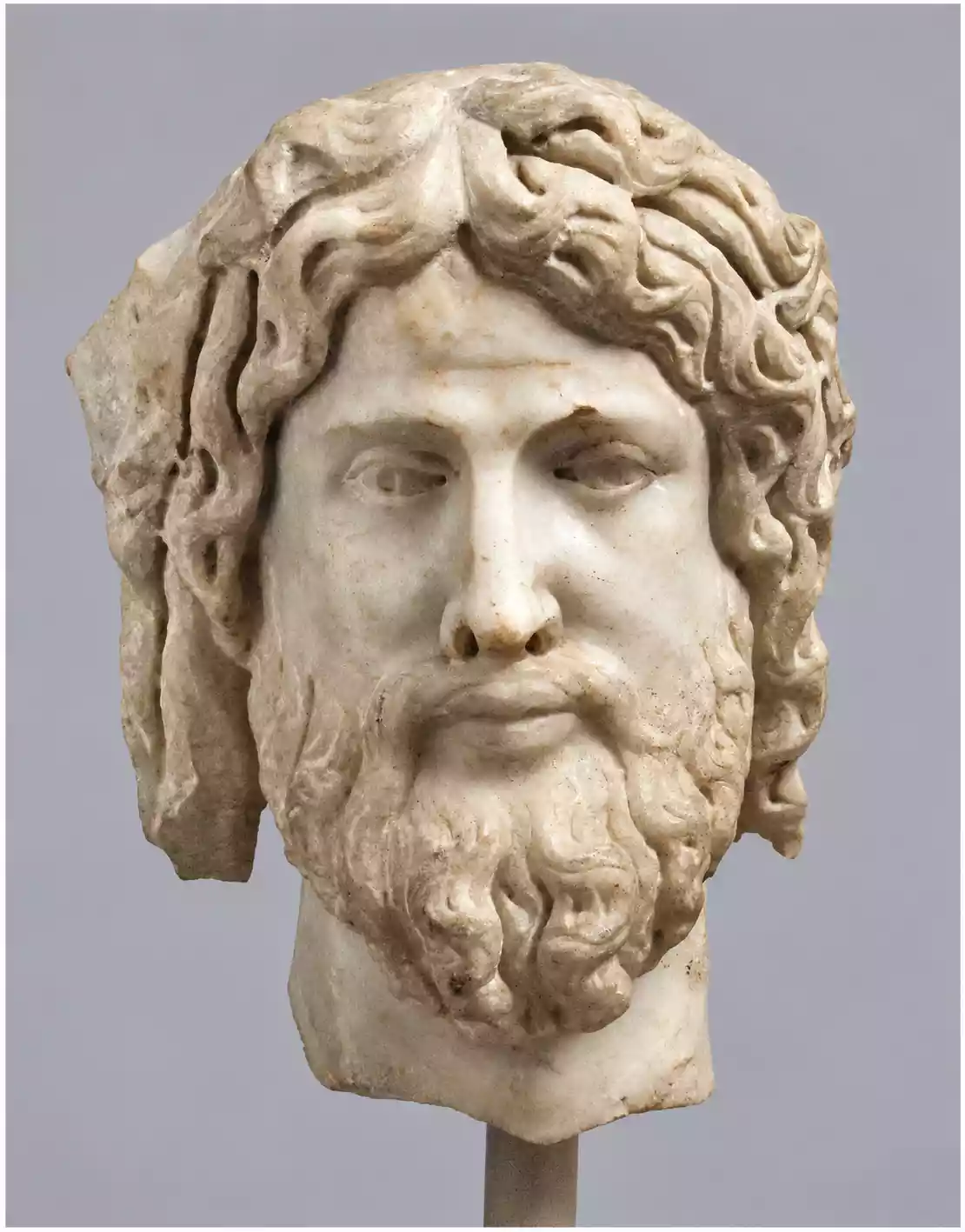
 ‘Head of Christ or Zeus’, Roman, marble, 3rd or 4th century AD, with later reworking. The Metropolitan Museum of Art, New York, accession no. 55.38. Fletcher Fund, 1955.
It is Zeus whom Odysseus invokes when he asks the Cyclops to respect his guests. In this scene from the Odyssey, the ruler of the sky is presented at once as the protector of whoever arrives, unprotected, in a foreign place. His authority reaches into a human obligation, even inside the cave of Polyphemus, where the visitor is at the mercy of his host.
The Olympian gods were bound up with experiences familiar to the ancient Greeks, from the uncertainty of a sea passage to dependence on the harvest. For the people who worshipped them, they were divine presences capable of intervening in their lives. Symbolic readings developed within this religious world and could differ considerably. An Athenian of the fifth century BC and a Stoic philosopher of later times spoke of the same Zeus, yet gave his name different content.
The Twelve Gods in everyday life
In the cult practices of Greek communities, the relationship with the gods was expressed through specific acts. A votive offering, that is, a dedication to a sanctuary, could be made in thanksgiving or together with a plea for protection. Sacrifices gathered the participants around the altar, while festivals gave the community’s year its own rhythm. Thousands of such offerings have come to light in excavations of sanctuaries.
Nor was the composition of the Twelve the same everywhere. Different lists and representations include Hestia or Dionysus, and cult groups of twelve gods could show other variations as well. Beyond these there were many further deities. The position of Hestia herself shows how carefully we need to relate a figure’s role in myth to its significance in cult.
Zeus and Poseidon in the face of human uncertainty
In Zeus, sovereignty over the sky meets the authority that sustains an order of things. Thunder and the thunderbolt make his supremacy felt. In the Homeric narrative, however, Zeus Xenios is also concerned with how a visitor is treated. The god’s power thus acquires meaning within human relationships, alongside his celestial domain.
This connection can also be read as reinforcing a social obligation. The traveller, far from his kin, invokes a protector whom the other party will recognise. Polyphemus scornfully rejects the appeal to Zeus. In this scene the reader also follows a conflict over what one owes to the stranger standing before one.
Poseidon was associated with the sea, and his hostility towards Odysseus has a personal cause: the hero has blinded Polyphemus, the god’s son. The perils at sea become part of a story of retribution, as the Cyclops asks his father to prevent his adversary’s homecoming or make it hard. Human vulnerability at sea finds narrative expression here through the will of a deity.
Demeter and the experience of loss
The link between the natural world and human experience is especially dense in the Homeric Hymn to Demeter. After Persephone is carried off by Hades, with the consent of Zeus, the goddess searches for her daughter. Later she stops the earth from bearing fruit. Famine threatens humankind and, with it, the continuance of sacrifices to the gods.
In this story the separation of mother and daughter meets the anxiety of a society that lives by farming. A modern psychological reading may dwell on Demeter’s grief and on her anger at a decision taken without her. The poem allows such an approach, since it gives room to the search and to the goddess’s prolonged refusal to return to her former life.
The final settlement provides that Persephone will spend one third of the year in the underworld and the remaining two thirds with her mother and the other immortals. This is the proportion given in this particular hymn. At the close of the narrative Demeter also teaches the sacred rites at Eleusis, linking her daughter’s story to cult.
Athena and Apollo in the realm of thought
In the first book of the Iliad, as Achilles is about to draw his sword against Agamemnon, Athena intervenes. Only he can see her. The goddess holds him back from the killing, and the sword returns to its sheath, although his anger persists and breaks out in words.
The poem gives the hero’s dilemma the form of a dialogue with a deity. Today we may recognise in the scene an image of self-restraint, with the proviso that Athena has a far wider presence in the epic. She takes part in the war and favours particular heroes. Her intervention with Achilles belongs to these personal bonds of protection.
For Apollo, music and prophecy are central spheres of action, with Delphi holding a pre-eminent place in his cult. At the opening of the Iliad, once again, his arrows bring plague upon the camp of the Achaeans after his priest has been insulted. Musical harmony coexists in the same divine figure with the power to cause death on a massive scale.
Desire and human relationships
The Homeric hymn that bears her name describes Aphrodite’s power as a force that stirs desire in gods and mortals, reaching even the animals. Erotic attraction takes on cosmic scope. Within this poetic image we can recognise a human experience, the desire that arises without our having chosen it beforehand.
The hymn also names those who remain outside her power: Athena, Artemis and Hestia. This divine exception marks the limits of Aphrodite, however broad her dominion is made to appear.
Hera held a special place in marriage. The connection was also expressed in imagery, as on the east frieze of the Parthenon, where the goddess is shown seated, holding up her veil in a bridal gesture. The protection of the marriage bond offers a social framework for understanding her. In myth, her conflicts with Zeus add the experience of marital tension, developed differently in each narrative.
Artemis was associated with hunting and with mountain country, as the Homeric Hymn to Aphrodite also recalls. The protection of women in childbirth likewise mattered in her cult. The goddess’s virginity coexisted with this responsibility towards birth, extending her sphere beyond what one might assume from her hunting imagery alone.
The home and the world outside it
In Hestia the hearth of the house acquired a divine presence, while her cult was also bound up with the communal life of the city. Her role in myth is comparatively limited. To assess her place in ancient Greek religion, however, we need to examine the ritual honours she received and the significance of the space with which she was associated.
Outside the house, on roads and at boundaries, one would encounter herms. Hermes protected travellers and the entrances of houses. Such monuments were set up along routes or near gateways, giving divine protection a place visible to the passer-by, exactly where one space gave way to another.
With Hephaestus, the craft of metalworking entered Olympus. The labour that transforms matter had its divine craftsman, while Ares, whose sphere was war, belonged to the same world. Their presence allows us to consider how widely differing human activities found a place in the pantheon, together with their consequences for the community.
In Euripides’ Bacchae, Tiresias presents wine as a gift of Dionysus that eases sorrow and brings sleep. The course of the tragedy, however, leads to the dismembered body of Pentheus, who resisted the god. Relief and a catastrophic loss of control coexist in the play. Here the exploration of human limits passes through a specific dramatic conflict, with characters speaking from different positions.
When philosophers interpreted the gods
Criticism of the traditional divine figures already appears in antiquity. Xenophanes censured Homer and Hesiod for attributing to the gods deeds held blameworthy among humans. He also commented on the tendency of different peoples to imagine gods with features like their own. His fragments thus raise the question of how far human experience shapes conceptions of the divine.
Stoic philosophy developed along different lines. Zeus was identified with the active, rational principle that pervades and orders the cosmos. Theology formed part of the study of nature and was connected with how one ought to live. Living in agreement with nature required bringing one’s own reason into harmony with the reason of the whole.
These interpretations have particular proponents and historical contexts. The question ‘what did the Olympian gods really symbolise?’ therefore calls each time for a further qualification: for whom, and in what period. A sacrifice at a local sanctuary offers one kind of material, a philosophical commentary on Zeus another.
A head of uncertain identity
The marble head pictured here shows a bearded face with thick, wavy hair and deeply carved locks. In the museum’s catalogue it bears the title ‘Head of Christ or Zeus’ and is dated to the third or fourth century AD, with later reworking. The double name leaves the identification open. The photograph shows minor surface damage and the fragmentary end of the neck, above the modern mount.
The figure lends itself to comparisons between traditions of representing the divine. For this particular sculpture, though, the catalogue records a later intervention without explaining it in detail in the public entry. The work’s present appearance needs to be considered together with this unresolved question in its history.


