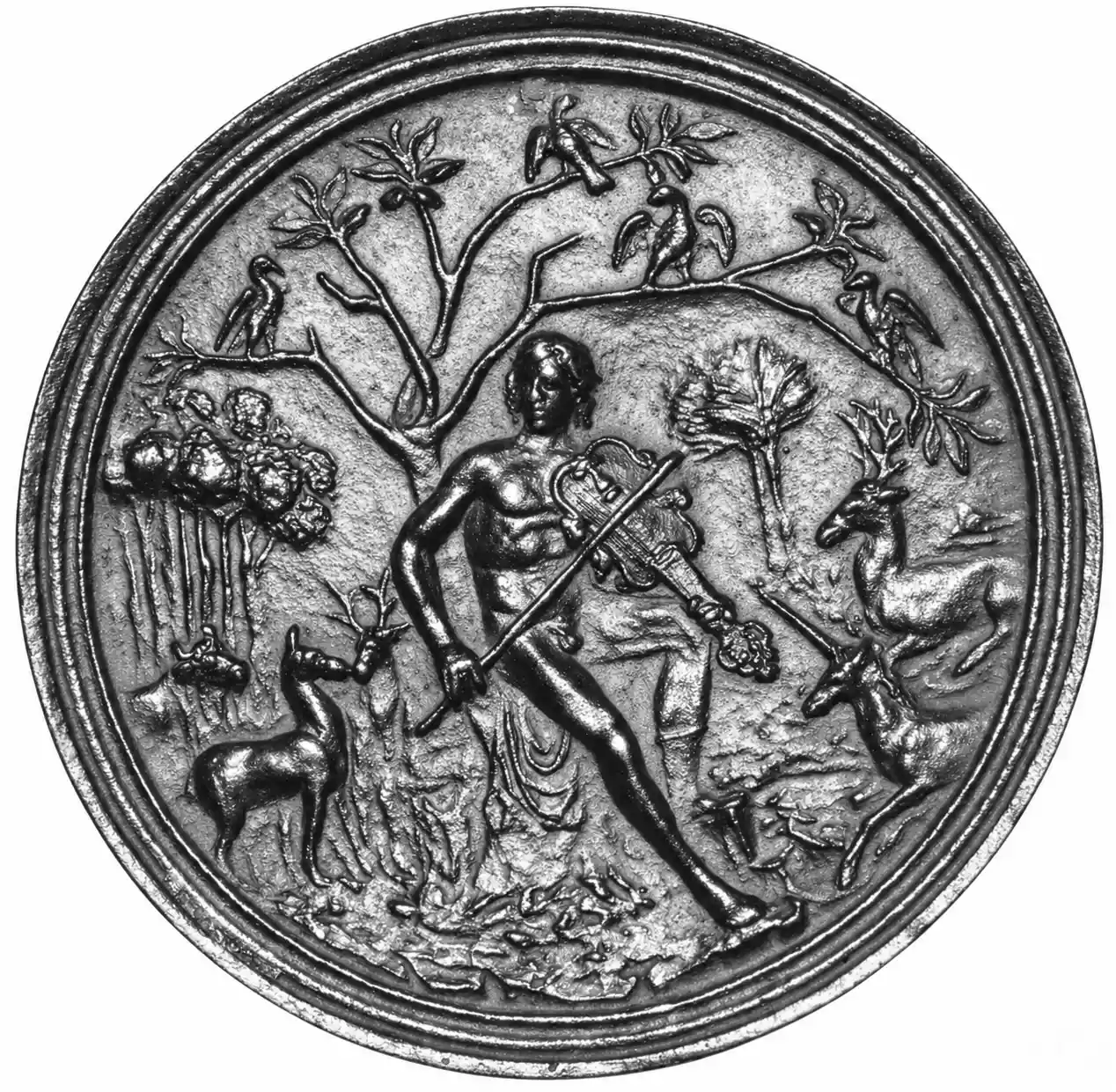
 Orpheus Master, Orpheus Playing to the Animals, Italy, early 16th century. Bronze plaquette, diameter 10.5 cm. The Metropolitan Museum of Art, New York, 1986.319.29. Collection of Erich Lederer, Gift of Mrs Erich Lederer, 1986.
Close to the way out into the world of the living, Orpheus loses Eurydice for the second time. His song has moved the rulers of the Underworld and won back his dead wife. All that is left is to keep walking without looking back until he has left the lower world. Yet he turns while she is still behind him, and Eurydice goes back to the dead.
For the fullest ancient accounts of this failed return that have come down to us we are indebted to two Roman poets: Virgil, in the fourth book of the Georgics, and Ovid, in the tenth and eleventh books of the Metamorphoses. Their versions part company on points of substance, above all in how they render Eurydice’s final moment. The fatal movement takes on a different colouring in each text, and so does the farewell of the woman who slips away.
The Death of Eurydice and the Descent into Hades
In both accounts Eurydice dies of a snakebite. In Virgil she is fleeing from Aristaeus, who is pursuing her, and as she runs along the river she does not see the snake lying in the long grass. The episode there belongs to the larger story of Aristaeus’ misfortunes and the loss of his bees, which is put down to the Nymphs punishing him for Eurydice’s death.
Ovid leaves the pursuit out. The new bride is walking through the grass with a company of Naiads when she receives the fatal bite on the ankle. The marriage has already been marked by ill omens, the torch of Hymenaeus giving off smoke instead of a clear flame. Before the snake has even appeared, the poet has let unease into the wedding rite itself.
Out of grief comes the decision to go down. Both poets place at Taenarum, at the southern tip of the Peloponnese, the entrance through which Orpheus passes into Hades. His descent – the entry, that is, of a living man into the place of the dead – is made in order to ask for Eurydice back.
Music before Pluto and Persephone
In Ovid’s Metamorphoses Orpheus appears before Pluto and Persephone and accompanies his plea on the lyre. He grants that all mortals will one day come under their sway, and that Eurydice too will return once she has completed the years allotted to her. What he asks is that she be given the span of life taken from her before its time.
The plea also makes room for a daring reminder: if the old story of Persephone’s abduction is true, Love has joined the very lords of the Underworld. Orpheus uses this kinship of experience to support his request. That is how the hero frames his argument within the poem, where the abduction becomes part of his own effort to persuade.
For a short while the song suspends the torments. Ixion stops revolving on his wheel; Sisyphus sits down upon his rock. Even the Erinyes shed tears, Ovid observes, ascribing the detail to report. For as long as the song is heard, the damned cease the endless motions of their punishment.
Both deities are moved. Eurydice is called from among the newly arrived shades and comes forward slowly, her wound still affecting her step. That slowness will acquire its weight a little later, on the uphill path towards the exit.
The Condition of the Return
Along with Eurydice, Orpheus receives a prohibition: for as long as the way out of the lower world lasts, he must not turn his eyes back. If he looks behind him, the gift is revoked.
The condition is often attributed to Pluto alone. In Ovid’s Latin both rulers accept the plea, while the rule is stated without naming the one who pronounces it. Virgil states more specifically that Persephone had laid down that Eurydice should walk behind her husband. The explicit mention of the goddess matters, especially where later retellings assign the whole bargain to her consort.
The poets give no explicit reason for the choice of this condition. We may read it as a test of trust: Orpheus has to go on relying on a promise, without the reassurance that the sight of Eurydice would give him. This is an interpretation of the scene, one the narrative permits without imposing it.
The Moment of the Glance and the Question of Doubt
In Ovid the upward path is dark and silent. The surface of the earth is already near when Orpheus, afraid that Eurydice might be falling behind and eager to see her, turns his eyes. The line in question ties the movement to the lover’s anxiety and his longing to look upon her. No suspicion that the gods have tricked him is expressed.
On this climb Orpheus is denied precisely the face for whose sake he has come so far. Eurydice has only just been given back to him, and still he has to walk on without seeing her. If we read his turning as doubt, it is the fear that the one following him might be lost again, after that first sudden death.
Virgil describes the incident differently. A sudden madness seizes the lover and, having lost all awareness of the condition, he stops and turns towards Eurydice, almost on the threshold of the light. The poet even steps in with a note of sympathy: the fault might have been forgiven, if the dead knew how to forgive.
On the threshold of the light, with the exit so close, the glance annuls the gift. In Virgil a triple crash from the depths of the Underworld accompanies the breaking of the pact.
Eurydice Lost a Second Time
In the Georgics Eurydice is given a last speech. She asks what madness has ruined them both, feels the sleep of death covering her eyes and bids Orpheus farewell, stretching out her hands to him. Then she vanishes like smoke into the air. For a moment the narrative passes into her own experience, as she reaches out her feeble hands in the darkness.
Ovid’s Eurydice departs with a farewell that can scarcely be heard. The narrator remarks that she made no complaint against her husband, for the only thing she could have reproached him with was that he had loved her. The explanation is the narrator’s; from Eurydice herself we hear only the farewell.
Love sets the descent in motion and, in Ovid’s version, has a share in the error that defeats the return. To put everything down to a lack of trust would lessen the tension of the scene. What remains is the difficulty of that waiting, when Eurydice has been given back but Orpheus cannot yet look at her.
Orpheus among the Animals in Renaissance Art
Another aspect of his power appears in the bronze relief Orpheus Playing to the Animals, a work of the early sixteenth century kept in the Metropolitan Museum of Art in New York. The Italian plaquette measures just 10.5 cm in diameter and is catalogued under the name “Orpheus Master”, the conventional name given to its maker.
At the centre of the circular field sits the musician, nude, with drapery falling from his seat. His head turns towards the left of the image, while one leg stretches diagonally down to the right. Above the figure spread the branches of a tree with birds; at the sides stand animals, among them a stag with large antlers on the right. The stringed instrument Orpheus holds is played with a bow. The detail carries the ancient musician into the craftsman’s Renaissance world, where an instrument other than the lyre of the poetic sources could be recognised.
Eurydice is absent from the scene, which concentrates on the spell that music casts over the animals. Set against the descent into Hades, the relief throws light on another side of the same figure: the musician who draws creatures around him and holds their attention.
A Second Meeting in the Underworld
Ovid returns to the couple in the eleventh book, lines 61–66. After Orpheus has been torn to pieces by the Maenads of Thrace, his shade goes down once more to the places it already knows. In the fields of the pious he searches for Eurydice and, when he finds her, takes her in his arms.
Now they walk together in the Underworld, sometimes side by side, sometimes one behind the other – and so the poet comes back to the very movement that had caused the second loss. Orpheus can now turn and look at Eurydice in safety, in the places where he himself has come to rest.


