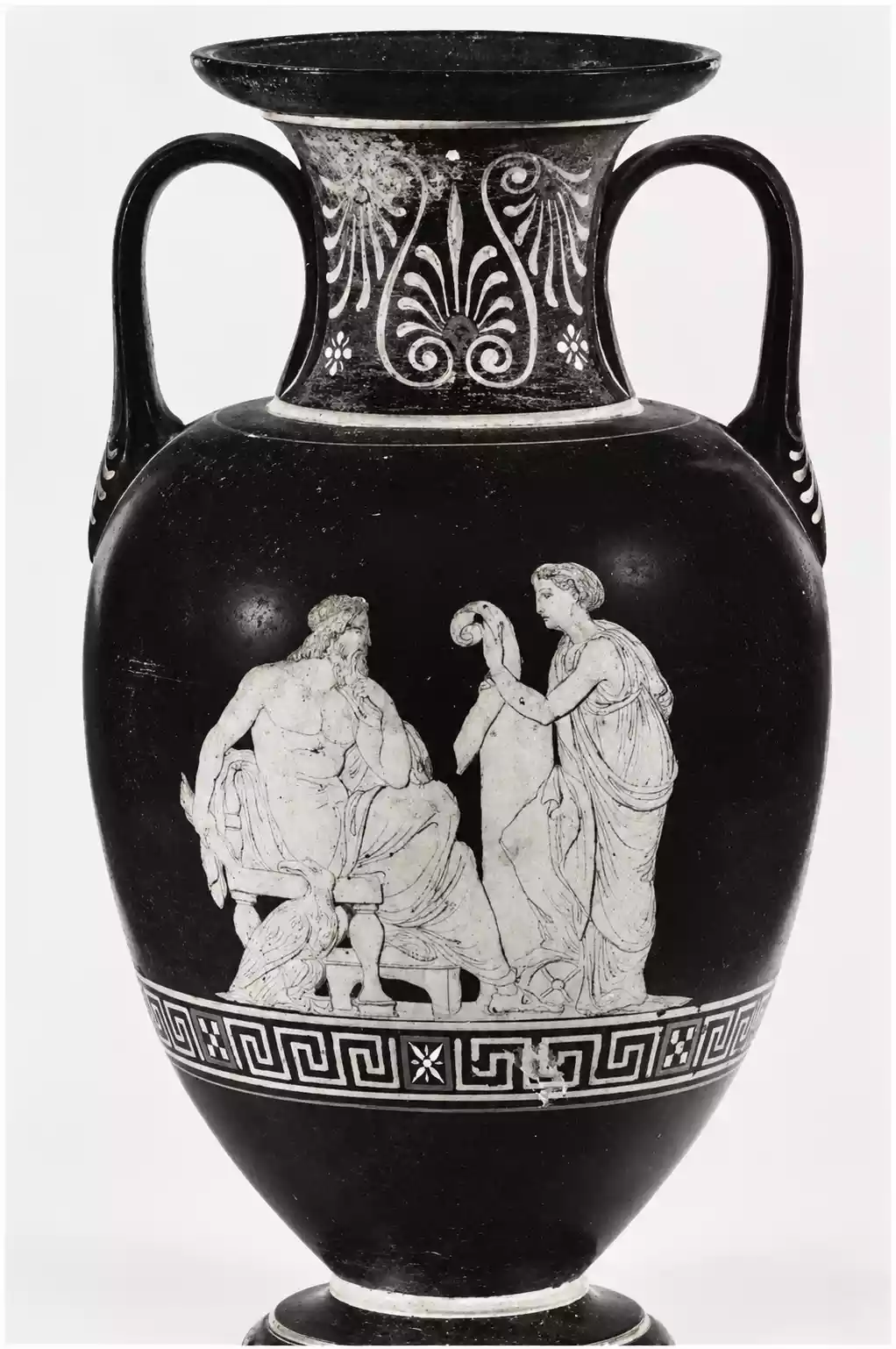
 Nemesis before Zeus. Terracotta vase by Frederick Sonne, decorated by V. Wendrich, c. 1875, after a relief by Bertel Thorvaldsen. The Metropolitan Museum of Art, 69.216.2. Public domain.
Creon has the power to forbid the burial of a dead man. But does he have the right? Much of Sophocles’ Antigone is built around this gap between the ability to enforce a decision and its justice. The king of Thebes will eventually recognise his error and try to put things right, but only once his decision has already led to catastrophe.
Hubris, ate, nemesis: these are the terms through which we often approach the overstepping of limits, and its consequences, in ancient Greek literature. Yet the stories are far from alike. Icarus and Sisyphus are considered here through the mythological tradition, whereas Prometheus is also the protagonist of a surviving tragedy. Setting them beside Oedipus and Creon brings together figures who suffer for very different reasons, some fully aware of what they are risking, others ignorant even of their own parentage.
What hubris, ate and nemesis meant
Hubris can take the form of insulting behaviour that springs from a sense of superiority. In the Rhetoric (II.2, 1378b), Aristotle describes it more precisely as shaming another person for the pleasure the offender takes in that humiliation. The word thus acquires a concrete content, tied to actions and to the way power is used against other people.
With ate, it is the faculty of judgement itself that is affected. The term denotes ruinous delusion, a blinding of the mind, and at times the disaster that follows. In Book 19 of the Iliad, Agamemnon invokes Ate as he accounts for the affront he had given Achilles. He shifts part of the blame onto divine powers, even though he agrees to make amends. What we hear is the hero’s own explanation, given in the middle of his quarrel with another man.
Nemesis is bound up with indignation at something undeserved or unjust. In the Rhetoric (II.9), Aristotle treats nemesan as pain at undeserved good fortune. The goddess Nemesis also came to be associated with retribution and with the punishment of immoderation, and she acquired a recognisable presence in iconography.
The progression from arrogance to delusion, and from there to ruin, offers a useful interpretative scheme. It has to be applied with care to each work, however, particularly when the hero is unaware of crucial facts or suffers for an act that benefited others.
Icarus: the flight and the conditions that make it possible
In the version told by the Roman poet Ovid in the Metamorphoses (VIII.183–235), Daedalus makes wings so that he and his son can escape from Crete. He warns Icarus to hold a middle course: too low, and the damp will weigh the wings down; too high, and the sun will destroy them. Carried away by the pleasure of flying, the young man leaves his guide behind and climbs. The wax that holds the feathers together melts, and Icarus falls into the sea, calling out to his father.
We may read the story as a warning against immoderation, provided we pay attention to how Ovid narrates the fall. The device comes apart because of the heat. No deity is shown ordering the boy’s death, and Daedalus himself has used his invention successfully to get away.
Icarus’ mistake comes at the very moment when everything seems to be working. It is the success of the flight that leads him to lose sight of its conditions, while his father flies a little way ahead, looking back anxiously.
Sisyphus and the attempt to cheat death
Odysseus encounters Sisyphus in the world of the dead, in the eleventh book of the Odyssey (593–600). He pushes an enormous boulder towards the top of a hill; the boulder rolls back down and the effort begins all over again. Homer’s brief description conveys the torment without explaining what offence had brought it about.
Accounts of why he was punished vary. In the version attributed to Pherecydes, Sisyphus tells the river Asopus about Zeus’ affair with his daughter Aegina. When Zeus sends Death against him, Sisyphus manages to imprison him. Later he secures his own return from Hades by pleading that the funeral rites had been neglected, an omission he had himself requested of his wife. The presentation of the myth at Brigham Young University distinguishes these narratives from the Homeric scene, where the grounds for his sentence go unstated.
His cunning can be interpreted as a repeated attempt to exempt himself from the common lot of mankind. In the torment of the boulder, every approach to completion is undone. What is left is bodily effort, which Homer makes tangible through the sweat and the dust around his head.
Prometheus: when transgression benefits humankind
A harder moral question is raised by Prometheus Bound, a play handed down under the name of Aeschylus, although its authorship has been questioned by modern scholarship. Its protagonist is a Titan, an immortal divine figure, and the conflict in which he is caught concerns the survival of mortals.
Prometheus is chained to the rock because he helped human beings and gave them fire, and he presents his gifts as the foundation of civilisation. He rests his defence on the knowledge he passed on to them, fully conscious of his transgression and of what it costs. His choice makes it possible to read disobedience as a form of responsibility towards those who have no power.
Whose justice, then, is the spectator asked to accept? The punishment is imposed by Zeus, while the one being punished appeals to the benefits he has conferred on humanity. In the exchange about Necessity, Prometheus goes so far as to claim that Zeus, too, is subject to fate. In the surviving play the conflict is left unresolved, with the Titan still holding out.
In the Persians, the price of royal arrogance
In Aeschylus’ Persians, staged in 472 BC, disaster is linked more plainly to a ruler’s transgression of due measure. The ghost of Darius interprets Xerxes’ campaign in terms of his presumption in seeking to subdue even the Hellespont, bridging the sea as though he could put it in fetters. This is the theological and political reading of a dramatic character, in a play written by a Greek poet about the Persian defeat.
But who pays for the king’s arrogance? The play keeps returning to the war dead and to a lament that spreads well beyond the royal house. The decision is made at the summit of power; its cost is borne by society at large. Xerxes comes home alive, and in its lament the Chorus searches for the names of those who were lost.
Oedipus: responsibility in ignorance
In Sophocles’ Oedipus Tyrannus, the question is carried to the limits of human knowledge. Oedipus leaves Corinth in order to escape the oracle that he will kill his father and share his mother’s bed. He does not know that Polybus and Merope, the couple he is putting behind him, are his adoptive parents. On the road, in flight, he will meet his real father, Laius, without knowing who he is.
Having become king of Thebes, he insists on tracking down the murderer of Laius. The search uncovers his own identity and a past of which he had been unaware. His anger and the accusations he levels at others weigh against him; even so, the parricide and the incest were committed in ignorance of the kinship involved. That ignorance complicates any attempt to regard his downfall as a simple, proportionate punishment, all the more so because the revelation strikes Jocasta and their children as well.
Antigone and a recognition that comes late
In the Antigone, Creon forbids the burial of Polynices, whom he treats as an enemy of the city. Antigone appeals to the unwritten laws of the gods and to what she owes her brother. Competing claims to justice clash here, together with the rigidity of the people who uphold them, a theme also explored in the related overview from University College London.
Creon at first dismisses Tiresias’ warning as an interested intervention. By the time he is persuaded to change his mind, Antigone has already killed herself. The suicides of Haemon and Eurydice follow. Creon himself survives, acknowledging his responsibility.
By then the possibility of putting things right has shrunk dramatically. Creon is able to revoke his edict, but he is still left facing the losses it has caused within his own household.
Nemesis and Prometheus on nineteenth-century vases
In the vases from the Metropolitan Museum illustrated here, antiquity returns by way of nineteenth-century decorative art. Made in Copenhagen around 1875 by Frederick Sonne and decorated by V. Wendrich, the two terracotta pieces follow marble reliefs of 1825 by Bertel Thorvaldsen.
On the Nemesis vase, the goddess stands holding an open scroll before the seated Zeus. An eagle can be made out near his throne. The scene presents Nemesis reading out the record of a human life to the god who presides over the judgement. On the other vase, a helmeted Minerva places a butterfly on the head of the small human figure fashioned by Prometheus, who is seated on the right. The butterfly symbolises the soul.
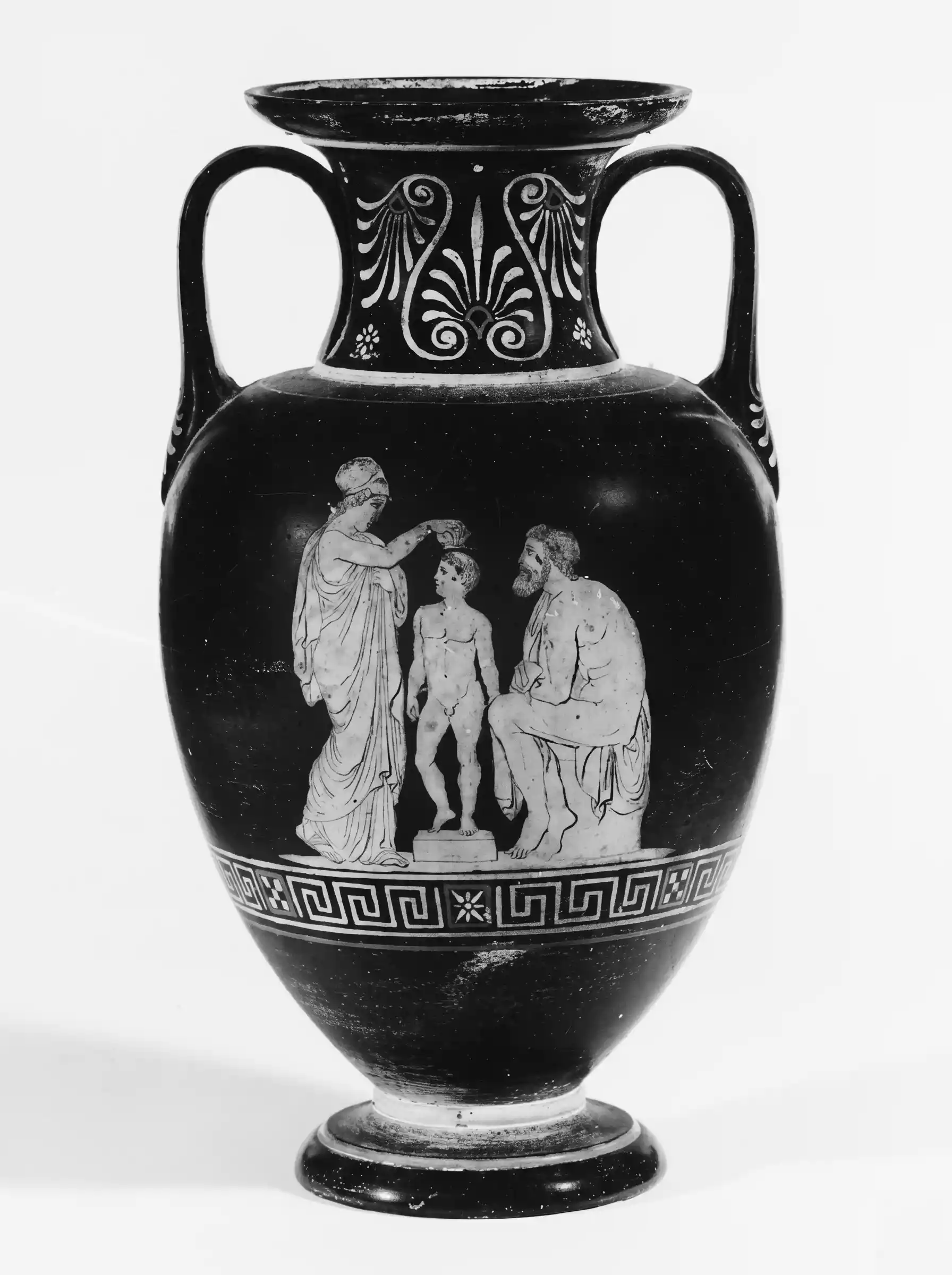 Prometheus and Minerva. Terracotta vase by Frederick Sonne, decorated by V. Wendrich, c. 1875, after a relief by Bertel Thorvaldsen. The Metropolitan Museum of Art, 69.216.1. Public domain.
An anthemion ornament on the neck and a meander band frame the scenes. The photographs are in black and white and show wear on the surface of the vases, especially around the rims and the decorative motifs.


