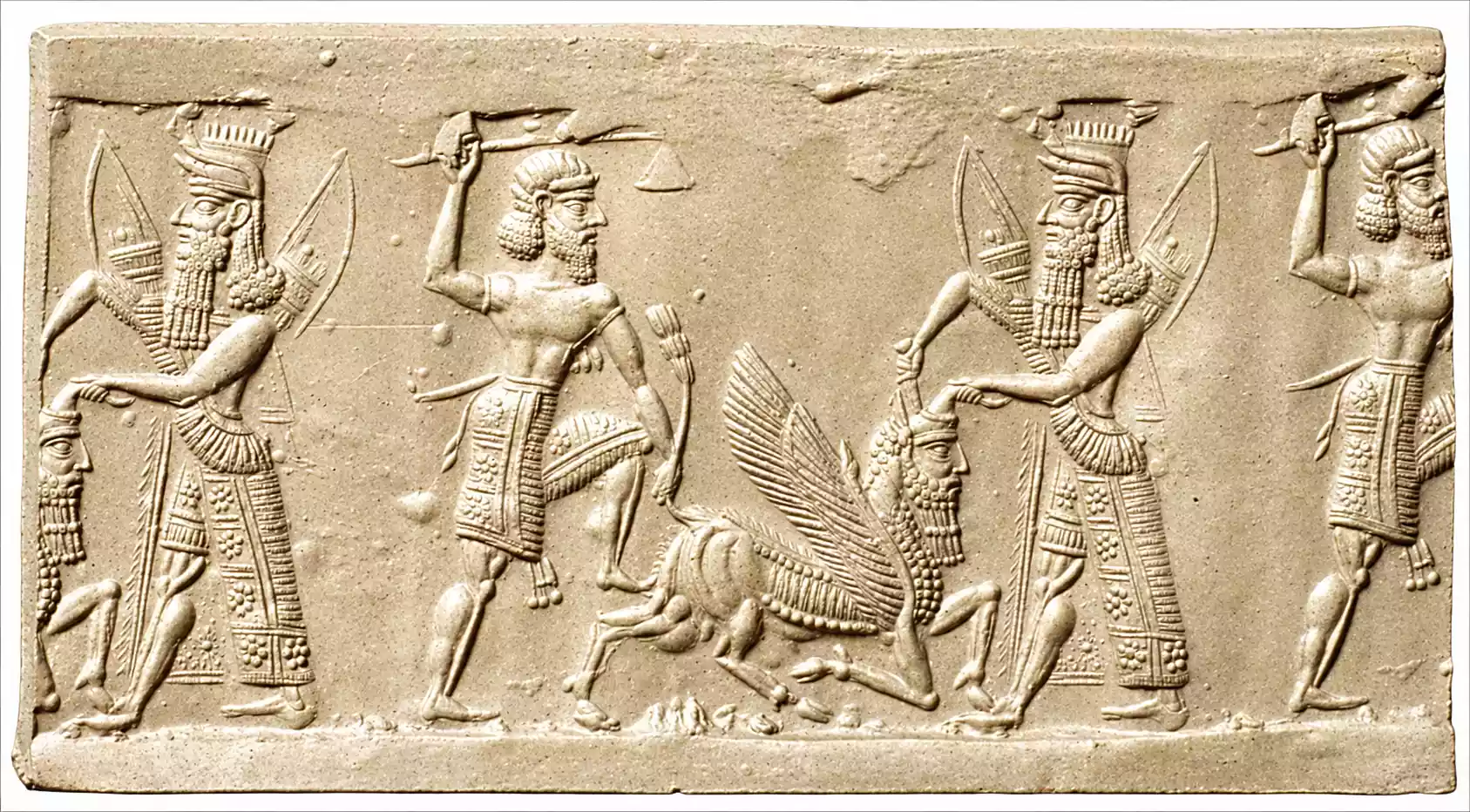
 Gilgamesh and Enkidu slaying the Bull of Heaven, as identified by the Schøyen Collection. Reproduction of the impression of a Neo-Assyrian cylinder seal in brown agate, c. 7th century BC, MS 1989.
Gilgamesh, king of Uruk, cannot bring himself to accept the death of Enkidu, the companion with whom he had shared his greatest dangers, for in his friend’s lifeless body he now recognises his own end. Faced with that prospect, the strength that once allowed him to measure himself against supernatural adversaries loses its use. He leaves his city to seek out a man who managed to escape the common lot, hoping that he too might obtain what that man had received from the gods.
In the final stage of his wanderings lies the celebrated plant often called the “flower of immortality”. The name needs some qualification: the epic describes a thorny plant with the power to restore youth, and nowhere states that it grants everlasting life. Gilgamesh will obtain it, only to lose it before he has had the chance to discover its effect.
The making of a Mesopotamian epic
The tradition of the epic took shape over many centuries, through self-contained tales and successive reworkings. Sumerian poems about Gilgamesh circulated as separate compositions, while from the Old Babylonian period, especially the eighteenth century BC, fragments survive of a longer Akkadian narrative. It is in the later, so-called Standard Babylonian version that the story of the search for the plant and its loss finds its place. Among the most important surviving copies of that version are the tablets from Ashurbanipal’s library at Nineveh, dating from the seventh century BC, which record a literary tradition already many centuries old.
This history explains why the stories about the hero differ from one another. In the narrative under discussion here, admiration for the king’s exploits sits alongside a persistent questioning of what heroic strength leaves unresolved. The death of someone loved alters the weight of all his earlier triumphs.
Enkidu and the collapse of heroic certainty
At the opening of the story Gilgamesh rules oppressively, provoking the complaints of the people of Uruk. As a counterweight to his power, Enkidu is created through divine intervention and, after their first clash, becomes his closest companion. Together they kill Humbaba, guardian of the Cedar Forest, and later the Bull of Heaven, which Ishtar sends against Uruk when the king rejects her advances. As the essay published by the Metropolitan Museum of Art summarises, the death of Enkidu follows as a consequence of the gods’ reaction to what the two heroes have done.
With his companion’s illness and death, Gilgamesh is confronted with something he has no means of overturning. He stays beside the body, putting off the parting, until decay forces upon him the knowledge he has been trying to defer; and when at last he leaves, fear of his own death has already worked its way into his grief. The wandering that follows can therefore be read as a continuation of that anguish, an attempt to get away from the end he has just seen at such close quarters.
An interpretation along these lines, centred on the working-through of grief, has also been put forward in modern scholarship. It remains a way of reading a literary figure, with the caution required whenever present-day concepts are carried over into an ancient text.
Beyond the Waters of Death
His destination is Utnapishtim, the survivor of the great Flood, on whom the gods conferred immortality together with his wife. With the help of the ferryman Urshanabi, Gilgamesh crosses the Waters of Death and reaches the remote place where the couple live. There he learns that Utnapishtim’s exemption was bound up with a particular decision taken by the gods after the Flood, which leaves the visitor’s hope of following the same path hanging in the air.
In the eleventh tablet, his weakness is exposed by a test that looks simpler than anything he has already achieved: he is asked to stay awake for six days and seven nights. He falls asleep almost at once. At Utnapishtim’s bidding, his wife places a loaf of bread by the sleeping king’s head each day and marks the days, so that when he wakes he will have before him the proof of the time that has passed.
In bread that dries out or turns mouldy, time takes on a domestic, almost tangible presence. The scene may be read as a reminder of how far the hero depends on his body: while he strives to overcome death, sleep takes hold of him without any outside struggle being needed at all.
The plant of youth and the postponed trial
As he is about to depart, and after his wife has intervened, Utnapishtim reveals to Gilgamesh the existence of a thorny plant that can restore youth. Tying heavy stones to his feet, the king descends into the deep waters, tears the plant free although the thorns wound his hands, and cuts loose the weights so as to rise back to the surface. He explains to Urshanabi that he will take it to Uruk, where he intends first to give it to an old man to eat, in order to test its power, and only then to use it himself.
The delay leaves room for a different side of the hero. After so much anguish, Gilgamesh is still able to wait and to plan, having placed between finding the plant and using it the need for some confirmation. Until then, however, the precious find remains exposed to the hazards of the journey.
On the way back, when he stops to bathe in cool water, a snake catches the scent of the plant, approaches silently and carries it off; as it slithers away, it sheds its skin. Gilgamesh sits down on the bank and weeps, wondering for whom he has toiled so hard, while the ferryman is still close by.
The serpent and an unequal share of renewal
Within the narrative, the sloughing of the skin links a familiar piece of animal behaviour with humanity’s lost chance of becoming young again. The episode thus lends itself to an aetiological reading, offering a mythological explanation for the renewal the snake appears to achieve, at the very moment the king loses the means to his own.
The plainness of the incident may strike us as particularly harsh. Gruelling journeys and supernatural perils have come before, and in the end the plant is lost during a stop to bathe. Attention stays on the weary man mourning his wasted labour, and if we are to speak of a defeat by time, we must also include this inability of his to keep hold of what he had only just gained.
The seal of the two companions and the return to Uruk
The accompanying image reproduces an earlier episode, the slaying of the Bull of Heaven, as it appears on the impression of a cylinder seal. The catalogue of the Schøyen Collection records the original as a Neo-Assyrian work in brown agate, of around the seventh century BC, numbered MS 1989. According to the collection’s identification, Enkidu, in a short garment and with an axe raised, holds the animal’s tail, while Gilgamesh, in a long decorated robe and horned headdress, grips one horn and strikes at its neck. The bull is shown human-headed and winged, its forelegs bent.
The repetition of the figures along the length of the image corresponds to the continuous unrolling of the design as the seal is rolled out. In this scene the two companions are still acting together; looking at it as readers who know what comes next, we can dwell on that closeness, and especially on the coordinated movement of their hands around the animal’s body.
At the end of the eleventh tablet Gilgamesh returns to Uruk and invites Urshanabi to inspect its walls. The return invites a reading of the city as a place of reconnection with the life the king had abandoned. From anguish over his own body, his gaze turns to a human work that can be surveyed and maintained, beginning with its foundations and its baked bricks.


