
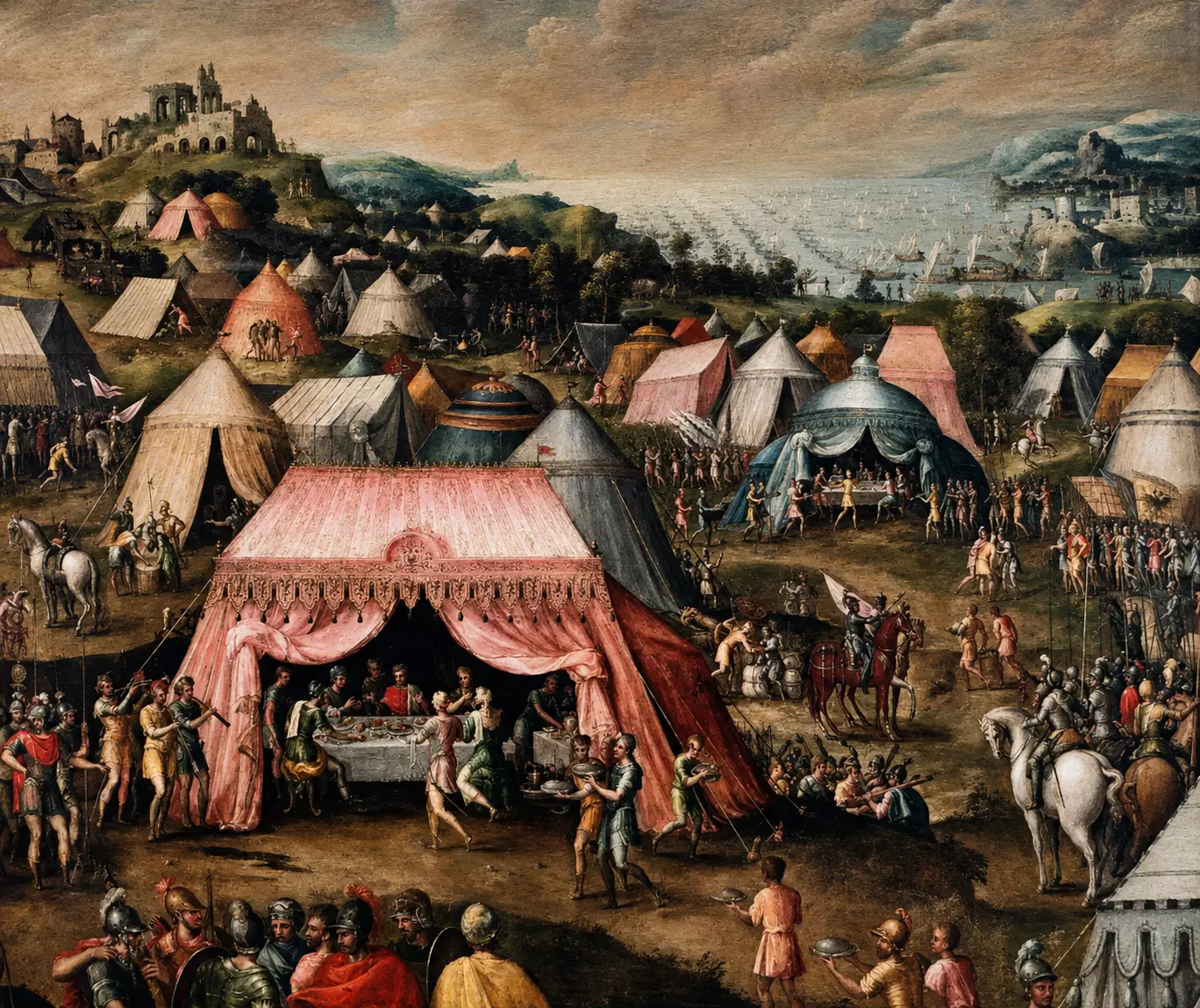
Niccolò dell’Abate’s Meeting of Charles V and the Bey of Tunis, painted around 1545–50, transforms an episode of sixteenth-century Mediterranean politics into a densely populated encampment. Executed in oil on canvas and measuring 176 × 211 cm, the painting is now in The Courtauld, London. Tents, soldiers, mounted figures, servants, fortified buildings and ships occupy nearly every part of the surface, while the historical protagonists named in the title are absorbed into a much broader image of ceremony and military presence. Art UK dates the work to about 1546–50, and Courtauld records identify it as P.1951.XX.2.
The subject looks back to Charles V’s expedition against Tunis in 1535. The previous year, Hayreddin Barbarossa had seized the city and displaced the Hafsid ruler Mulay Hasan. Charles led a large coalition to North Africa, captured Tunis and restored Mulay Hasan as a dependent ruler. The campaign immediately acquired a commemorative life in European visual culture: Jan Cornelisz Vermeyen accompanied the emperor and later supplied designs connected with the celebrated Conquest of Tunis tapestry cycle. Dell’Abate approached this political memory through a very different pictorial mechanism, making the encampment itself an essential bearer of meaning.
At the lower centre, a large rose-coloured pavilion dominates the foreground. Its curtains are drawn back to reveal a table around which several figures gather, with attendants, guards and other participants clustered near the opening. The tent functions almost as an architectural interior inserted into the temporary world of the camp. Behind it rises a dark conical structure, while farther to the right a broad blue-green pavilion contains another group gathered beneath its canopy.
Across the surrounding ground, activity breaks into dozens of small episodes. Mounted men arrive or depart, soldiers stand in compact groups, attendants carry objects, horses wait beside their riders. Rows of lances create thin vertical accents along the right edge, while the irregular roofs and peaks of the tents establish a repeated triangular rhythm across the middle distance. No single procession controls the scene. Movement spreads laterally, diagonally, inward toward the tents, outward toward the harbour.
From this elevated viewpoint, the camp extends toward a luminous stretch of water crowded with shipping. The pale surface of the sea opens a visual interval in the otherwise congested composition, and the tiny vessels register the maritime scale of the expedition. On the left, fortified and partly ruined architecture rises above the tents; across the water, buildings and rocky slopes mark another inhabited shore. The eye is continually redirected between foreground incident and distant geography.
Mannerist Landscape and the Architecture of Power
The canvas belongs to the Italian phase of dell’Abate’s career, before his departure for France in 1552 and his work at Fontainebleau with Francesco Primaticcio. The National Gallery notes the importance of Parmigianino for his early work in Modena and Bologna, as well as the prominent place landscape would later assume in his French paintings. Those tendencies are already legible in this canvas: the human figure remains important, yet landscape, architecture and spatial organization govern the historical narrative.
Colour contributes strongly to that organization. Soft pinks, creams, ochres and muted reds distinguish the tents from the dark earth and shadowed groups of soldiers. Cooler blue-green and grey tones gather around the sea, distant hills and several large pavilions. Above them stretches a broad, clouded sky, its warm light flattening some distant forms while allowing the foreground structures to retain heavier tonal weight. The alternation of warm fabric and cool recession keeps the crowded scene intelligible without imposing rigid geometric order.
Dell’Abate also varies scale decisively. Large foreground figures and horses gradually give way to minute groups, then to ships that become small marks across the water. Perspective is constructed through overlapping, diminishing scale and successive bands of terrain, yet the panoramic view retains a slightly compressed, stage-like clarity typical of large narrative decoration. From above, the viewer can inspect both ceremonial enclosure and military infrastructure at once.
A Historical Meeting Recast as Spectacle
Diplomacy supplies the nominal event; military occupation supplies its visual environment. The meeting of Charles V and the Tunisian ruler is embedded within tents, cavalry, standards, weapons, maritime transport and the visible machinery required to sustain an imperial expedition. Individual likeness carries limited weight at this distance. Rank and historical significance emerge through placement, gathering, escort and the elaborate spaces prepared for encounter.
The political setting was charged. After the Habsburg victory of 1535, Mulay Hasan was restored under conditions that bound him closely to Charles’s power, and the Tunis campaign became an important component of Habsburg imperial self-representation. Dell’Abate’s picture, painted roughly a decade after the undertaking, participates in that commemorative atmosphere while devoting unusual attention to the material texture of the event: canvas shelters, horses, formations of men, food, movement, coastline, ships at anchor.
That breadth is central to the work’s fascination. A diplomatic subject that could have been concentrated upon two rulers becomes a panoramic history scene in which political authority is made visible through scale and organization. The immense temporary city of tents gives the meeting its setting and its measure, while the harbour carries the scene beyond the land and into the contested Mediterranean. Within only a few years, dell’Abate would leave Italy for France, entering the decorative world of Fontainebleau in 1552.